Home | Impressum | Datenschutz | KIT

Sustainable Construction. How we are shaping our built environment in a sustainable way.

The book offers solutions, innovations and thought-provoking discussion. It is a call for an inclusive approach to planning. This publication not only encourages climate- and resource-friendly building – it also shows how it can be done!

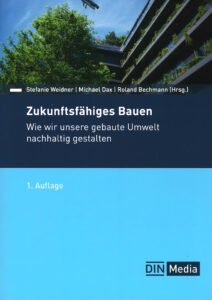
Hebel, Dirk E., and Elena Boerman. “Projektstudie 2 (Schwerpunkt: Materialien): Der Kreislaufbasierte Architekturansatz.” In Zukunftsfähiges Bauen – Wie Wir Unsere Gebaute Umwelt Nachhaltig Gestalten, 64–78. Berlin: DIN Media Innovation, 2026.


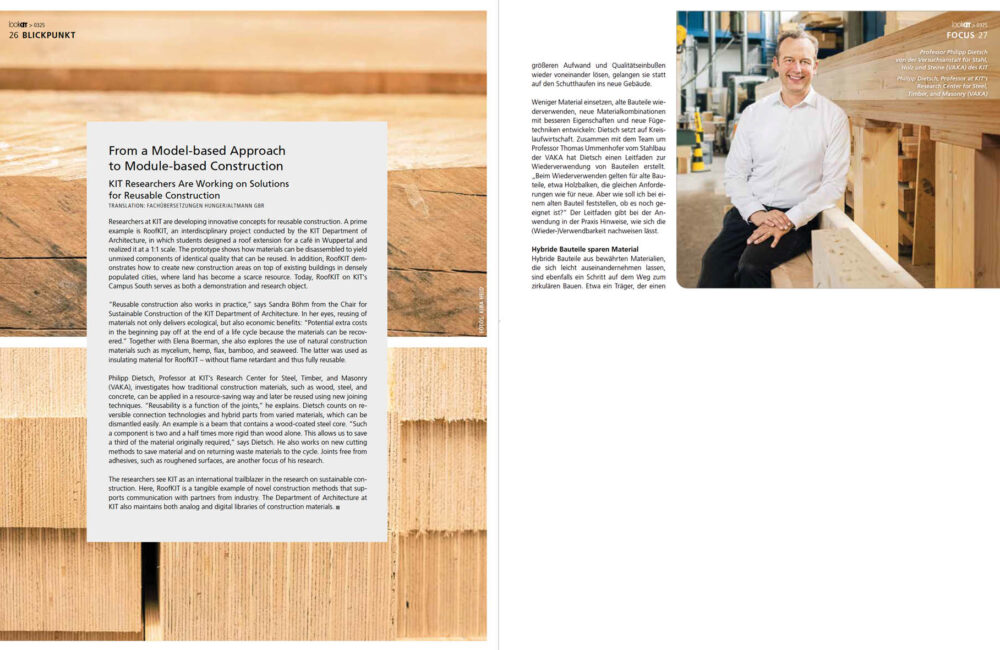
LooKIT-Interview: „More Modular Design – less Model Making“

In the interview of Regina Link for „lookKIT“ with Sandra Böhm and Elena Boerman from the Professorship of Sustainable Construction at KIT they share insights into circular building practices. Their work centers on circular buildings that allow materials to be reused at the same quality level, reducing waste and conserving resources.

A key example is RoofKIT, a full-scale prototype of a rooftop extension developed by students. It demonstrates how modular design and natural materials like sea grass, hemp, and mushroom mycelium can be used effectively in construction. RoofKIT also serves as a communication tool with industry stakeholders, making circularity tangible.


Exhibition „WEtransFORM“ at the Bundeskunsthalle Bonn

David Ertl, 2025 © Kunst- und Ausstellungshalle der Bundesrepublik Deutschland

In 2025, the Bundeskunsthalle is focusing on ecological transformation. The exhibition  WEtransFORM. On the Future of Building invites visitors to engage in a lively debate about the future of our built environment. The focus is on fundamental design principles for a climate-friendly renewal of our building culture. Around 80 projects are on display, all of which deal with the challenges of climate change in an exemplary manner. (Text: Bundeskunsthalle)

The KIT Professorship of Sustainable Construction is contributing to the exhibition with selected exhibits, photographs and video material on the projects ‘Urban Mining and Recycling Unit’ in the Nest and ‘RoofKIT’. The exhibition can be visited from 6 June 2025 to 25 January 2026 at the Bundeskunsthalle in Bonn.


DETAIL-Interview: „From linear to a circular system“

In this interview, Dirk E. Hebel, discusses the urgent need to shift the construction industry from linear to circular processes. Hebel explains how the construction sector can reduce resource waste and CO₂ emissions by adopting a circular economy. He highlights the importance of “design for disassembly,” using pure materials, and reusing entire buildings and components. Through his vision, Hebel introduces an innovative approach to the future of architecture and construction, focusing on sustainability, resource efficiency, and circular value creation.


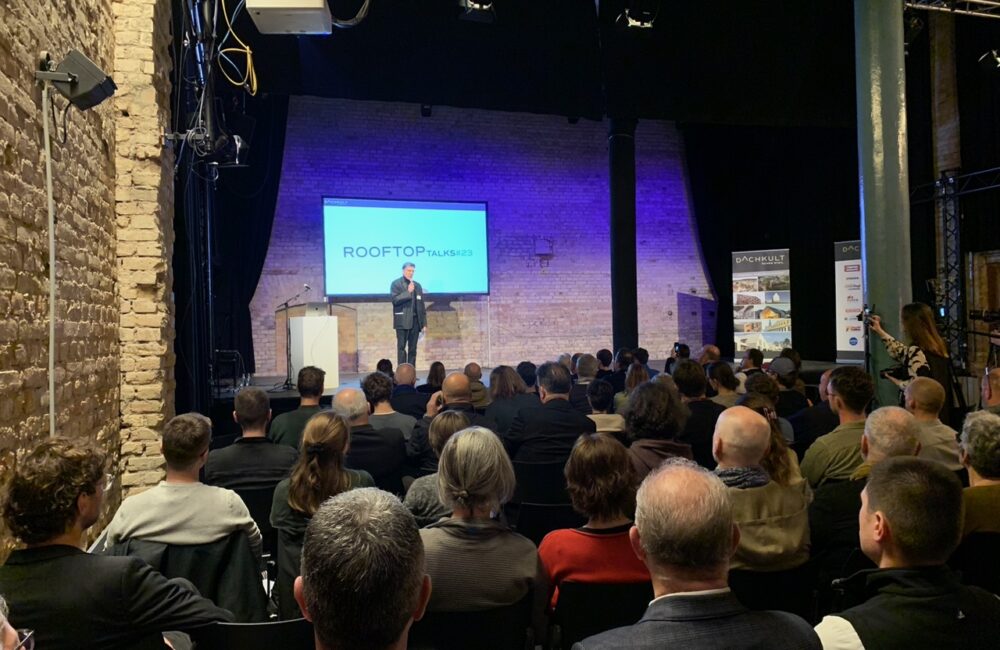
Rooftop Talks #23 „Modular up to the roof“ on March 21st with Elena Boerman

  • © Nadja Lowitzsch, Dachkul

The federal and state governments have agreed on a „construction turbo pact“ to speed up planning and approval processes. Industrial production methods should make building cheaper and approval procedures faster: „In order to further promote this form of building, the federal states will regulate that once type approvals for serial, modular and systemic construction have been granted, they will be valid nationwide,“ writes the Federal Building Ministry BMBSW. An occasion for the initiative Dachkult to take a look at outstanding architecture that is modularly planned right up to the roof.

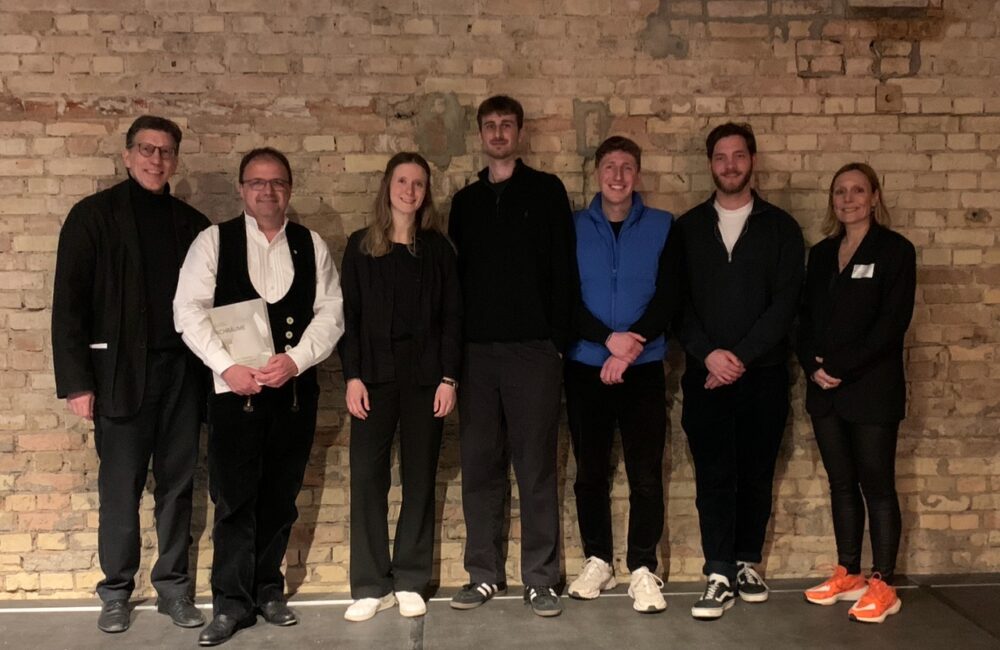
The event took place on March 21st in the Kulturzentrum Tempel in Karlsruhe. The Heilbronn office of Joos Keller Architekten has won the Hugo Häring Prize with its modularly designed Bernhäusle children’s garden – Thomas Heyd, Managing Director of Zimmerei Heyd, took a look behind the scenes of production. The KIT team led by Prof Dirk E. Hebel has won the Solar Decathlon Europe with a modularly developed roof extension – Elena Boerman, Researcher/Sustainable Construction at KIT Karls- ruhe presents the design and process. The winners of the Dachwelten 2023 competition from Würzburg Schweinfurt University of Applied Sciences also impressed with a modular roof extension.

In addition to speed and cost certainty, modular construction offers another advantage: circularity – a requirement for which the pitched roof is particularly suitable in its basic structure.

Click here to see more impressions and videos of the event soon.


RoofKIT – Interview with Prof. Dirk E. Hebel

„Primary materials are becoming increasingly rare, especially in our resource-poor region of Central Europe. The circular building method can therefore be an answer to the question of how we can still allow future generations to build according to their needs, ideas and values and thus also be able to realize a dignified life.“

Prof. Dirk E. Hebel explains the principle of the „anthropocene depot“ using the example of the „RoofKIT“ in a video interview: the city, the built environment, becomes an urban mine from which raw materials are recovered.

The stacking module designed and constructed for the „Solar Decathlon 2022“ student competition, which Prof. Hebel supervised as a faculty advisor, has caused a sensation since winning the largest building competition for universities because it has implemented a large number of central architectural themes: Circular economy, adding storeys, biological building materials, timber construction, the use of renewable energies to supply electricity… None of this as a „promise for the future“, as Prof. Hebel emphasizes, but as a module that can already be implemented at this point in time.

video cut: AKBW

Prof. Hebel is one of numerous high-profile guests who will be speaking at the anniversary event of the „Auf Holz bauen“ education initiative at the Haus der Architektinnen und Architekten in Stuttgart on December 4:
akbw.de/angebot/kammerveranstaltungen/drei-jahre-bildungsoffensive-aufholzbauen

Due to the complexity of the topics, RoofKIT will be presented in two films. The next part will highlight the student team members‘ view of the project.


MaterialLab at IBA’27: RoofKIT and Material Samples

  • © IBA’27 / Franziska Kraufmann

A large hands-on exhibition on new (and old) building materials is located in a warehouse in the future Backnang-West neighborhood: programmed wood, insulation made from old clothes, concrete foam. Selected exhibits from research and industry are on display. The focus is on various materials and their further development.

There is also an exhibition contribution from the KIT Faculty of Architecture, which consists of a documentation of the RoofKIT project and an excerpt from the material library. Among others, the University of Stuttgart, ILEK/ITKE/Biomat, FRA UAS Frankfurt and selected industrial partners are also involved.

The exhibition is open from 07.07. to 22.07 always on Thursdays and Fridays from 14 to 19 clock and Saturdays from 10 to 15 clock. All interested parties are cordially invited.

On the evening of 07.07. the exhibition opening took place with a Science Night including a short presentation of all exhibits by the exhibitors. Elena Boerman, research associate at the Chair of Sustainable Construction, presented the KIT contribution to an interested audience.


RoofKIT – the full documentation

We are pleased to finally publish the entire documentation of the RoofKIT project. Many thanks to all project participants, sponsors, to the RoofKIT team and the film team around Pia Berchtold (piapiapia).

RoofKIT was one of 18 entries to the Solar Decathlon Europe 21-22, in which student teams from international colleges and universities each constructed a fully functional building prototype in Wuppertal in the summer of 2022, with which they competed in ten different architectural and structural engineering disciplines. With the RoofKIT project, the team from the Karlsruhe Institute of Technology won the Solar Decathlon Europe 21-22. In two and a half years of intensive interdisciplinary teamwork in teaching, research and practice, students and teachers addressed the issues of sustainable resource consumption, renewable energy generation and coexistence in the city of the future from an architectural perspective.

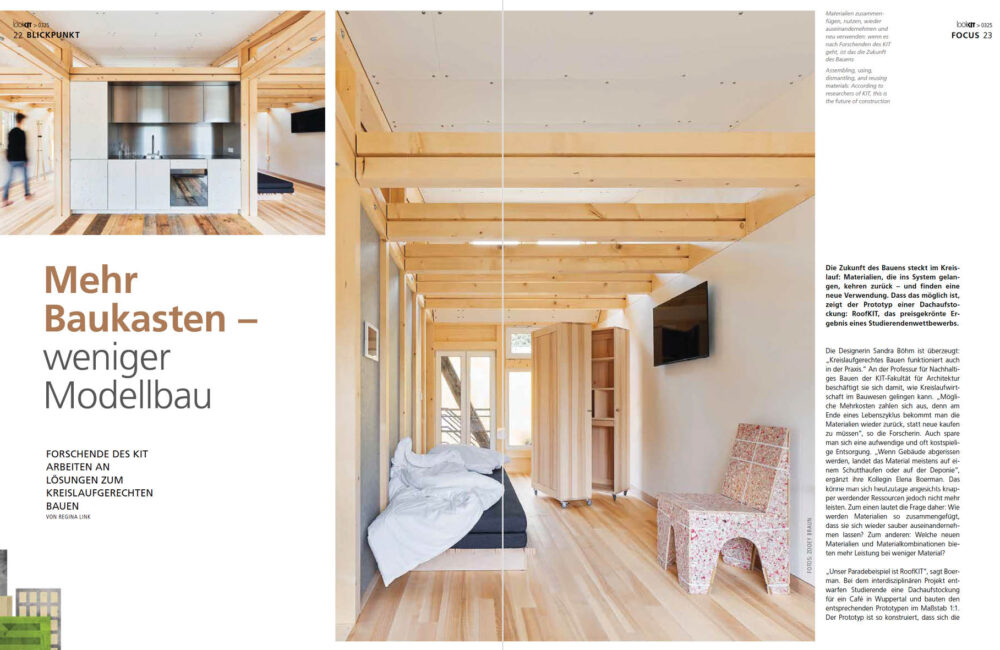
The building prototype is now located on KIT Campus Süd in Karlsruhe – we cordially invite you to register for a public RoofKIT tour here.


KIT Campustag and Reinschauen 2023

  • VIELFALT © Professorship of Sustainable Construction

On Saturday, May 13, the KIT Campustag will take place again. All KIT faculties will present their study programs and offer great hands-on activities, experiments, guided tours and much more. In addition, there will be a stage on the forum, where a colorful live program will be offered. Various bands, science slam, theater groups, university groups, and many more will show what KIT has to offer besides studies.

The Faculty of Architecture at the Karlsruhe Institute of Technology also cordially invites you to its annual exhibition „Reinschauen“. From May 11 to 17, 2023, all professorships, workshops and studios will present works and projects from the past academic year and provide an insight into the range of teaching and research at the faculty. The program includes presentations, short lectures, taster lectures and guided tours.

The Professorship of Sustainable Construction presents its wide-ranging work in teaching, research, exhibitions, events and other projects in the foyer of the 1st floor. The RoofKIT project is also part of this exhibition.

The building prototype of RoofKIT, which has been located on the KIT South Campus since November 2022 (building 30.79, intersection Straße am Forum / Richard-Willstätter-Allee), will open its doors in the context of the Campus Day on May 13 from 1 pm. Team RoofKIT cordially invites you to talk about the project and to have a look at the building prototype.

WHEN: Saturday, May 13, 2023 from 1PM
WHERE: RoofKIT (building 30.79), intersection Straße am Forum / Richard-Willstätter-Allee

RoofKIT was one of 18 entries to the Solar Decathlon Europe 21-22, in which student teams from international colleges and universities each constructed a fully functional building prototype in Wuppertal in the summer of 2022, with which they competed in ten different architectural and structural engineering disciplines. With the RoofKIT project, the team from the Karlsruhe Institute of Technology won the Solar Decathlon Europe 21-22. In two and a half years of intensive interdisciplinary teamwork in teaching, research and practice, students and teachers addressed the issues of sustainable resource consumption, renewable energy generation and coexistence in the city of the future from an architectural perspective.
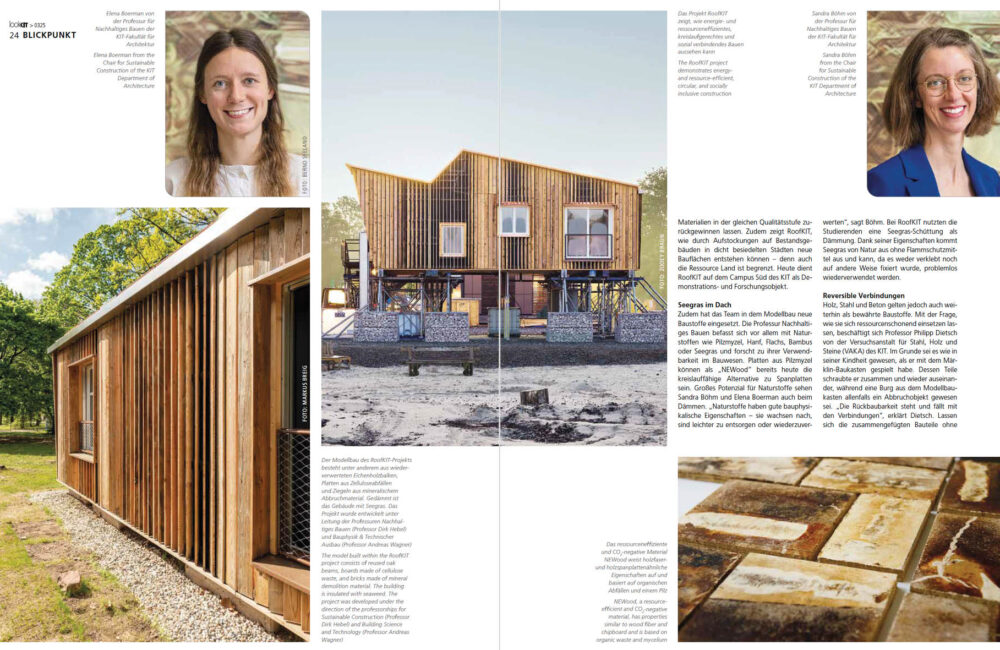


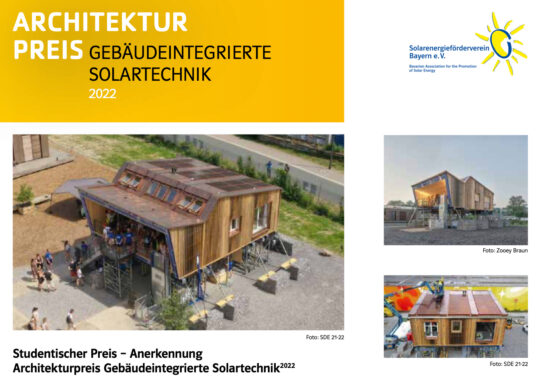
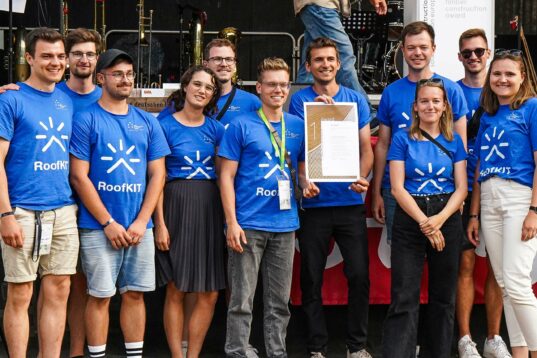
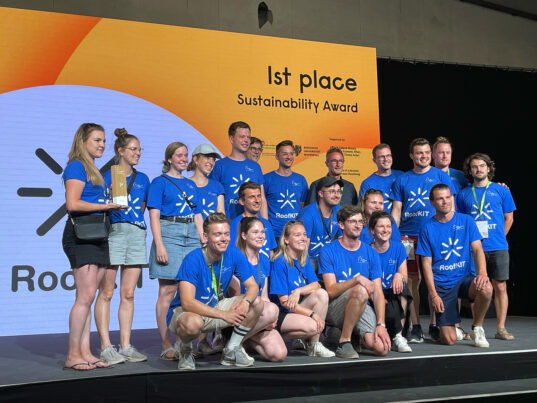
RoofKIT awarded with a recognition of the „Architekturpreis Gebäudeintegrierte Solartechnik 2022“

The „Architekturpreis Gebäudeintegrierte Solartechnik 2022“ awards projects that provide outstanding impetus for the planning and design of building-integrated solar systems and draw attention to exemplary solutions in sophisticated architecture. According to the jury, the award-winning projects show that the integration of photovoltaic modules and solar thermal collectors can succeed with equally high design and technical ambition.
© Solarenergieförderverein Bayern e.V.

In the RoofKIT project, six high-format standard modules were expanded into photovoltaic-technical hybrid modules. As part of a coherent overall concept, the handling of the PV roof also demonstrates integration into the building design and urban context.

More information here.


Helmholtz: How we build in the future

In the article „How we build in the future“, the Helmholtz Association presents sustainable, climate-friendly solutions from architecture and construction research. In this context, Prof. Dirk E. Hebel presents the RoofKIT project of the KIT Faculty of Architecture as an innovative lighthouse project for circular justice, purity of types, recycling and reuse, and the resource-friendly handling of materials.

Concrete as a building material is then critically examined. Prof. Frank Dehn, Institute Director at the KIT Civil Engineering Faculty, is researching climate-friendly alternatives and the use of old concrete. In addition, other forward-looking topics such as the „sponge city“ and the energy supply of future buildings are highlighted.

Read the full article here.


RoofKIT: Welcome to Karlsruhe!

RoofKIT, the Karlsruhe winning project of the Solar Decathlon 2021/22 was re-located and re-errected in Karlsruhe on Wednesday 09 November 2022. Under the supervision of the project management, the wooden modules were dismantled in Wuppertal within two days, transported to Karlsruhe and now reassembled by the experienced carpenters of Kaufmann Zimmerei und Tischlerei in cooperation with the KIT Solar Decathlon team.

About the project:
The Karlsruhe Institute of Technology participated in the 2021/22 Solar Decathlon Competition in Wuppertal, Germany with its project RoofKIT. Designed as a top-up to an existing structure, it demonstrates a vision for the building industry: social adequate, energy positive and circular sustainable. Since 2020, more than 100 students from KIT within different faculties and under the leadership of the professorships of Sustainable Construction (Prof. Dirk E. Hebel) and Building Technologies (Prof. Andreas Wagner) worked on the project which cumulated in the construction of the House Demonstration Unit in May and June 2022 in Wuppertal, Germany.

Video: Daniel Lenz and Katharina Blümke, Professorship Sustainable Construction, KIT
cut: Elena Boerman, Professorship Sustainable Construction, KIT

For the next three years, the housing unit can be visited on the campus of the Karlsruhe Institute of Technology (Straße am Forum/Richard-Willstädter-Allee). Furthermore, from spring 2023 onwards, research projects subsequent to SDE 21/22 are planned by the Professorship of Building Technology in cooperation with the Professorship of Intelligent Living.

More information about RoofKIT here.


Team RoofKIT presents their project at IGB

  • © IGB

Two members of the RoofKIT team, Katharina Knoop and Johannes Hasselmann, had the opportunity to present the RoofKIT project and the Solar Decathlon at the Ingenieurgruppe Bauen (IGB) in Karlsruhe last Thursday.

All the listeners were very interested in the topics the two presented and were particularly impressed by the team spirit and the continuing enthusiasm and motivation. The event was able to show the company new perspectives for everyday work and planning.


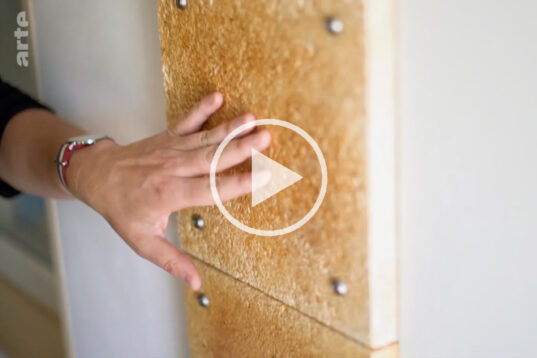
RoofKIT in Re: on arte – How mycelium researchers are working on the future

In this report, arte investigates the power of mushrooms and visits various actors. A Swiss mushroom expert, for example, wants to restore polluted soils. Researchers are also working together with students on a biological packaging material made from mushrooms. Mushroom leather or stable insulation and building materials are also examined in this episode of Re:.

The reporters also visit the Solar Decathlon in Wuppertal. Prof. Dirk E. Hebel explains why the mushroom, as a biologically renewable raw material, could become an important component of the future sustainable construction industry within planetary boundaries and in line with the European Green Deal.

Re: Mehr als Hut und Stiel © arte


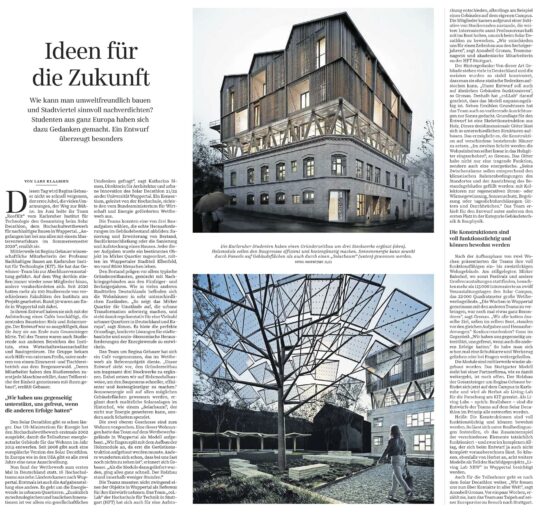
Süddeutsche Zeitung reports about RoofKIT

How can we build in an environmentally friendly way and redensify city districts in a sensible way? Süddeutsche Zeitung reports about the winning design of the Solar Decathlon 21/22.

The project was supervised by Prof. Dirk E. Hebel and Prof. Andreas Wagner at KIT.

© Süddeutsche Zeitung


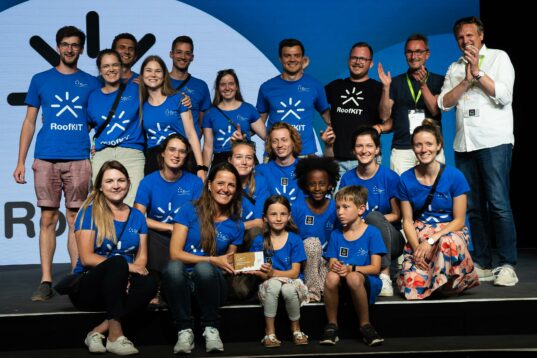
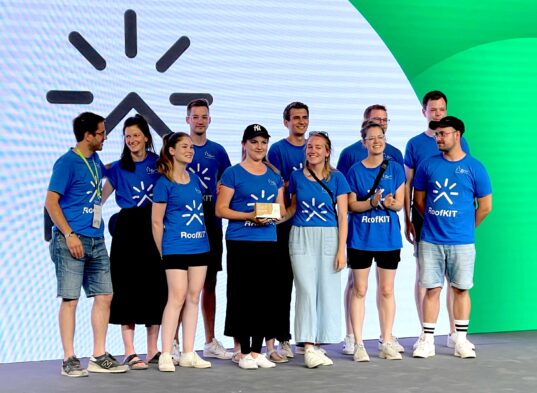
Team RoofKIT wins the Solar Decathlon Europe 21/22 in Wuppertal

  • Team RoofKIT wins the the Solar Decathlon Europe 2021/22 © SDE 2021/22

On Friday 24 June at about 6 pm, the time had finally come – the Competition Director of the Solar Decathlon Europe 2021/22, Karsten Voss, in Wuppertal announced the winning team of the student competition: Team RoofKIT from Karlsruhe! The team was very surprised about this development and expressed their relief, happiness and pride. The moment of the announcement was captured on video by SDE 2021/22:

Second place in the overall competition was taken by Team Virtue from Eindhoven, and third place was shared by Team SUM from Delft and Team Aura from Grenoble. On the website of the SDE 2021/22, all other placements and the intermediate results and awards of the competition can be viewed.

After the award ceremony, Team RoofKIT was visited by WDR and the winning house was shown live on WDR’s Lokalzeit (approx. from minute 20), where some team members were also interviewed about the project.

The Professorship of Sustainable Construction and the Professorship of Building Physics would like to thank all the students and staff of Team RoofKIT and congratulate them on this great competition result!


RoofKIT wins 1st in out-of-competition category „Sustainable Architectural Lighting Award“ at Solar Decathlon Europe 21/22 in Wuppertal

© SDE 2021/22


RoofKIT wins 2nd in category „Innovation“ at Solar Decathlon Europe 21/22 in Wuppertal

  • © SDE 2021-22


RoofKIT wins 2nd in out-of-competition category „German Sustainability Housing Award“ at Solar Decathlon Europe 21/22 in Wuppertal


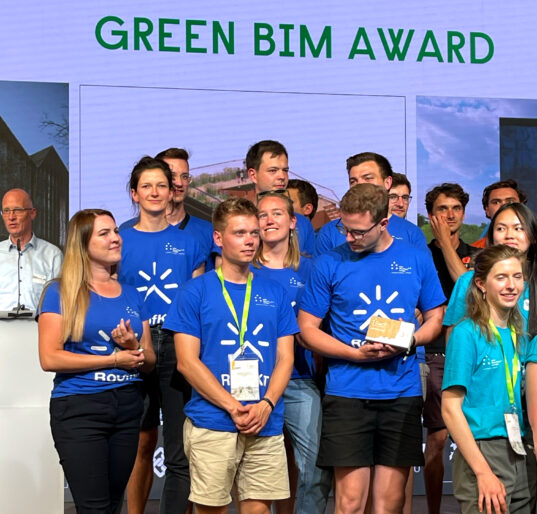
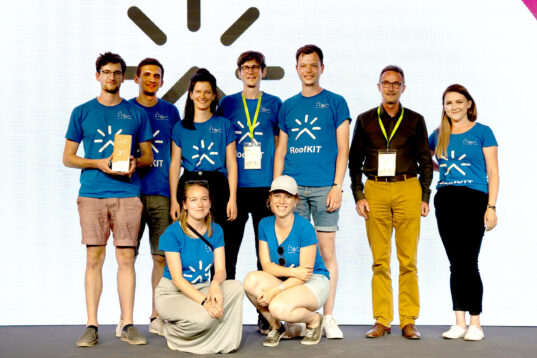
RoofKIT wins 3rd in out-of-competition category „Green BIM Award“ at Solar Decathlon Europe 21/22 in Wuppertal


RoofKIT wins 1st in out-of-competition category „Timber Construction“ at Solar Decathlon Europe 21/22 in Wuppertal

Our thanks go to the Kaufmann Zimmerei and Tischlerei in Reuthe, Austria and to the Timber Construction Award Jury.

1st OOC Timber Construction Award © SDE 21-22


RoofKIT wins 1st in category „Sustainability“ at Solar Decathlon Europe 21/22 in Wuppertal


RoofKIT wins 3rd in category „Engineering and Construction“ at Solar Decathlon Europe 21/22 in Wuppertal

3rd Engineering and Construction Award © SDE 21-22


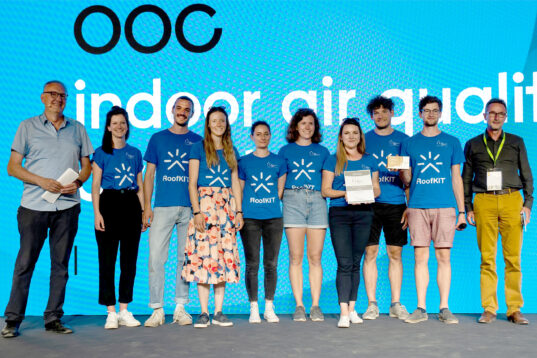
RoofKIT wins 3rd in out-of-competition category „Indoor Air Quality“ at Solar Decathlon Europe 21/22 in Wuppertal

3rd OOC Indoor Air Quality Award © SDE 21-22


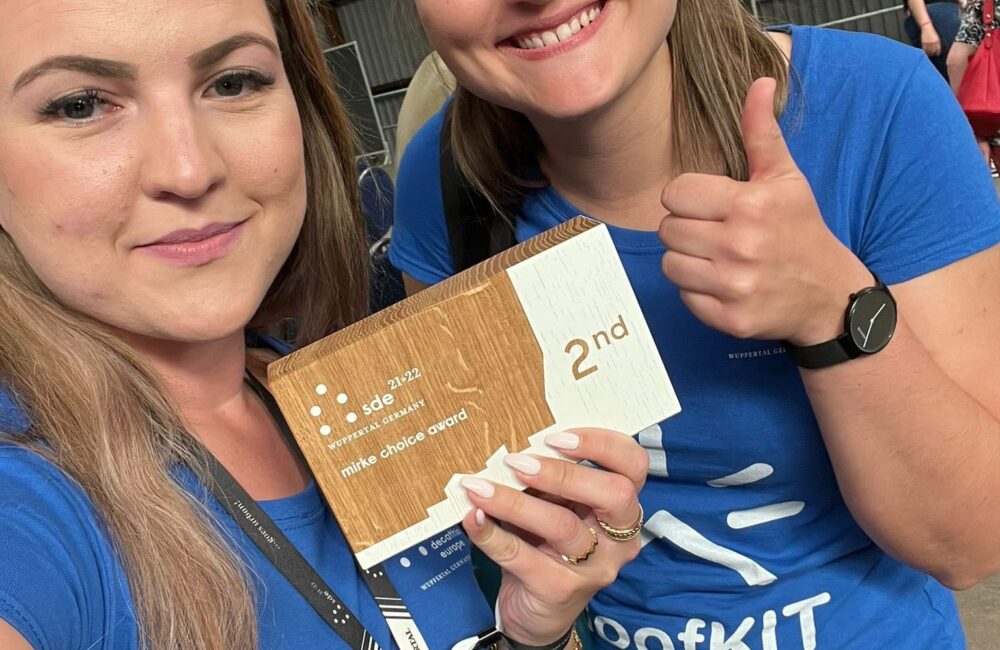
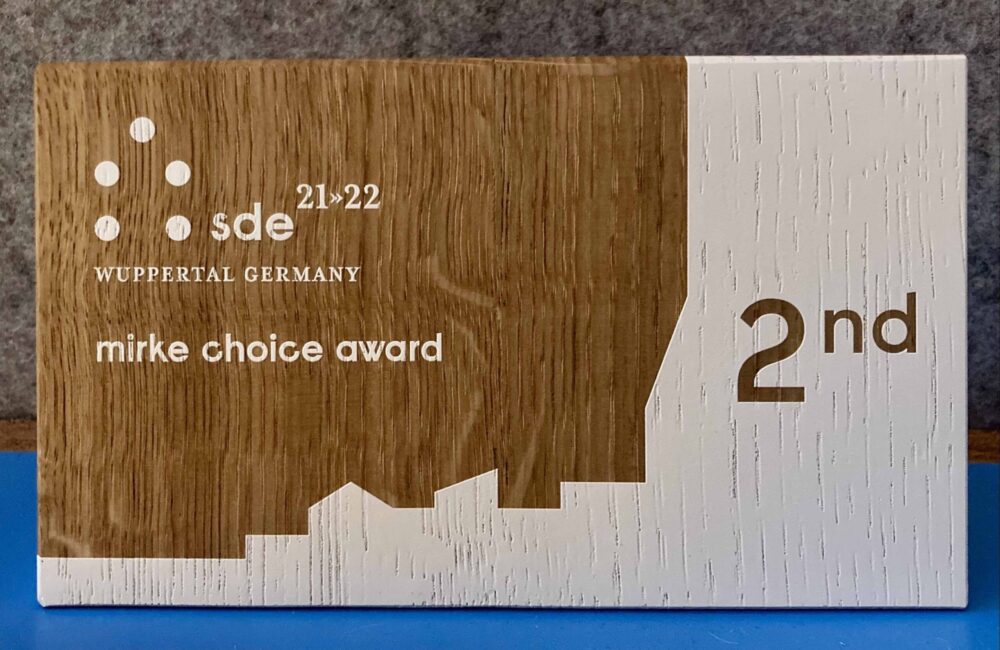
RoofKIT wins 2nd in out-of-competition „Mirke Choice“ at Solar Decathlon Europe 21/22 in Wuppertal

On Sunday 12th the Award Ceremony of the first „Out Of Competition Award“ has taken place at the Solar Campus. Team RoofKIT ist very happy that the fist day of Award Ceremonies also brought the first trophy – The inhabitants of the Wuppertal neighborhood of Mirke, where the proposed plots of the SDE 21/22 are located, voted RoofKIT second place of the „Mirke Choice Award“. The team is especially proud that the proposal for topping up the Café ADA in the heart of the neighborhood is appreciated by the people it was designed for.


Karlsruher Institut für Technologie
Fakultät für Architektur
Institut Entwerfen und Bautechnik

Professur Nachhaltiges Bauen
Englerstr. 11, Geb. 11.40, Raum 25
D-76131 Karlsruhe
 
Tel: +49 (0)721/608-42167


Recent Publications:  
 

    Interview: „We’ve already made significant progress“

    Juli 9, 2026

    Kohring, Katharina, and Dirk E. Hebel. ‘Interview: “We’ve already made significant progress”’. topos. circularity in cities (München), 2026.


    Better this way

    Juli 9, 2026
    Screenshot

    Holl, Christian. ‘Besser So’. Marlowes, 7 July 2026. https://www.marlowes.de/besser-so/.


    Interview: „We’ve already made great progress“

    Juli 9, 2026

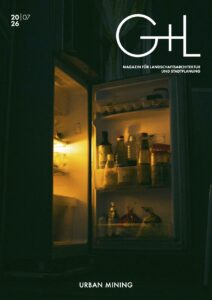
    Kohring, Katharina, and Dirk E. Hebel. ‘Interview: “Wir sind schon einen großen Schritt weiter”’. G+L – Magazin für Landschaftsarchitektur und Stadtplanung (München), 2026.


    Umbauhof – A Place for the Reuse of Building Components

    Juni 24, 2026

    Boerman, E., & Hebel, D. E. (2026). Weniger Treibhausgasemissionen durch Wiederverwendung. In Umbauhof—Ein Ort für die Wiederverwendung von Bauteilen. Birkhäuser Verlag GmbH (Architektur Raumburgenland, Asphalt / Kollektiv für Architektur).


    Sustainable Construction. How we are shaping our built environment in a sustainable way.

    Mai 7, 2026

    Hebel, Dirk E., and Elena Boerman. “Projektstudie 2 (Schwerpunkt: Materialien): Der Kreislaufbasierte Architekturansatz.” In Zukunftsfähiges Bauen – Wie Wir Unsere Gebaute Umwelt Nachhaltig Gestalten, 64–78. Berlin: DIN Media Innovation, 2026.


    Circular! Foundations and principles of a circular construction industry.

    März 11, 2026

    Hebel, Dirk E., and Annette Hillebrandt, eds. 2026. Zirkulär! Fundamente und Postulate einer kreislaufbasierten Bauwirtschaft. Bauwelt Fundamente. Birkhäuser Verlag GmbH.


    A matter of consequence

    März 11, 2026

    Deutsches Architekt:innen Blatt. 2026. “Eine Frage der Konsequenz.” March.


    Circular Construction. Regenerative Building material management.

    Januar 8, 2026

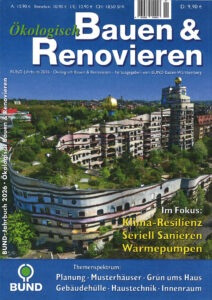
    Steiff, Peter. “Zirkuläres Bauen. Regeneratives Baustoff-Management.” BUND Jahrbuch 2026, January 2026.


    Wood as a foundation of a sustainable building culture

    Januar 8, 2026

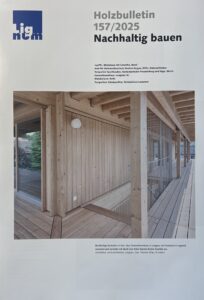
    Glanzmann, Jutta. “Holz Als Basis Für Eine Nachhaltige Baukultur.” Lignum Holzbulletin 157/2025, no. Nachhaltig bauen (2025): 4058–59.


    MycoTree

    Januar 5, 2026

    McLean, Will, Pete Silver, and Dirk Hebel. “MycoTree.” In Sustainable & Regenerative Materials for Architecture – A Source Book. 2025; Laurence King, 2025.


    Really Circular – Material Library at KIT

    Oktober 29, 2025

    Dietzold, Lutz, ed. Iconic Awards 2025 – Spaces Objects Visions. Frankfurt: Rat für Formgebung GmbH, 2025.


    Activating the Urban Mine

    Oktober 2, 2025

    Hebel, Dirk E. „Activating the Urban Mine.“ In Architecture and Technology Volume II: Cities in Climate Crisis. Madrid: Norman Foster Foundation Press, 2025.


    The city as a resource

    September 18, 2025


    Hebel, Dirk E. und Felix Heisel. “Die Stadt als Ressource.” In Für eine nachhaltige Architektur der Stadt. Berlin: Verlag Klaus Wagenbach, 2025.


    From a linear to a circular system

    September 15, 2025

    Hebel, Dirk E. “Vom Linearen Zum Kreislaufsystem.” In Architektur Und Klimawandel. München: Edition DETAIL, 2025.


    Interview: „We must finally start measuring CO2 emissions – not just how thick the insulation is“

    Juli 29, 2025

    Hebel, Dirk E. Interview: “Wir müssen endlich anfangen, den CO2-Ausstoß zu messen – nicht nur, wie dick die Dämmung ist.” Interview by Christoph Karcher. LooKIT 0225, 2025.


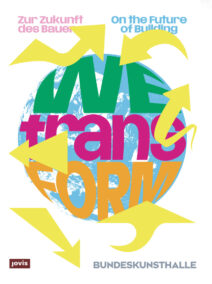
    WEtransFORM – On the Future of Building

    Juni 22, 2025

    BUNDESKUNSTHALLE, ed. WEtransFORM – Zur Zukunft Des Bauens. Berlin: jovis Verlag, 2025.


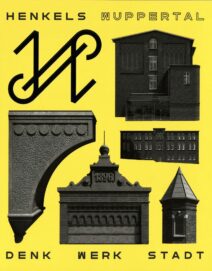
    Henkels Wuppertal

    Juni 4, 2025

    Renaissance AG, ed. Henkels Wuppertal – DenkWerkStadt. Wuppertal: renaissance Immobilien und Beteiligungen Aktiengesellschaft, 2025.


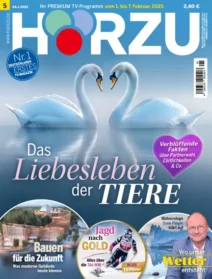
    Building for the world of tomorrow

    April 24, 2025

    Monkenbusch, Helmut. „Bauen für die Welt von morgen.“ Hörzu, 24.1.2025


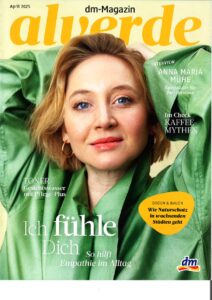
    Funghi – underground networkers

    April 24, 2025

    Hebel, Dirk E., Tanja Hildbrandt. „ Pilze – Netzwerker im Untergrund“. alverde, dm-Magazin, April 2025.


    Fungi are versatile

    Februar 24, 2025

    Merkert-Andreas, Carolin. “Pilze Sind Vielseitig.” Wohnglück, January 2025.


    “RoofKIT – Carbon storage and Material storage”

    Januar 9, 2025

    Boerman, Elena, and Dirk E. Hebel. “RoofKIT – Kohlenstoffspeicher Und Materiallager.” Architektur.Aktuell, vol. 12.2024, no. Tradition und Innovation, Dezember 2024, pp. 98–109


    The many applications of mycelium construtction

    Dezember 8, 2024

    Grossarth, Jan. „Exkurs: Die vielen Einsatzbereiche von Myzel im Bauwesen“. In Bioökonomie und Zirkulärwirtschaft im Bauwesen, eine Einführung, 174–117. Wiesbaden: Springer Fachmedien, 2024.


    Interview: „From a Linear to a Circular System“

    November 13, 2024

    Hebel, Dirk E. Interview: “Vom linearen zum zirkulären Kreislaufsystem.” Interview by Sandra Hofmeister, DETAIL 11.2024, Nov. 2024.


    Building with renewable materials – Nature as a resource depot

    Oktober 29, 2024

    Hebel, Dirk E., Sandra Böhm, Elena Boerman, Hrsg. Vom Bauen mit erneuerbaren Materialien – Die Natur als Rohstofflager. Stuttgart: Fraunhofer IRB Verlag, 2024.


    Guest contribution: ‚Thinking, designing and operating in circular ways.‘

    Juni 27, 2024

    Hebel, Dirk E. “In Kreisläufen denken, entwerfen und wirtschaften.” MÄG – Mein Häfele Magazin, 2024.


    Interview: ‚Mycelium power for the construction industry‘

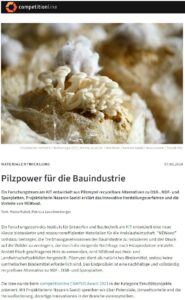
    Juni 10, 2024

    Rubel, Maike, and Patricia Leuchtenberger. Interview: “Pilzpower für die Bauindustrie.” competitionline, 7 June 2024, https://www.competitionline.com/de/news/schwerpunkt/pilzpower-fuer-die-bauindustrie-7283.html.


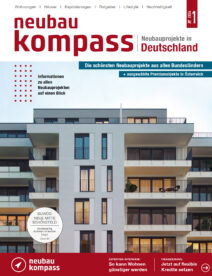
    ‚Future building materials: mushroom, hemp and algae‘ in neubau kompass

    Mai 27, 2024

    Müller, Janek. “Baumaterialien der Zukunft: Pilze, Hanf und Algen.” neubau kompass – Neubauprojekte in Deutschland, May 3, 2024. https://www.neubaukompass.de/premium-magazin/.


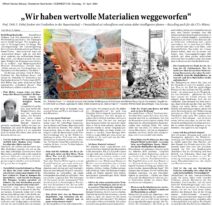
    Interview: ‚We have disposed of valuable materials‘

    Mai 7, 2024

    Sören, S. Sgries. “Interview: ‘Wir haben wertvolle Materialien weggeworfen.’” Rhein-Neckar-Zeitung, April 27, 2024, SÜDWEST I 28 edition, sec. Sinsheimer Nachrichten.


    Built on mushroom

    April 24, 2024

    Schweikle, Johannes. “Auf Pilz gebaut.” Stuttgarter Zeitung, April 23, 2024, sec. Die Reportage.


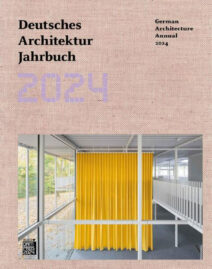
    Organic Architecture – Fungus mycelium and flax as materials for the ecological building transition

    Februar 13, 2024

    Klaaßen, Lars. “Organische Architektur – Pilzmyzel und Flachs als Materialien für die ökologische Bauwende.” In Deutsches Architektur Jahrbuch 2024, edited by Peter Cachola Schmal, Yorck Förster, and Christina Gräwe, 198–209. Berlin, Germany: DOM publishers, 2024.