Home | Impressum | Datenschutz | KIT

New Publications available now

publications

CoReSing has recently contributed to three new publications:
AFRITECTURE: Building Social Change
Where a term like “Western architecture” is likely to conjure a gamut of specific examples ranging from the Colosseum to the Empire State Building, “African architecture”-whether ancient or modern-still connotes very little for a general audience in the West. Happily, this is changing, as Africa’s recent economic boom is transforming the urban landscape across the continent, and yielding a rich new crop of architects and buildings with a range of approaches and solutions as diverse as Africa itself. This opulently illustrated volume, with informative texts by the architectural historian Andres Lepik and documentation of models and maps, examines a broad range of examples of contemporary architecture in Africa. The selection is confined to countries south of the Sahara, such as Burkina Faso, Rwanda and South Africa, where the transformation of the architectural landscape has been particularly pronounced and remarkable in recent years. Throughout, references to the hallmarks and principles of Western historical architecture are notable; but equally striking is the innovative use of local materials and often minimal resources. Very little has been published on contemporary African architecture, making this substantial volume an important and pioneering publication.

Construction Ahead – Constructing Alternatives Part II:
The Assistant Professorship Dirk E. Hebel has been guest-editing two editions of Ethiopia’s leading construction magazine: ‘Construction Ahead’. The 80 page issues “Constructing Alternatives” propose a variety of alternative modern, and sometimes transformed building materials and construction methods. Although tested in and derived from an African context, their application can also answer the rising needs of other developing territories and turn them from import-oriented systems into self-sustaining, knowledge exporting nations.

‘Construction Ahead’ is a specialized bimonthly magazine for engineers, industry academics, architects, construction material manufacturers and suppliers and related service providers. ‘Construction Ahead’ delivers keen insight and analysis of key construction markets, projects, products and trends.

The School the Book the Town
The School, The Book, The Town is a biography of an experiment undertaken in Ethiopia for nearly a decade, starting with the founding of a school, setting off a series of investigations assembled in a book, and leading to the construction of a town. A timeline running all through the book reveals how logical and consistent, but in some cases also chaotic and interrupted the story evolved.
In an age of rapid urbanization, the city is everywhere. In the case of Ethiopia, as with so many other developing nations, architecture and urban design are brought face to face with a country undergoing radical, often painful transformations that put longstanding traditions to the test. The burning question here is how to modernize and yet maintain distinct cultural identities, while also trying to accommodate mass migration from rural regions to urban centers. In sum, the route followed here is one marked by a series of trials that leave nothing standing as it was.
Contributions by Marc Angélil, Philippe Block, Zegeye Chenet, Dirk Hebel, Fasil Giorghis, Sarah Graham, Franz Oswald, Cary Siress, et al.

Please find article excerpts below:

Dirk E. Hebel:
ARCHITECTURAL EDUCATION IN ETHIOPIA
in: AFRITECTURE, Hatje Cantz, Ostfildern, 2013, pp. 160-165

Dirk E. Hebel, Toma Berlanda, Susanne Gampfer, Marc Olweny, Alfred Omenya, Hans Skotte:
PRO AND CONTRA: DESIGN-BUILD PROJECTS AS A FROM OF KNOWLEDGE TRANSFER
in: AFRITECTURE, Hatje Cantz, Ostfildern, 2013, pp. 210-216

Dirk E. Hebel, Dirk Donath:
PARTNER PROJECTS IN ETHIOPIA
in: AFRITECTURE, Hatje Cantz, Ostfildern, 2013, pp. 166-171

Felix Heisel, Elias Yitbarek:
BUILDING LAWS FOR ALTERNATIVE MATERIALS: A SHIFT TOWARDS FUNCTION AND PERFORMANCE-BASED BUILDING PERMITS
in: Construction Ahead, Constructing Alternatives part II, Vol. 23/12, Addis Ababa, 2013, pp. 10-12

Karsten Schlesier:
BAMBOO PERSPECTIVES: THE FUTURE OF BAMBOO AS A BUILDING MATERIAL
in: Construction Ahead, Constructing Alternatives part II, Vol. 23/12, Addis Ababa, 2013, pp. 45-47

Dirk E. Hebel, Felix Heisel, Alireza Javadian:
BAMBOO: THE NEW SUPER FIBER
in: Construction Ahead, Constructing Alternatives part II, Vol. 23/12, Addis Ababa, 2013, pp. 54-57

Dirk E. Hebel:
ENVISIONEERING ETHIOPIA: FROM THE CITY TO THE UNIT AND BACK
in: The Book the School the Town, Ruby Press, Berlin, 2013, pp. 136-139

Felix Heisel:
FILMIC SPACES
in: The Book the School the Town, Ruby Press, Berlin, 2013, pp. 96


FCL Magazine launched with issue on Technology

fclmagazine

On September 6th 2013, the editors Dirk E. Hebel and Stephen Cairns launched the new FCL Magazine with its first issue ‘Technology’.

The FCL Magazine is a periodical about research. It does not aim to present unquestionable research results, nor fully worked out ‘solutions’ to the myriad dilemmas that contemporary and future cities unfold. Rather, it aims to show things which are not yet fully resolved, work in progress, approaches to longer term issues. In so doing, the magazine will embrace mistakes and failures. It will celebrate questions, highlight methodologies, and revel in the shaping of research.

FCL Magazine is time limited. It will only be alive, as long as the Future Cities Laboratory is active. It draws its content and energy from the researchers inside FCL. It has a dual audience: those researchers within FCL, for whom the magazine is intended as a provocation for discussion and prompt for critical reflection on interdisciplinary approaches to the city; and colleagues who work in related fields, for whom the magazine is intended as a source of information on the work being conducted at FCL, and as an invitation to engage.

The first issue of the FCL Magazine aims to address the role of technology in FCL’s research activities. The word technology is derived from the Greek words techné, meaning art or craft, and logos, meaning word, intellectual capability, doctrine, rational or even reflection. Technology therefore suggests a mentality of “thinking” on what we are “doing”. For a laboratory setting, this seems to be an ideal point of departure and is more open than simplified definitions such as technique or machine.

Over the past two and a half years various ways of using technology in FCL’s daily work have emerged in our research community. While some claim, that architects in general show a fear of implementing technology in their designs, others try to define the term in an alternative approach by developing links between local traditions and state of the art technologies. Others are impatient to see new developments in the technological sector and claim that information technology is printing technology. Robotic drones create artificial three-dimensional maps of our immediate environment and reduce it to a thin layer of data carpets and point clouds. Technology is conventionally described in low– tech and high-tech variants. This first issue of FCL Magazine offers a platform for divergent definitions of technology, and offers suggestions, clues, and approaches on how to operate on a shifting. It gives a selected overview, no more and no less.


Bamboo – rock-hard iron substitute for the tropics

globe_hebel

ETH Globe published in its latest issue called “The particle tamers” an article on the research of the Chair of Architecture and Construction Dirk E. Hebel at FCL Singapore called “Bamboo – rock-hard iron substitute for the tropics” by Samuel Schlaefli. “Bamboo grows quickly, is common in tropical countries, and some species have a greater tensile strength than steel. It would be an ideal alternative to imported construction steel for the rapidly growing cities of the south, which is where the Future Cities Laboratory in Singapore comes in.” See also: www.ethz.ch/about/publications/globe


New Publication: Bamboo Composite Reinforced Concrete

aedes-cover

Dirk E. Hebel, Felix Heisel
BAMBOO COMPOSITE REINFORCED CONCRETE 
in: SMART CITIES, The Next Generation, Focus South East Asia, Berlin, 2013, pp. 46-49


Karlsruher Institut für Technologie
Fakultät für Architektur
Institut Entwerfen und Bautechnik

Professur Nachhaltiges Bauen
Englerstr. 11, Geb. 11.40, Raum 25
D-76131 Karlsruhe
 
Tel: +49 (0)721/608-42167


Recent Publications:  
 

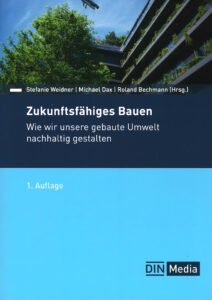
    Sustainable Construction. How we are shaping our built environment in a sustainable way.

    May 7, 2026

    Hebel, Dirk E., and Elena Boerman. “Projektstudie 2 (Schwerpunkt: Materialien): Der Kreislaufbasierte Architekturansatz.” In Zukunftsfähiges Bauen – Wie Wir Unsere Gebaute Umwelt Nachhaltig Gestalten, 64–78. Berlin: DIN Media Innovation, 2026.


    Circular! Foundations and principles of a circular construction industry.

    March 11, 2026

    Hebel, Dirk E., and Annette Hillebrandt, eds. 2026. Zirkulär! Fundamente und Postulate einer kreislaufbasierten Bauwirtschaft. Bauwelt Fundamente. Birkhäuser Verlag GmbH.


    A matter of consequence

    March 11, 2026

    Deutsches Architekt:innen Blatt. 2026. “Eine Frage der Konsequenz.” March.


    Circular Construction. Regenerative Building material management.

    January 8, 2026

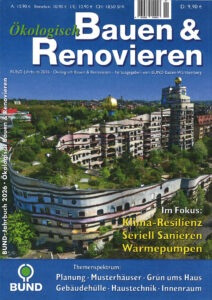
    Steiff, Peter. “Zirkuläres Bauen. Regeneratives Baustoff-Management.” BUND Jahrbuch 2026, January 2026.


    Wood as a foundation of a sustainable building culture

    January 8, 2026

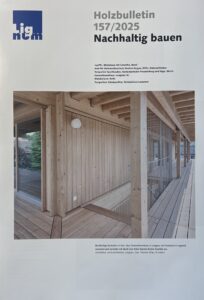
    Glanzmann, Jutta. “Holz Als Basis Für Eine Nachhaltige Baukultur.” Lignum Holzbulletin 157/2025, no. Nachhaltig bauen (2025): 4058–59.


    MycoTree

    January 5, 2026

    McLean, Will, Pete Silver, and Dirk Hebel. “MycoTree.” In Sustainable & Regenerative Materials for Architecture – A Source Book. 2025; Laurence King, 2025.


    Really Circular – Material Library at KIT

    October 29, 2025

    Dietzold, Lutz, ed. Iconic Awards 2025 – Spaces Objects Visions. Frankfurt: Rat für Formgebung GmbH, 2025.


    Activating the Urban Mine

    October 2, 2025

    Hebel, Dirk E. “Activating the Urban Mine.“ In Architecture and Technology Volume II: Cities in Climate Crisis. Madrid: Norman Foster Foundation Press, 2025.


    The city as a resource

    September 18, 2025


    Hebel, Dirk E. und Felix Heisel. “Die Stadt als Ressource.” In Für eine nachhaltige Architektur der Stadt. Berlin: Verlag Klaus Wagenbach, 2025.


    From a linear to a circular system

    September 15, 2025

    Hebel, Dirk E. “Vom Linearen Zum Kreislaufsystem.” In Architektur Und Klimawandel. München: Edition DETAIL, 2025.


    Interview: “We must finally start measuring CO2 emissions – not just how thick the insulation is”

    July 29, 2025

    Hebel, Dirk E. Interview: “Wir müssen endlich anfangen, den CO2-Ausstoß zu messen – nicht nur, wie dick die Dämmung ist.” Interview by Christoph Karcher. LooKIT 0225, 2025.


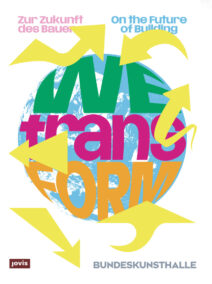
    WEtransFORM – On the Future of Building

    June 22, 2025

    BUNDESKUNSTHALLE, ed. WEtransFORM – Zur Zukunft Des Bauens. Berlin: jovis Verlag, 2025.


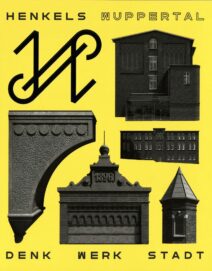
    Henkels Wuppertal

    June 4, 2025

    Renaissance AG, ed. Henkels Wuppertal – DenkWerkStadt. Wuppertal: renaissance Immobilien und Beteiligungen Aktiengesellschaft, 2025.


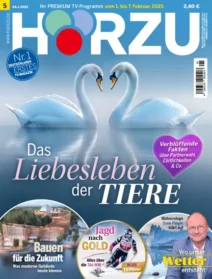
    Building for the world of tomorrow

    April 24, 2025

    Monkenbusch, Helmut. „Bauen für die Welt von morgen.“ Hörzu, 24.1.2025


    Funghi – underground networkers

    April 24, 2025

    Hebel, Dirk E., Tanja Hildbrandt. „ Pilze – Netzwerker im Untergrund“. alverde, dm-Magazin, April 2025.


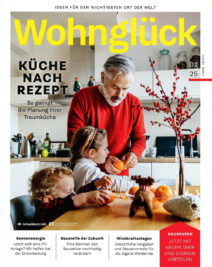
    Fungi are versatile

    February 24, 2025

    Merkert-Andreas, Carolin. “Pilze Sind Vielseitig.” Wohnglück, January 2025.


    “RoofKIT – Carbon storage and Material storage”

    January 9, 2025

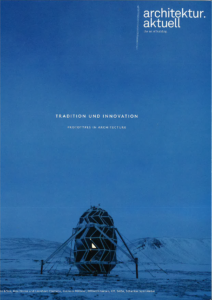
    Boerman, Elena, and Dirk E. Hebel. “RoofKIT – Kohlenstoffspeicher Und Materiallager.” Architektur.Aktuell, vol. 12.2024, no. Tradition und Innovation, Dezember 2024, pp. 98–109


    The many applications of mycelium construtction

    December 8, 2024

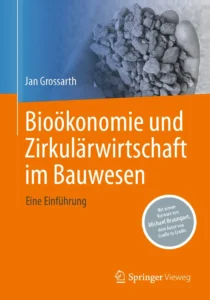
    Grossarth, Jan. „Exkurs: Die vielen Einsatzbereiche von Myzel im Bauwesen“. In Bioökonomie und Zirkulärwirtschaft im Bauwesen, eine Einführung, 174–117. Wiesbaden: Springer Fachmedien, 2024.


    Interview: “From a Linear to a Circular System”

    November 13, 2024

    Hebel, Dirk E. Interview: “Vom linearen zum zirkulären Kreislaufsystem.” Interview by Sandra Hofmeister, DETAIL 11.2024, Nov. 2024.


    Building with renewable materials – Nature as a resource depot

    October 29, 2024

    Hebel, Dirk E., Sandra Böhm, Elena Boerman, Hrsg. Vom Bauen mit erneuerbaren Materialien – Die Natur als Rohstofflager. Stuttgart: Fraunhofer IRB Verlag, 2024.


    Guest contribution: ‘Thinking, designing and operating in circular ways.’

    June 27, 2024

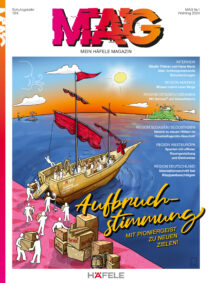
    Hebel, Dirk E. “In Kreisläufen denken, entwerfen und wirtschaften.” MÄG – Mein Häfele Magazin, 2024.


    Interview: ‘Mycelium power for the construction industry’

    June 10, 2024

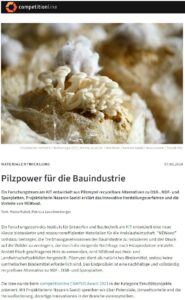
    Rubel, Maike, and Patricia Leuchtenberger. Interview: “Pilzpower für die Bauindustrie.” competitionline, 7 June 2024, https://www.competitionline.com/de/news/schwerpunkt/pilzpower-fuer-die-bauindustrie-7283.html.


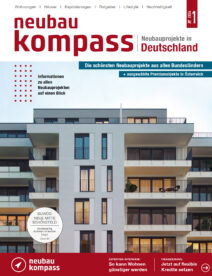
    ‘Future building materials: mushroom, hemp and algae’ in neubau kompass

    May 27, 2024

    Müller, Janek. “Baumaterialien der Zukunft: Pilze, Hanf und Algen.” neubau kompass – Neubauprojekte in Deutschland, May 3, 2024. https://www.neubaukompass.de/premium-magazin/.


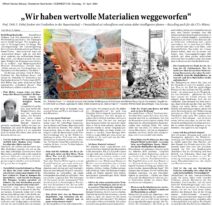
    Interview: ‘We have disposed of valuable materials’

    May 7, 2024

    Sören, S. Sgries. “Interview: ‘Wir haben wertvolle Materialien weggeworfen.’” Rhein-Neckar-Zeitung, April 27, 2024, SÜDWEST I 28 edition, sec. Sinsheimer Nachrichten.


    Built on mushroom

    April 24, 2024

    Schweikle, Johannes. “Auf Pilz gebaut.” Stuttgarter Zeitung, April 23, 2024, sec. Die Reportage.


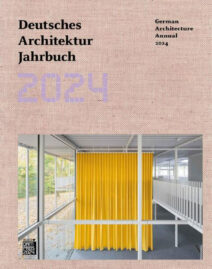
    Organic Architecture – Fungus mycelium and flax as materials for the ecological building transition

    February 13, 2024

    Klaaßen, Lars. “Organische Architektur – Pilzmyzel und Flachs als Materialien für die ökologische Bauwende.” In Deutsches Architektur Jahrbuch 2024, edited by Peter Cachola Schmal, Yorck Förster, and Christina Gräwe, 198–209. Berlin, Germany: DOM publishers, 2024.


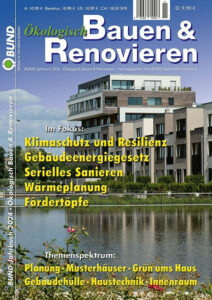
    Circular construction – Circulation instead of demolition in “BUND-Jahrbuch 2024”

    January 18, 2024

    Streiff, Peter. “Zirkuläres Bauen – Kreislauf statt Abriss.” BUND-Jahrbuch – Ökologisch Bauen & Renovieren 2024, January 2024.


    Redesigned Material Library at KIT in ‘Mitteilungsblatt des VDB-Regionalverbands Südwest’

    January 8, 2024

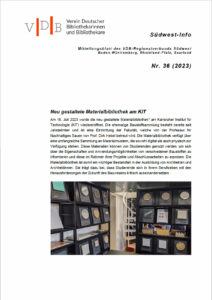
    Mönnich, Michael, and Sandra Böhm. “Neu gestaltete Materialbibliothek am KIT.” Südwest-Info: Mitteilungsblatt des VDB-Regionalverbands Südwest Nr. 36 (2023), 2023.


    RoofKIT Wuppertal, Germany; Interview with Prof. Dirk Hebel

    November 20, 2023

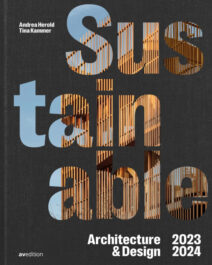
    Hebel, Dirk E. “RoofKIT Wuppertal, Germany; Interview with Prof. Dirk Hebel: The aim is clear, we must forge the path ourselves.” In Sustainable Architecture & Design 2023/ 2024, edited by Andrea Herold, Tina Kammerer, and InteriorPark., 46–55. Stuttgart, Germany: av edition GmbH, 2023.


    The existing building stock is the future resource

    November 16, 2023

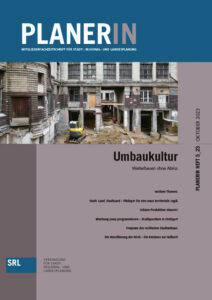
    Hebel, Dirk E. “Der Bestand ist die künftige Ressource – Den linearen Umgang mit Baumaterialien schnellstmöglich stoppen.” Planerin – Mitgliederfachzeitschrift für Stadt-, Regional- und Landesplanung, Oktober 2023.