Home | Impressum | Datenschutz | KIT

Master Design Studio: Renovation first! A new building for the KIT Faculty of Architecture on the South Campus

The spatial structure of university educational institutions is undergoing fundamental change. New forms of teaching, research, and collaboration are challenging traditional learning environments and calling for flexible, open, and sustainable spatial concepts. Rigid structures and monofunctional spaces no longer meet today’s requirements. This discrepancy is particularly evident in architectural education: design work, digital production, manual manufacturing, collaborative formats, and public discourse require new working environments.

The master design studio therefore examines what a contemporary architecture faculty might look like and how it could be integrated into the KIT campus. It examines the current location in Building 20.40, as well as the physics building with its high-rise and/or low-rise structures, as examples of spatial obsolescence, lack of flexibility, and the need for energy-efficient renovation. 

The question is which rooms are really needed today and how workshops, digital laboratories, open learning environments, concentrated workplaces, and communication forums can be spatially linked. The focus is on analysis, transformation, and further development of the existing buildings. The goal is an innovative, sustainable utilization concept with short-term functionality and a long-term campus perspective, developed in teams of two.

First Meeting: 23.04.2026, 10:00
Submission/Presentation: 05.08.2026


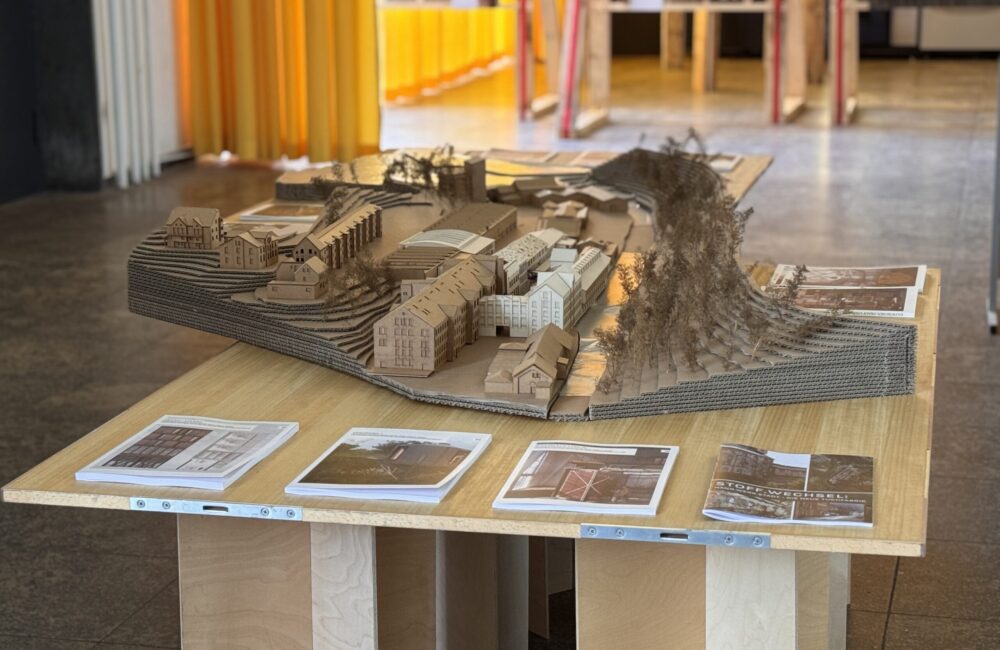
Master Design Studio: Sch(l)auinsland: Renovation of the university building on Schauinsland near Freiburg

The University of Freiburg owns a historic cabin in the Black Forest, which will be used as a place of learning and work for experimental teaching and learning formats in the future. Away from the urban campus and nestled in the Black Forest landscape, the property offers ideal conditions for testing alternative spatial concepts, new forms of collaborative work, and ecological strategies.

As part of the master design studio, students are tasked with developing a spatial transformation concept that not only expands the functionality of the existing hut, but also serves as a laboratory for circular economy and sustainable construction. The focus is on upcycling and recycling processes, the creative use of existing materials, and low-tech approaches to self-sufficiency.

The design task includes analyzing the building, identifying spatial potential, and developing atmospheric, structural, and programmatic interventions. The goal is to create a sustainable utilization concept that combines learning, research, and collaborative appropriation in an experimental process. Working in teams of two, students will develop an open, adaptable project that is deeply rooted in the landscape.

First Meeting: 23.04.2026, 14:00
Excursion: 24.04.2026, 09:00
Submission/Presentation: 06.08.2026


Research Seminar: LOAM +, Loam and natural building materials for a emission free construction industry – A research seminar of the KIT Material Library

The materials library houses conventional building materials as well as recyclable building materials made from secondary and renewable raw materials. The seminar focuses on loam building materials and other natural building materials used in construction and renovation projects. Loam (along with wood) is one of the oldest building materials known to humankind, and even today, a third of the world’s population lives in loam buildings, particularly in Africa, South America, and Asia. In our region, this natural material is experiencing a renaissance thanks to modern advancements such as prefabrication, the production of dry construction materials and the integration of this traditional building material in digital design and construction methods. In conjunction with renewable materials, such as wood, natural insulation or natural paints and plasters, building with loamrepresents one of many opportunities for addressing the enormous challenges posed by climate change within the construction industry. 

During the research seminar, the students will conduct independent and critical research on the mentioned topics. They will examine the life cycles of selected materials in detail in order to integrate sustainable alternatives into the materials library in the form of detailed datasets and physical material samples. The seminar is accompanied by mentoring sessions, workshops, lectures and excursions.

First Meeting: 21.04.2026, Bldg. 20.40, R 141.1 (material library)
Regular Meeting: Tuesdays, 11.30 – 13.00
Submission/Exam: 21.07.2026
Focus of study: Building Technology


Research Seminar: Systemic Balance in Habitat Making – Revisiting the African Traditional Architecture

Contemporary city making is rooted in the ethos of modernity, scripting natural processes as ‘the other’ with a clear boundary between the lived and the natural spaces. This dichotomous reading of Nature and Culture, which has promoted a continuous, often tense, struggle for the subjugation of nature, is still the foundational spirit that drives our collective strive for growth and transformation.  However, traditional African conceptions do not make such a division between nature and society – offering a vast field of rediscovery for a more harmonious coexistence and dialogue in and with nature. Though the current rapid urban production is disruptive of this dialogue by being dependent on the global circuit of capital, materials, equipment, and skills, the majority of Africa still depends on traditional productions and localized cycles.     

By focusing on a particular geographic region within the vast continent, the seminar will attempt to explore the operational mechanics of traditional architecture (habitat making) within the metabolic cycles of the different ecological zones of the region. The main aim is to draw vital and timeless values and principles that are foundational in ensuring stability and balance in the making of the Human Habitat.  

First Meeting: 21.04.2026, 14:00
Regular Meeting: Tuesdays, 14:00 – 15:30
Submission/Exam: 21.07.2026
Focus of study: Urban Design


Seminar Week: Back to Earth – A journey to pioneering clay buildings in German-speaking regions

Clay, long an underrated building material, is currently experiencing a renaissance in light of the ecological crisis and is now considered a forward-looking material. The seminar trip takes us to the most significant clay buildings in Germany, Switzerland, and Austria. On a bus trip, we discover historic half-timbered and clay houses, contemporary projects in rammed clay and light clay, as well as innovative approaches to sustainable clay architecture. The excursion combines theoretical insights with practical observations and provides a deep understanding of the structural, design, and ecological potential of clay.

First Meeting: Thursday 07.05.2026, 13:00-14:00 , Bldg. 11.40, R 26
Excursion:  26.05. – 29.05.2026
Costs: max. 500€


Final Presentation: KARLSRUHE.ART.COURT. – Expansion of the Staatliche Kunsthalle Karlsruhe

The Staatliche Kunsthalle Karlsruhe, opened in 1846 as one of Germany’s first public museums, is one of the most important art museums in the state. In order to present its collections in a contemporary manner and better fulfil its educational mission, the museum needs modern premises.

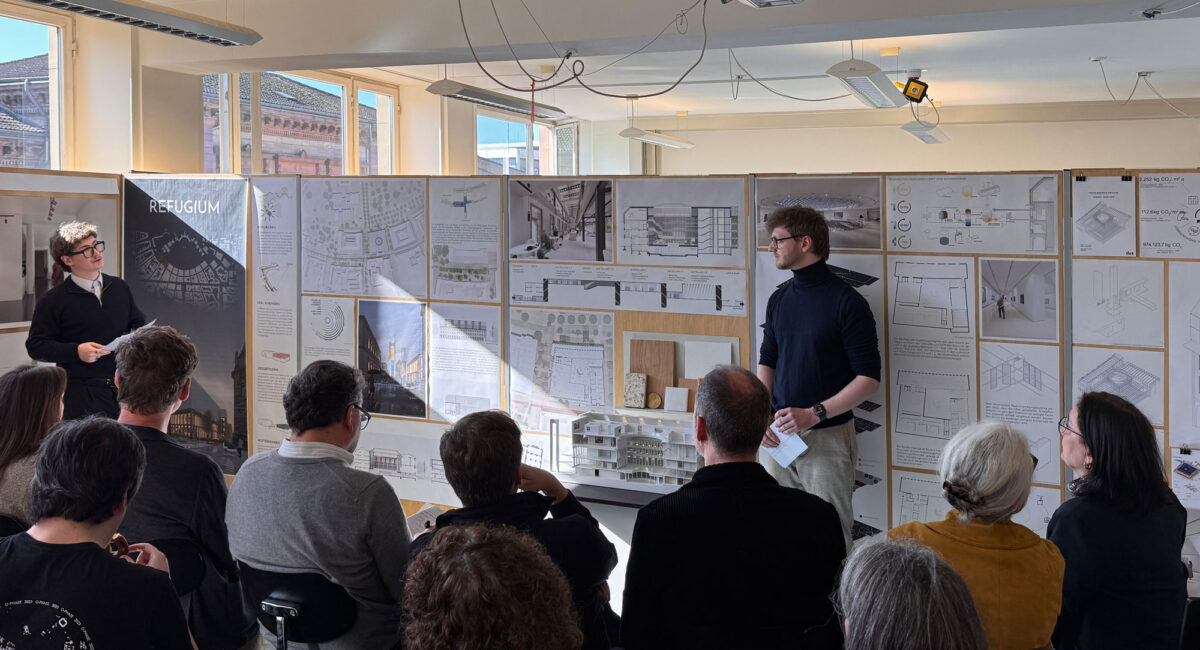
As part of the Master’s design project “KARLSRUHE.ART.COURT. – Expansion of the Staatliche Kunsthalle Karlsruhe”, this functionally and programmatically necessary extension was developed by fifteen students in line with circular construction principles, while preserving the existing building. The ‘Kunsthalle der Gegenwart’ will house collections from the 20th and 21st centuries, special exhibitions, offices for art history and communication, a copperplate engraving cabinet and rooms for paper restoration. The former courthouse, built in 1962, will also be opened to the urban community and will house a restaurant and an art library.

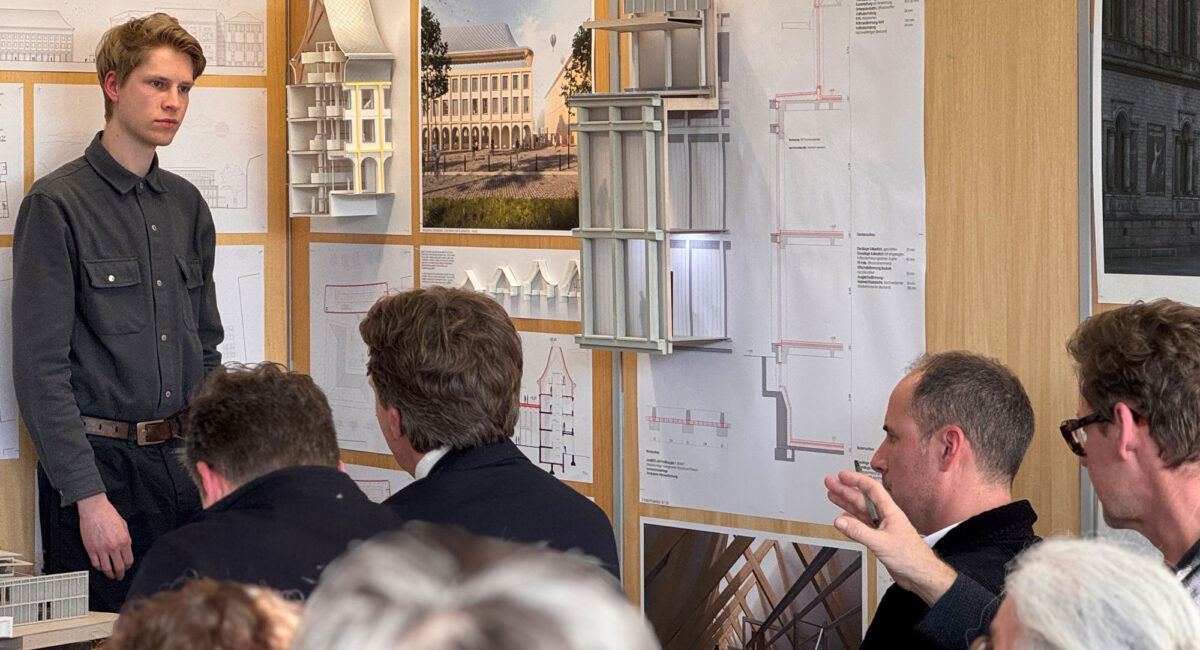
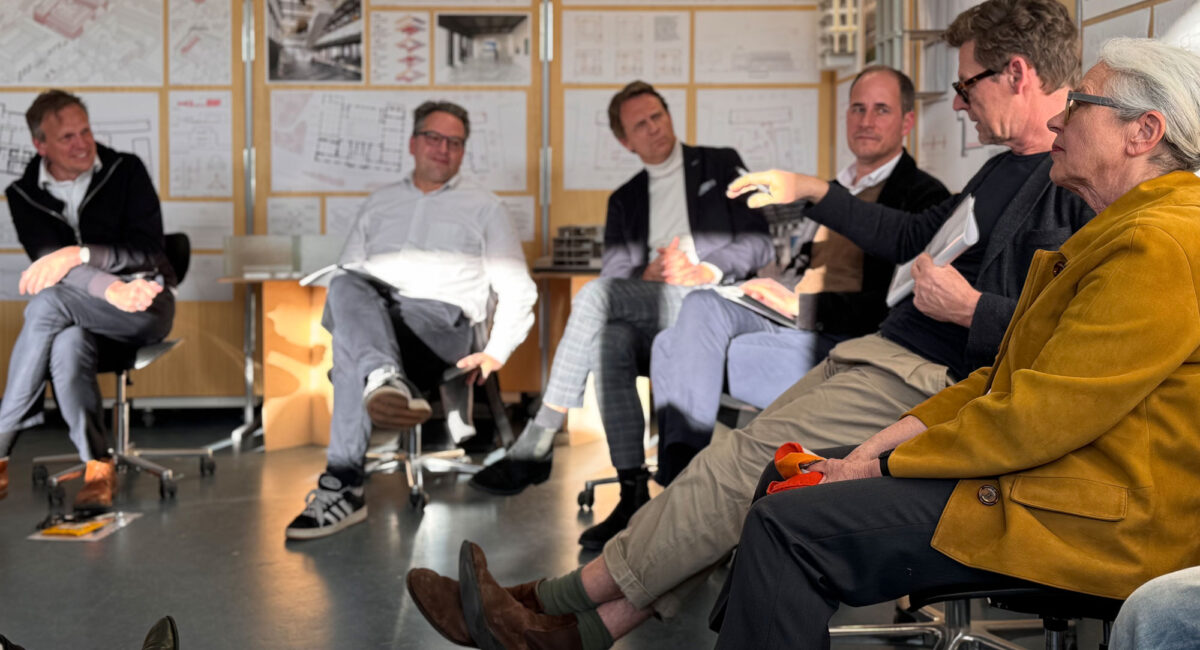
On 26 February 2026, the final presentation of the Master’s design project took place in the studio spaces of the Architecture Building. The students presented their projects to the invited guest critics Frédéric Bußmann and Silvia Stetter-Kalbus (Staatliche Kunsthalle Karlsruhe), Uta Hassler (architect and building researcher), Kai Fischer and Dagmar Menzenbach (Vermögen und Bau Baden-Württemberg) and Patrick Chladek (architect), as well as the teaching staff from the Chair of Architectural Communication (Prof. Riklef Rambow and Nerina Kosenina) and the Chair of Sustainable Comstruction (Prof. Dirk E. Hebel and Elena Boerman).

Many thanks to all the students and guest critics for the exciting day and the presentation of forward-looking ideas for the extension of the Staatliche Kunsthalle Karlsruhe, representing the transformation of the existing museum into an open, inviting art campus for social exchange and cultural participation in Karlsruhe.


MycoTree

McLean, Will, Pete Silver, and Dirk Hebel. “MycoTree.” In Sustainable & Regenerative Materials for Architecture – A Source Book. 2025; Laurence King, 2025.


Open position: Employee (f/m/d) in science and teaching for the field of architecture (Material Library)

Tender Number: 1334/2025

Material Library © Zooey Braun

Organizational Unit: Institute IEB
Start Date: 1. February 2026
Scope of work: Part-time 50%

More information here.


Finalist: Evergreen Prize 2025

Team MycoLab (Nazanin Saeidi, Karlsruhe Institute of Technology (KIT), Germany) was selected as one of the top 5 finalists for the prestigious Evergreen Prize 2025, sponsored by HS Timber Group and organized by the Evergreen Privatstiftung. Our project, “From Waste to Resource – Advancing Circular Bio-Based Materials for the Construction Industry,” was recognized by a distinguished jury of timber experts for its innovative approach and impact. During an exhilarating day of live presentations at the Vienna City Hall on 26 May 2025, witnessed by over 900 attendees from more than 50 countries, Team MycoLab advanced to the top 3, showcasing the global potential of circular, bio-based solutions in construction.

Team Mycolab was competing with Team BranchUP (Maximilian Pramreiter, University of Natural Resources and Life Sciences, Vienna (BOKU), Austria), Team Hyperlignification (Emil Engelund Thybring, University of Copenhagen, Denmark), Team Transparent Wood (Yuanyuan Li, KTH Royal Institute of Technology, Sweden) and Team LignoVolt (Ingo Burgert, ETH Zürich, Switzerland).

The live presentations took place at the Vienna City Hall. Team MycoLab advanced to the top 3, showcasing the global potential of circular, bio-based solutions in construction.

For more information watch the video about the team and their presentation here.


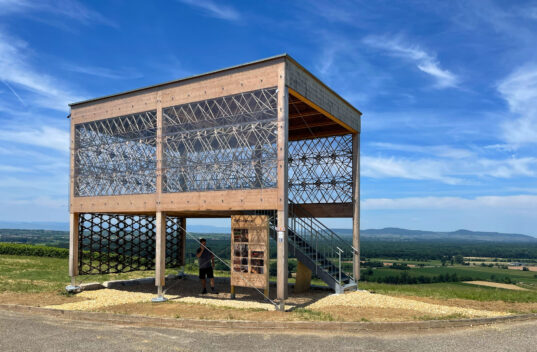
Pavilion “Residence” at Sommerberg Ebringen

Two stories high and made from sustainable materials, the mobile research pavilion ‘Residence’ now stands in a prominent location on the Sommerberg in Ebringen. The pavilion – declared a shelter for hikers for planning reasons – was originally designed by the KIT Professorships Digital Design and Fabrication (DDF), Design of Structures (dos) and Sustainable Construction (NB) for the 2024 State Garden Show in Wangen im Allgäu to showcase the current state of sustainable construction. After the end of the show, it found its permanent home in Ebringen.

Text: Badische Zeitung, Thursday 10 July 2025

Find out more about the research project here.


nbau review about “Vom Bauen mit erneuerbaren Materialien”

The editors of the nbau magazine write about the book: “Vom Bauen mit erneuerbaren Materialien is a whirlwind tour through the increasingly important world of the most important biological and geological building materials. Much is already possible today. At the same time, renewable materials seem to hold the promise of a climate-positive future for the construction industry based on a bio-based circular economy. In this sense, the book is both an overview and an appetiser.”


Interview: Sandra Böhm and Elena Boerman in the SIHGA TimberTalk

In the context of the Green Deal in Construction event, hosted by SIHGA in Gmunden, Austria, on 20 March 2025, Sandra Böhm and Elena Boerman gave a presentation on renewable materials and were interviewed by Thomas Hutzinger as part of the SIHGA TimberTalk series.

The interview focuses on necessary measures for resource-efficient and sustainable construction on the production and application side, areas of application for bio-based and innovative materials, and political and economic incentives to accelerate change in the construction industry.
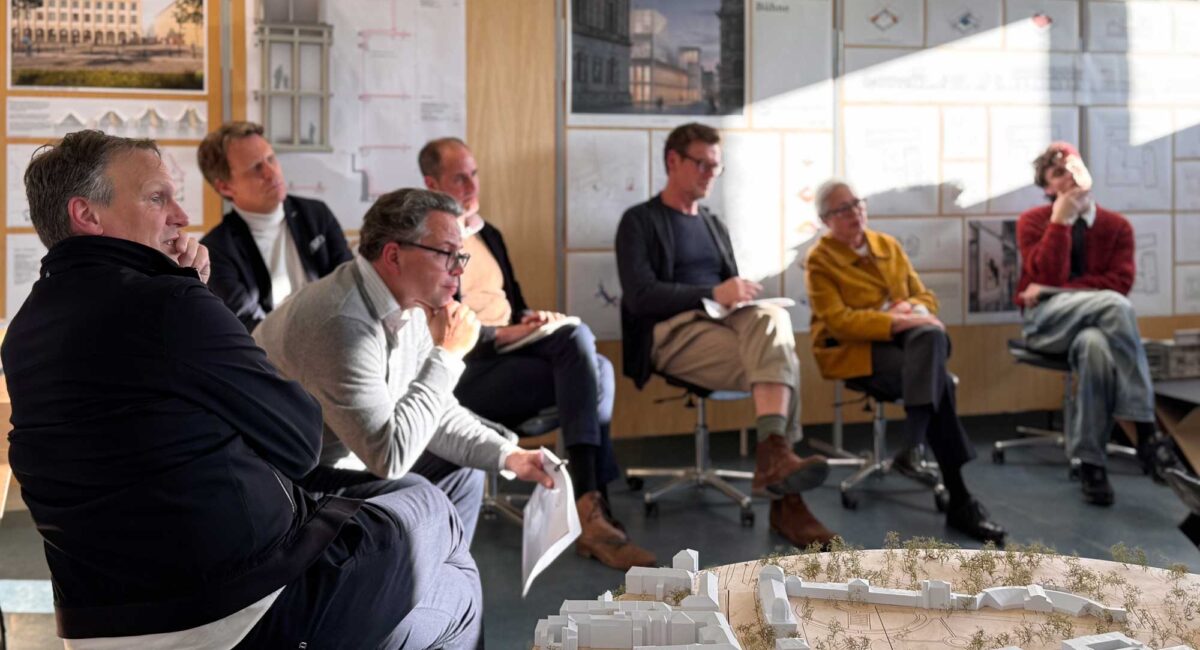


The Exhibition “HIRZBERG+”

Last week, the final reviews of Design Studio “HIRZBERG+ – Micro-Multifunctional Room for a Kindergarten in Freiburg” took place. Congratulations to all students!

The Haus für Kinder am Hirzberg in Freiburg is to be expanded to include a micro-multifunctional room due to a lack of space on its own property. This was the focus of the semester project and will be realised in cooperation with the Freiburg-based architecture office hotz + architekten. The room is to serve as a lounge and work space for employees, as well as a space for curative education activities and parent-teacher meetings. The design centred around a detailed examination of the environmental impacts, structural-economic, structural-technical and building-physical issues, as well as the use of resource-efficient, single-origin building materials such as renewable and secondary building materials, with sustainable, cycle-friendly construction methods and their design-technical effects on function and aesthetics, with planning up to a scale of 1:1.

Over the course of the winter semester, 8 groups of Bachelor’s and Master’s students approached these complex questions in a variety of ways. Since everyone has worked tirelessly on the project, we are very happy to give you an insight into the results. You can take a look at the diverse solutions since February 21 until March 6 in the exhibition at the KIT Faculty of Architecture in building 20.40 on the second floor.


Fungi are versatile

Merkert-Andreas, Carolin. “Pilze Sind Vielseitig.” Wohnglück, January 2025.


KIT Material Library wins BDAP Award for Interior Design

© Zooey Braun

The KIT Material Library has been awarded the “Badischer Architektur Preis” (BDAP) in the Interior Design category for its innovative, circular concept. The renovation features materials that have already completed a life cycle, sourced from the so-called “urban mine”. All materials are sorted and installed without adhesives or silicones to maximize recyclability.

© Zooey Braun

Manuel Rausch (STUDIO-MRA) was the lead architect of the Material Library. The design concept was developed in collaboration with the Material Library team, particularly the selection of materials for the interior was made with Professor Dirk E. Hebel, Sandra Böhm, Elena Boerman, and Thomas Kinsch.

With an extensive collection of building materials, the library offers students the chance to experience materials firsthand and integrate them into their design processes. The architectural redesign presents a bright, airy space with a gallery level that encourages interaction and exploration.

This material library serves as a knowledge repository for sustainable building materials, providing both analog and digital resources for research and education.

© Zooey Braun

For more information, visit the BDAP website.


Master Design Studio: HIRZBERG+

Micro-Multifunctional Room for a Kindergarten in Freiburg


The ‘Haus für Kinder am Hirzberg’ in Freiburg is characterised by its proximity to nature, built structures that have grown over time and space and an open room concept. In two existing buildings on a slope, which are connected by an intermediate building for access, the educational work of the team takes place in a homely atmosphere on different levels and always in close relation to the outdoors. The existing structure is complemented by a courtyard for the children to play in, which is protected by a small wooden tool shed facing the valley.

The kindergarten is now to be extended on its own site with a micro-multifunctional space, which is the focus of the semester assignment and which will subsequently be realised in cooperation with an architectural office based in Freiburg. The room will serve as a common and study room for staff as well as a room for curative education programmes and parent meetings. As the site is located within the “Roßkopf-Schloßberg” landscape conservation area, the preservation of the surrounding trees and copses as well as the protected wetland complex is an important design requirement. Particular importance is also attached to the spatial relationship between the existing buildings on the Hirzberg slope and the new spatial structure that is being created towards the valley, which should fit into the local landscape and provide a cosy atmosphere for the kindergarten staff.

The design is aiming for a detailed examination of the resulting environmental effects, building economics, structural engineering and building physics issues, as well as the use of resource-friendly, pure building materials such as renewable and secondary building materials, sustainable, circular construction methods and their design-related effects on function and aesthetics with planning up to a scale of 1:1.

Supervised by: Elena Boerman

First Meeting: 24.10.2024, 09.30 am (Bldg. 20.40, R 208)
Excursion: 15.11.2024, Freiburg
Pin-Up: 11.12.2024
Submission: 19.02.2025
Presentation: 21.02.2025
Form: Teamwork


Bachelor Design Studio: NETTO+Living

Living on the food market in Kaiserslautern

How do people want to live together today and tomorrow? What are the prerequisites for good neighbourliness in an urban context? How can contemporary living models be reflected in residential buildings? How can a market promote cohesion and identity in a neighbourhood

While modernism proclaimed a separation of work and living, today innovative housing construction must develop offers for increasingly differentiated lifestyles. The focus of the task is therefore a forward-looking residential housing project that will be constructed in conjunction with commercial use on the ground floor on a plot in a heterogeneous neighbourhood in Kaiserslautern. The architectural designs should take into account the housing needs of people in the city as well as the respectful treatment of the surrounding context, resources and environment. The aim is to make design decisions for housing and the market comprehensible on the basis of successful reference projects, which will be analysed during the semester. For example, the design-integrated examination of housing requirements in the city of Kaiserslautern, different forms of human coexistence, contemporary housing developments, innovative concepts for food markets, circular construction methods and materials, resulting environmental impacts, building economics, structural engineering and building physics issues as well as the requirements of stakeholders and the needs of different users contribute to this.

The task is a mixed-use project consisting of residential and a food market in Kaiserslautern, which is currently being supervised by the Regensburg-based company RATISBONA Handelsimmobilien, a leading project developer in the German and international retail sector, and the architectural firm KURIARCHITEKTEN and will be further developed as a real project following the semester.

Supervision: Fanny Hirt, Han Jun Yi
When? Wednesdays and Thursdays in the Studio

First Meeting: 23.10.2024, 2.00 pm (Bldg. 11.40, R 027)

Pin-Up: 11.12.2024
Excursion: 04.11.2024, Kaiserslautern
Submission: 18.02.2025
Presentation: 20.02.2025


Lecture Series SUSTAINABLE CONSTRUCTION 24/25

In the Winter Semester 2024/25, the KIT Department of Architecture will offer a lecture series on Sustainable Construction, organized by the Professorship of Sustainable Construction, Dirk E. Hebel. The lecture will address the history, state of the art, and alternative futures within the theme. Please refer to the poster for speakers and actual dates. The lecture is held every Wednesday, 9.45 am in the lecture hall Fritz-Haller in the building 20.40 at KIT Campus South.

Poster Design: Uta Bogenrieder


Lecture Series MATERIALS 24/25

In the Winter Semester 2024/25, the KIT Department of Architecture will offer a lecture series on Materials, organized by the chair of Sustainable Construction, Dirk E. Hebel. The lectures will address conventional and alternative building materials and their use in construction. Please refer to the poster for speakers and actual dates. The lecture is held every Friday, 9.45 am at the lecture hall Fritz-Haller in the building 20.40 at KIT Campus South.

Poster Design: Uta Bogenrieder


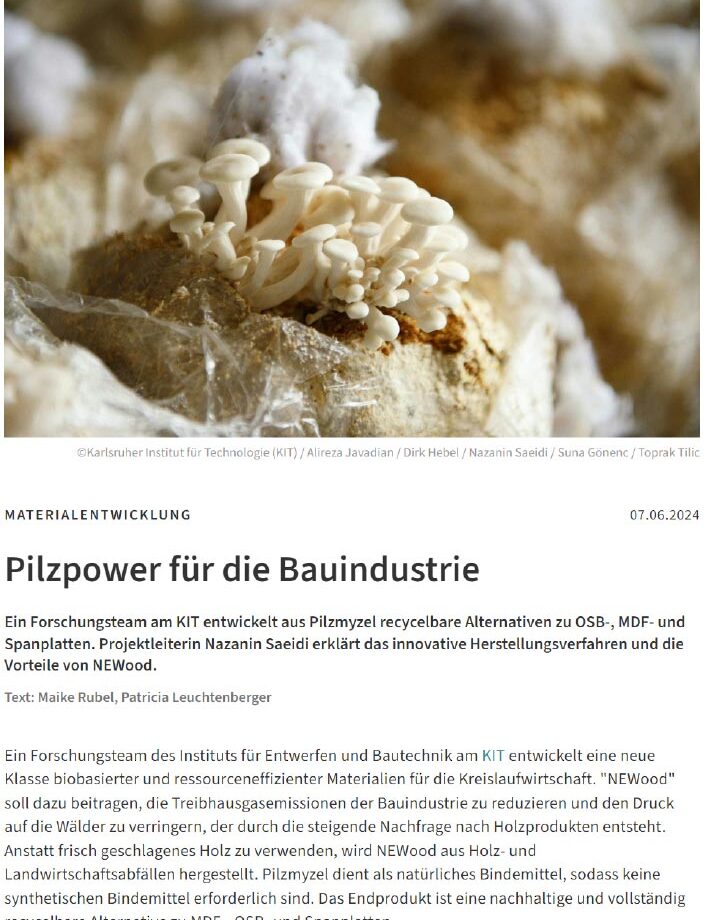
Interview: Mycelium power for the construction industry

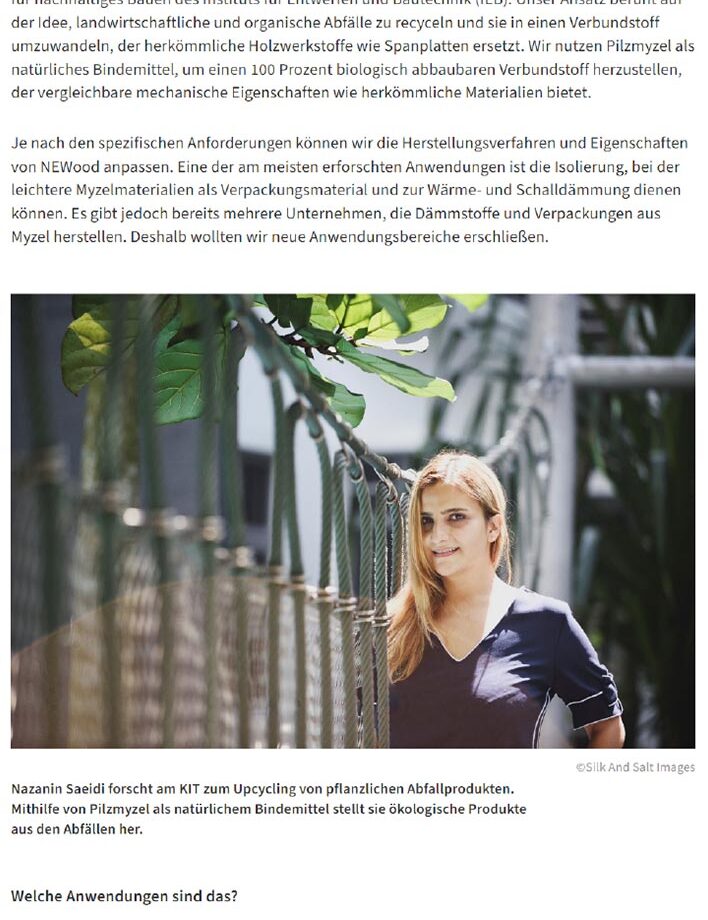
Nazanin Saeidi in an interview with Maike Rubel and Patricia Leuchtenberger about the innovative manufacturing process and the advantages of NEWood as a recyclable alternative to wooden composite materials.


Interview: ‘Mycelium power for the construction industry’

Rubel, Maike, and Patricia Leuchtenberger. Interview: “Pilzpower für die Bauindustrie.” competitionline, 7 June 2024, https://www.competitionline.com/de/news/schwerpunkt/pilzpower-fuer-die-bauindustrie-7283.html.


Urban Mining Student Award – Announcement of the shortlist

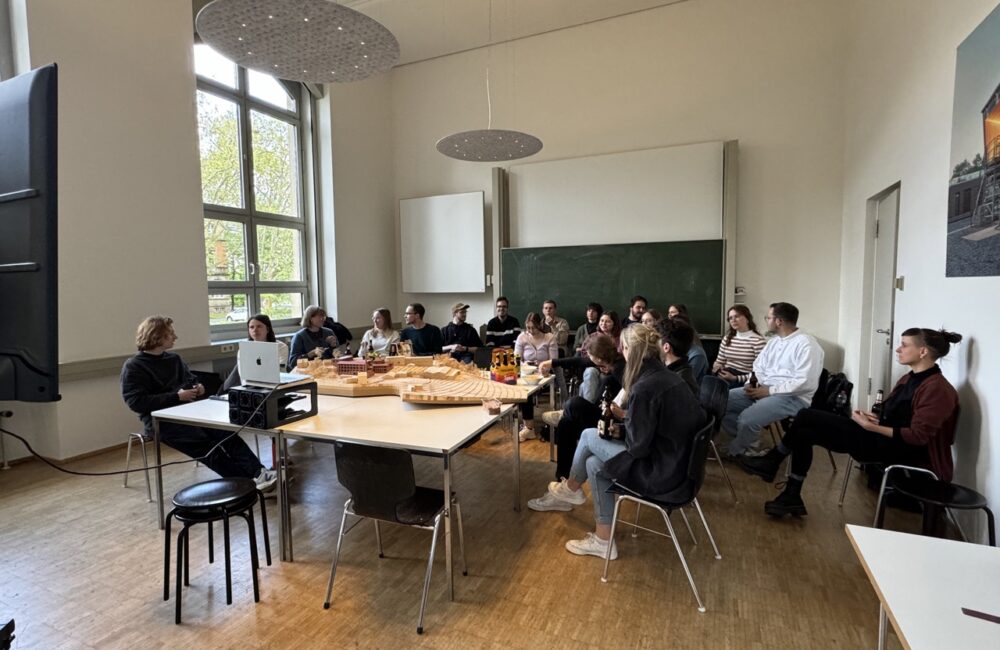
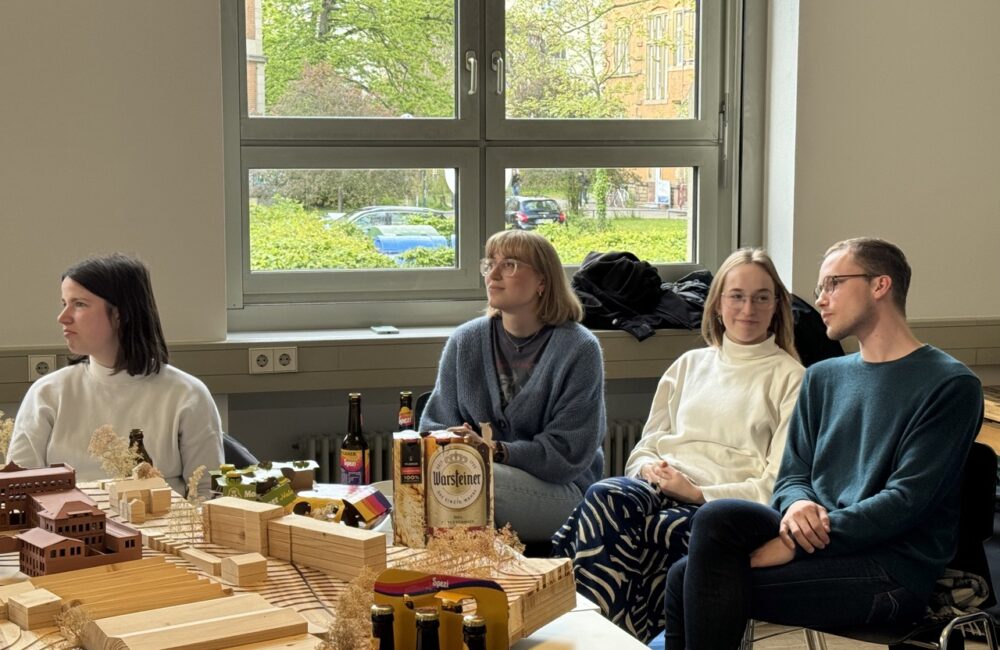
On 24 April 2024 at 6 pm, the UMSA shortlist was announced at the Haspel campus in lecture theatre 00.01. All participants of the competition, the supervising university teachers and relatives were invited to this event.

The event was broadcast online and KIT organised a public viewing for and with the students. Three out of six people on the shortlist have developed a design for the old lace factory in Wuppertal at KIT in the winter semester 2023/24: We warmly congratulate Nils Benkeser, Frederik Busch and Maximilian Weiß.

The official award ceremony with the announcement of the winners will take place on 3 May 2024 at 5 pm at the Schwebodrom Wuppertal (Werth 96, 42275 Wuppertal). Guests at the award ceremony will be greeted with welcome drinks and canapés. Afterwards, all visitors will be offered a VR tour of the Schwebodrom. The official award ceremony will begin at around 6 p.m. with the announcement of the winners, after which the winners will be invited to a dinner together at the Cafe Schimmerlos event location (Friedrich-Ebert-Straße 85, 42103 Wuppertal).


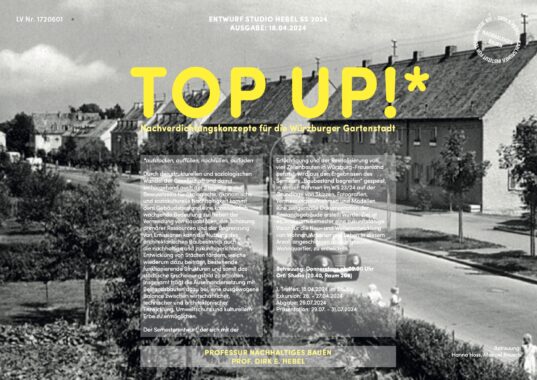
Design Studio Hebel: TOP UP!*

Redensification concepts for Würzburg-Gartenstadt

*to add, to fill, to refill, to recharge

Due to the structural and sociological changes in society and the associated increase in awareness of ecological, economic and socio-cultural sustainability, existing buildings are becoming increasingly important. In addition to avoiding construction waste, conserving primary resources and limiting emissions, the use of existing architectural buildings can also promote the sustainable and future-oriented development of cities, which in turn helps to preserve existing functioning structures and thus the urban appearance. Overall, dealing with existing buildings helps to achieve a balance between economic, technical and architectural development, environmental protection and cultural heritage. 

The semester design, which deals with the refurbishment and revitalization of four row buildings in Würzburg-Frauenland, is fed by the results of the seminar “Understanding existing buildings”, in which a contemporary documentation of the existing buildings was created in WS 23/24 on the basis of sketches, photographs, surveys and models. The aim of this semester is to develop a sustainable vision for the new and further development of living, working and living in this area, connected to the entire residential neighbourhood.

Supervised by: Hanna Hoss, Manuel Rausch

Supervision: Wednesday afternoons, Thursdays
Location: Studio (20.40, room 208)
1st meeting: 18.04.2024 in our studio
Excursion: 26. – 27.04.2024
Submission: 26.07.2024, 12.00
Presentation: 30.07.2024 and 31.07.2024


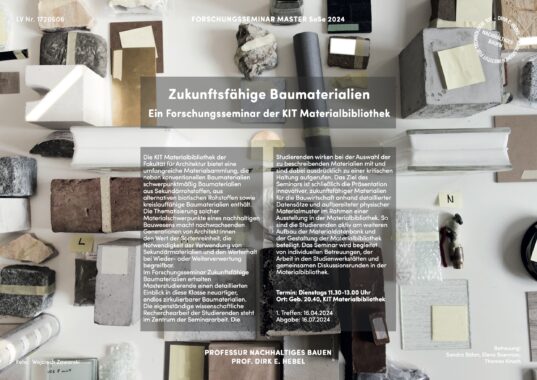
Research Seminar Master: Future-oriented Building Materials

A Research Seminar of the KIT Material Library

The KIT Materials Library of the Faculty of Architecture offers an extensive collection of materials that, in addition to conventional building materials, focuses on building materials made from secondary raw materials, alternative biotic raw materials and recyclable building materials. 

Addressing such material focal points of sustainable construction makes future generations of architects understand the value of varietal purity, the necessity of using secondary materials and the preservation of value when reused or recycled.

In the research seminar Future-oriented Building Materials, Master’s students gain a detailed insight into this class of innovative, endlessly recyclable building materials. The independent scientific research work of the students is at the heart of the seminar work. The students are involved in the selection of the materials to be described and are explicitly called upon to adopt a critical stance. The final aim of the seminar is to present innovative, sustainable materials for the construction industry using detailed data sheets and prepared physical material samples as part of an exhibition in the materials library. Students are thus actively involved in the further development of the materials database and the collection of the materials library. The seminar is accompanied by individual supervision, work in the study workshops and joint discussion rounds in the materials library.

Supervised by: Sandra Böhm, Elena Boerman

Date: Tuesdays 11.30-13.00
Location: KIT Material Library, 20.40, Room 141
1st meeting: 16.04.2024
Exam: 16.07.2024


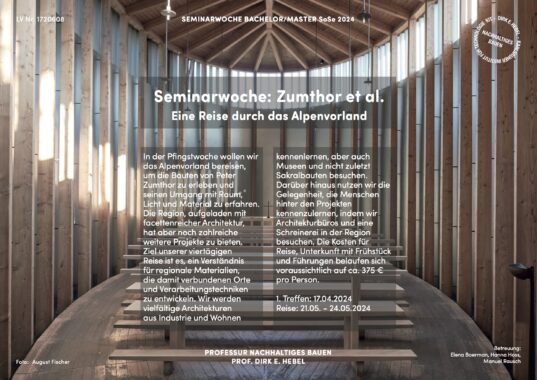
Seminar week: Zumthor et al.

A journey across the Alpine region

During Whitsun week, we want to travel to the Alpine foreland to experience Peter Zumthor’s buildings and his work with space, light and material. The region, rich in diverse architecture, has numerous other projects to offer. Our aim during the four days of our trip is to develop an understanding of regional materials, the places associated with them and processing technologies.

We will get to know multifaceted industrial and residential architecture, but also visit museums and, last but not least, religious buildings. In addition, we will take the opportunity to meet the people behind the architecture by visiting architectural offices and a carpentry workshop in the region.

The cost for travel, accommodation with breakfast and programme is estimated at around €375 per person.

Supervised by: Prof. Dirk E. Hebel, Elena Boerman, Hanna Hoss, Manuel Rausch

First Meeting: 17.04.24, 11.30 am, building 11.40, Raum 26
Excursion: 21.05.2024 – 24.05.2024


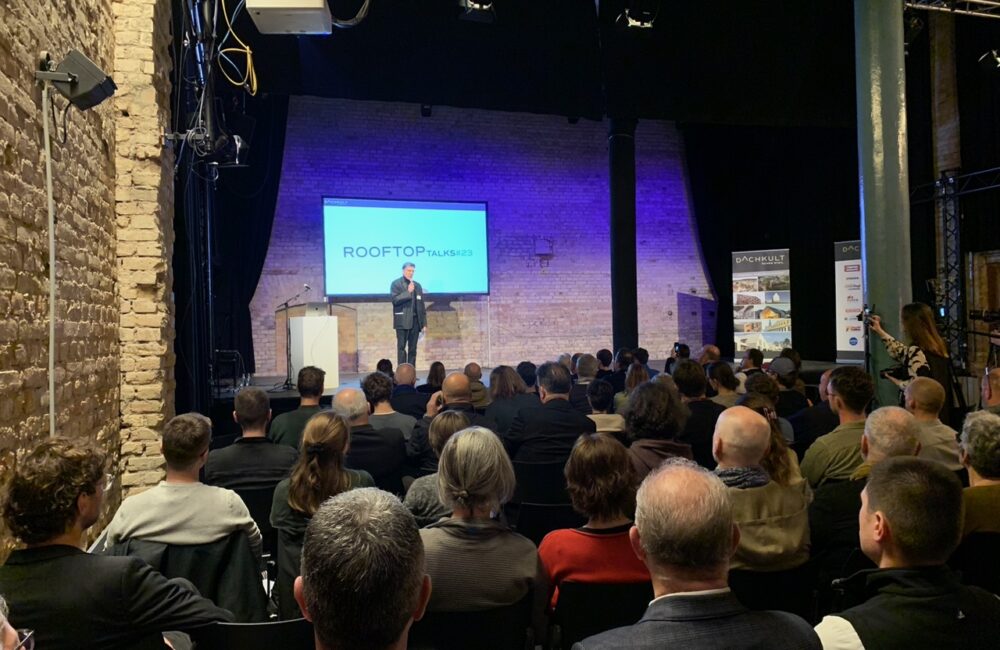
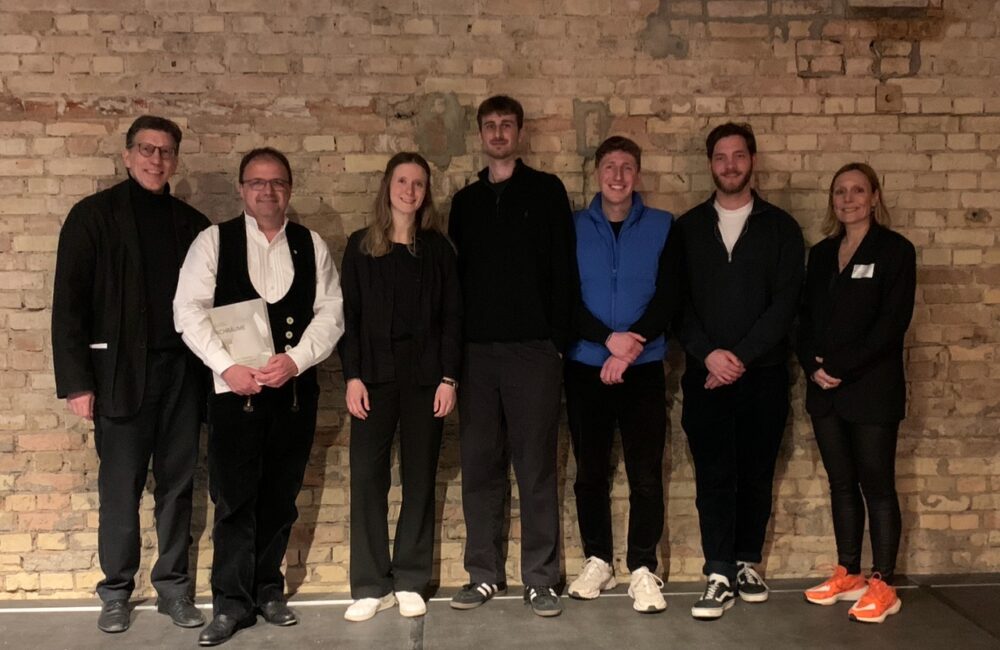
Rooftop Talks #23 “Modular up to the roof” on March 21st with Elena Boerman

© Nadja Lowitzsch, Dachkult

The federal and state governments have agreed on a “construction turbo pact” to speed up planning and approval processes. Industrial production methods should make building cheaper and approval procedures faster: “In order to further promote this form of building, the federal states will regulate that once type approvals for serial, modular and systemic construction have been granted, they will be valid nationwide,” writes the Federal Building Ministry BMBSW. An occasion for the initiative Dachkult to take a look at outstanding architecture that is modularly planned right up to the roof.

The event took place on March 21st in the Kulturzentrum Tempel in Karlsruhe. The Heilbronn office of Joos Keller Architekten has won the Hugo Häring Prize with its modularly designed Bernhäusle children’s garden – Thomas Heyd, Managing Director of Zimmerei Heyd, took a look behind the scenes of production. The KIT team led by Prof Dirk E. Hebel has won the Solar Decathlon Europe with a modularly developed roof extension – Elena Boerman, Researcher/Sustainable Construction at KIT Karls- ruhe presents the design and process. The winners of the Dachwelten 2023 competition from Würzburg Schweinfurt University of Applied Sciences also impressed with a modular roof extension.

In addition to speed and cost certainty, modular construction offers another advantage: circularity – a requirement for which the pitched roof is particularly suitable in its basic structure.

© Nadja Lowitzsch, Dachkult

Click here to see more impressions and videos of the event soon.


Building Better – Less – Different: Clean Energy Transition and Digital Transformation

Hebel, Dirk E., Felix Heisel, Andreas Wagner, und Moritz Dörstelmann, Hrsg. Besser Weniger Anders Bauen – Energiewende und digitale Transformation. Besser Weniger Anders Bauen 2. Basel: Birkhäuser Verlag GmbH, 2023.


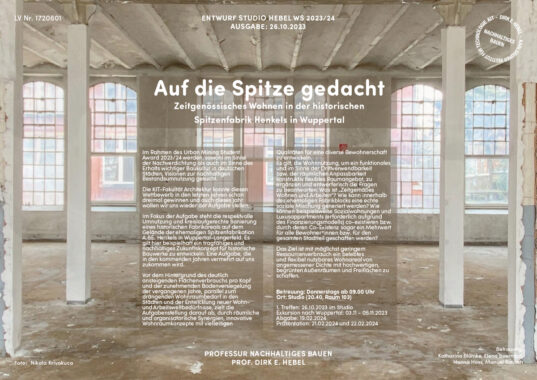
Design Studio Hebel: Thought to the point

Contemporary living in the historic Henkels lace factory in Wuppertal

As part of the Urban Mining Student Award 2023/24, visions for the sustainable use of existing buildings are being sought, both in the sense of redensification and in the sense of preserving important building culture in German cities. The KIT Faculty of Architecture has already won this competition three times in recent years and this year we want to take on the task again.

The focus of the task is the respectful conversion and cycle-compatible redevelopment of a historic factory site on the grounds of the former lace factory A.&E. Henkels in Wuppertal-Langerfeld. The task here is to develop an exemplary, viable and sustainable future concept for historic buildings. This is a task that will increasingly face us in the coming years.


Against the background of the significant increase in land consumption per capita and the increasing soil sealing of recent years, parallel to the urgent need for housing in the cities and the development of new living and working environment requirements, the task aims to develop innovative housing concepts with versatile qualities for a diverse population through spatial and organisational synergies.

The aim is to complement the residential use with a functional and constructively flexible range of spaces that can be used by third parties or adapted spatially, and to answer the design questions: What is “contemporary living and working”? How can a real social mix be generated within the former factory block? How can, for example, social housing and luxury apartments (necessary due to the financing model) co-exist or even create added value for all residents or for the entire district through their co-existence? The goal is to create a lively and flexibly usable residential area of appropriate density with high-quality, greened outdoor spaces and open spaces using as few resources as possible.

Supervised by: Katharina Blümke, Elena Boerman, Hanna Hoss, Manuel Rausch

Supervision: Wednesday afternoons, Thursdays
Location: Studio (20.40, room 103)
1st meeting: 26.10.2023 in our studio
Excursion to Wuppertal: 03.11 – 05.11.2023
Submission: 16.02.2024, 12.00
Presentation: 21.02.2024 and 22.02.2024


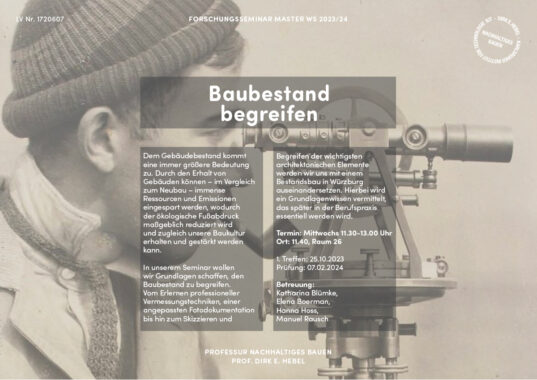
Seminar Master: Understanding the existing building stock

Research Seminar / Sustainable Construction

The building stock is becoming increasingly important. Through the preservation of buildings – compared to new construction – immense resources and emissions can be saved, which significantly reduces the ecological footprint and at the same time preserves and strengthens our building culture.

In our seminar we want to lay the basics for understanding the existing building stock. From learning professional measuring techniques and adapted photo documentation to sketching and understanding the most important architectural elements, we will look at an existing building in Würzburg. In the process, a basic knowledge is taught that will later become essential in professional practice.

Supervised by: Katharina Blümke, Elena Boerman, Hanna Hoss, Manuel Rausch

Date: Wednesdays 11.30-13.00
Location: 11.40, Room 26
1st meeting: 25.10.2023
Exam: 07.02.2024


Book release: Building Better – Less – Different: Clean Energy Transition and Digital Transformation

Cover © Birkhäuser Verlag GmbH, Basel 2023

Sustainability is to become the guiding principle of social action and economic activity. At the same time, its ways and means are far from clear. As a holistic praxis, sustainability must combine technical and material as well as social, economic, ecological and also ethical strategies, which have multiple complex interactions and all too often also conflicting goals and priorities. In no other field can these be better observed, addressed and influenced than in architecture and building.

Each volume of “Building Better – Less – Different” details two fundamental areas of sustainability and explores their specific dynamics and interactions. After introductory overviews, innovative methods and current developments are described and analysed in in-depth essays, international case studies and pointed commentaries. The sustainability criteria of efficiency (“better”), sufficiency (“less”) and consistency (“different”) form the framework for each book.

The clean energy transition and digital transformation are essential components of a fundamental shift towards circular construction with significantly lower impacts on the environment and climate. Building design and construction measures become part of a holistic energy concept spanning the entire life cycle. Digital construction technologies offer a means of reinterpreting natural building materials. The mass customization of tailor-made building components minimizes resource consumption. These form the foundations for a profound transformation of the architecture, construction and engineering industries.

Editors: Dirk E. Hebel, Felix Heisel with Andreas Wagner, Moritz Dörstelmann


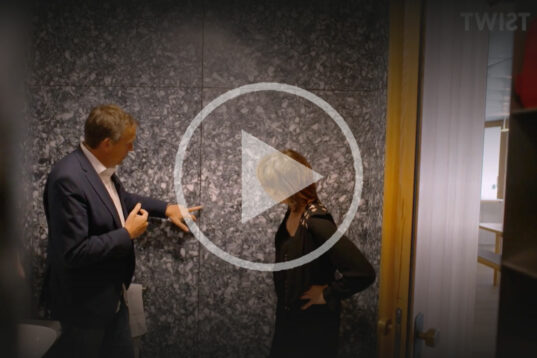
arte: Twist – Will AI soon be building our homes?

Will AI soon be building our houses? Artificial intelligence is also taking the architecture industry by storm. The internet is full of AI-generated fantasy architecture. Software generates images of houses and interiors from text commands that are real eye-catchers. And they do it in a matter of seconds. So will we soon no longer need architects? Or will AI become a useful tool?

Under the editorship of Anette Plomin, Prof. Dirk E. Hebel and other players in the construction industry are confronted with the issues of AI. Prof. Hebel sees the alternative in construction not primarily in AI, but in the recycling of building materials. In Zurich, he uses the Urban Mining and Recycling Unit to show what a flat could look like that is completely recyclable and compostable. He can also well imagine using AI to better manage building materials and resources in the future, but for him it is clear that only humans can initiate the great processes of change in terms of sustainable and future-oriented building.

© NDR arte, 2023


Online Panel Discussion of FNR

Daniela Schneider, doctoral student at the KIT Sustainable Building Professorship, will be taking part in an online panel discussion on the topic of “Cycle-efficient timber building system solutions” at the themed afternoons on timber construction organised by the Agency for Renewable Resources (FNR) on 15 November 2023.

More information about the event here.


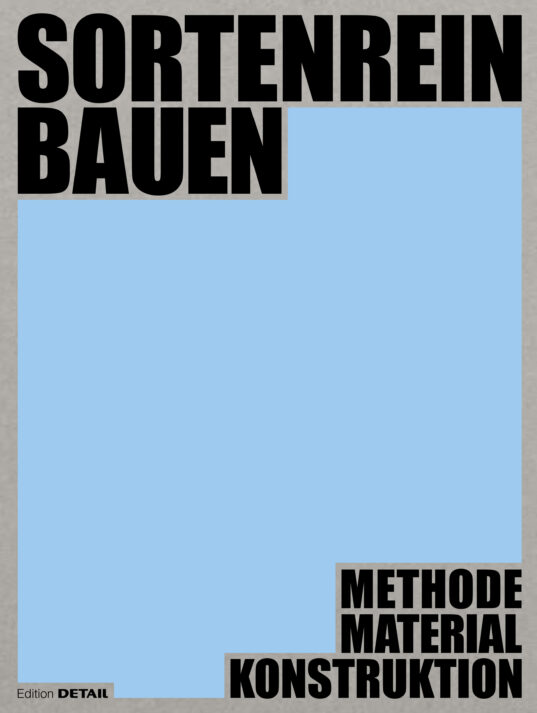
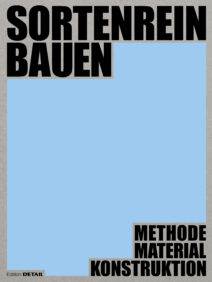
Book release: Building Circular – Method Material Construction

Cover: DETAIL Business Information GmbH, München 2023

Full landfills, ambitious climate targets: By 2050, the European Union wants to introduce a comprehensive circular economy. For the turnaround in construction to succeed, material resources must be fully reused and recycled. Pure and low-polluting building materials that are used in reversible component connections and are simply joined are the basic prerequisite for the circular construction of buildings. This handbook explains how to design and build according to the closed-loop principle. It shows the history and present of cycle-oriented architecture and analyses the basics of single-variety construction with regard to methodology, materials and construction. Joining and connecting techniques are discussed as well as the choice of materials in general and the life cycles of individual layers and their functions. The extensive detailed catalogue with drawings on a scale of 1:20 documents exemplary applications and connections, which are differentiated according to materials.

Editors: Dirk E. Hebel, Ludwig Wappner, Katharina Blümke, Steffen Bytomski, Valerio Calavetta, Lisa Häberle, Peter Hoffmann, Paula Holtmann, Hanna Hoss, Daniel Lenz, Falk Schneemann


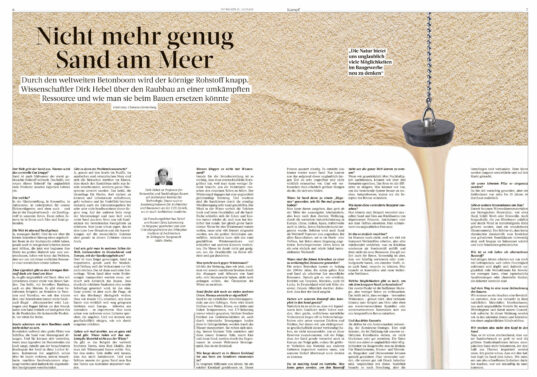
Frankfurter Rundschau: Not enough Sand on the Sea

Due to the worldwide concrete boom, the granular raw material is becoming scarce. In an interview with Clemens Dörrenberg of the Frankfurter Rundschau, Prof. Dirk E. Hebel talks about the overexploitation of an embattled resource and how it could be replaced in construction. The article appeared in the FR7 magazine of the Frankfurter Rundschau on 23/24 September 2023.

© Frankfurter Rundschau


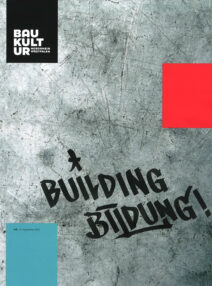
From hunting, breeding and harvesting future building materials

Hebel, Dirk E. “Vom Jagen, Züchten Und Ernten Zukünftiger Baumaterialien.” Baukultur Nordrhein Westfalen, September 2023.


Building Circular

Hebel, Dirk E., Ludwig Wappner, Katharina Blümke, Valerio Calavetta, Steffen Bytomski, Lisa Häberle, Peter Hoffmann, Paula Holtmann, Hanna Hoss, Daniel Lenz and Falk Schneemann, eds. Sortenrein Bauen – Methode Material Konstruktion. Edition DETAIL. München: DETAIL Business Information GmbH, 2023.


Fungi

Schweikle, Johannes. “Fungi.” In Earthlike, 1:70–75, 2023.


Recent Contributions in “wohnen”

Hebel, Dirk E. “Die Stadt als Rohstofflager.” wohnen – Zeitschrift der Wohnungswirtschaft Bayern, August 2023.

Hebel, Dirk E. “Das RoofKIT-Gebäude der KIT Fakultät für Architektur – Gewinner des Solar Decathlon 2021/22 in Wuppertal.” wohnen – Zeitschrift der Wohnungswirtschaft Bayern, August 2023.


Symposium “Biofrontiers: The Potential of Fungal-based Materials in Architecture”

Monday, October 9th, 2023
8:30 – 18:30 (CET)
Open Space 2 – Institute of Technology in Architecture (ITA ETH Hoenggerberg)

© Tobias Wootton

The one-day symposium is part of our work in the Future Cities Lab (FCL) research programme.

The event is being organized by the Block Research Group (ETH) and the chair of Digital Building Technologies (ETH), in collaboration with the chairs of Prof. Hortense Le Ferrand from NTU Singapore and Prof. Dirk Hebel from KIT Karlsruhe, with support from the Institute of Technology in Architecture (ITA) and ALIVE, and Holcim Foundation.

Our module BIO – Urban Biocycles Mycelium Digitalisation brings together researchers from the Block Research Group (ETH), the chair of Digital Building Technologies (ETH)Singapore (NTU), and Karlsruhe (KIT) to develop, utilize, and assess mycelium-bound composite materials in building construction.

This event aims to inspire new conversations regarding circularity in architecture and gauge the barriers and opportunities in utilizing bio-materials, with a focus on mycelium-based materials.

Each panel proposes a mix of experts in order to provide perspective on the industry and on the challenges and opportunities in utilizing mycelium-based materials in building construction and architectural applications

Please register now for our event – Registration, Lineup, and Schedule here: BIOFRONTIERS


The KIT Materials Library is reopened

The KIT Materials Library houses an extensive collection of material samples, whose haptic experience and critical assessment are of particular importance for the education of architects in our view. It offers the opportunity to learn about both established, well-known and new, innovative materials and technologies.

© Dominic Faltien

The extensive physical collection of material samples – and in the future also associated digital data sets – not only serves to deepen and illustrate the teaching of materials at the faculty, but also provides students with valuable assistance for working on exercises and in the design process. The material samples can be borrowed and used by students in the context of project developments and presentations.

During an evening event on 18 July 2023, the KIT Materials Library was finally ceremoniously reopened after a phase of restructuring and reconstruction. Prof. Dr. Alexander Wanner, KIT Vice President Teaching and Academic Affairs, Prof. Dr. Johannes Orphal, KIT Head of Natural and Built Environment, and Dr. Theo Mayer, Vice President R&D & Innovation Polymers, representing Wacker Chemie AG as sponsor, were invited as greeters. In addition, professors, employees and students of the KIT Faculty of Architecture, employees and responsible persons of some other KIT libraries as well as representatives of other universities, the Chamber of Architects and the manufacturing companies and sponsors of material samples took part in the event.

The KIT Materials Library is a central facility at the KIT Faculty of Architecture and is supervised by Sandra Böhm and Elena Boerman from the Sustainable Building Professorship (Prof. Dirk E. Hebel) and Thomas Kinsch.

© Dominic Faltien

In the KIT Materials Library, a special focus is placed on building materials that either originate from local availability or local production, that can be composted in the biological cycle or recycled in the technical cycle without loss of quality, or that consist of secondary, reused or recycled raw materials of the anthropogenic stock. These thematic focuses on important questions of the 21st century make the KIT Materials Library an international focal point for targeted research and teaching.

The Materials Library is intended to function as a vessel for knowledge storage and knowledge transfer regarding innovative building materials for the present and the future, in order to educate the new generation of visionary and interested young people who are able to think transdisciplinarily and scientifically and to act sustainably.

Within the framework of the cooperation “Material Library of German Universities MDH”, which currently already includes the Bergische Universität Wuppertal and the Münster School of Architecture and whose network will be expanded in the future to include other universities and colleges, the digital component to the material library, the material database, is being developed. This database will be set up, filled and maintained in cooperation with the other universities. In the future, it will also be openly accessible on the website of the KIT Materials Library and contain extensive data sets on the material samples of the Materials Library’s inventory.

Changing exhibitions in the KIT Materials Library provide information on specific topics, such as natural insulating materials, native wood species or recyclable materials. Student work from the subject of materials science (Bachelor’s degree) as well as from materials-specific research seminars (Master’s degree) is firmly integrated into the materials library, both digitally and physically. The students themselves are thus actively involved in expanding the materials library.

The premises of the KIT Materials Library can be used for seminars, workshops and lectures. In addition, there are three open workstations for students in the library gallery, which can be used for further research.

As a central facility of the KIT Faculty of Architecture, the KIT Materialbiblitohek helps our students to critically and intensively deal with the goals and challenges, with the present and the future of construction.

More information about the KIT Materials Library here.


Karlsruher Institut für Technologie
Fakultät für Architektur
Institut Entwerfen und Bautechnik

Professur Nachhaltiges Bauen
Englerstr. 11, Geb. 11.40, Raum 25
D-76131 Karlsruhe
 
Tel: +49 (0)721/608-42167


Recent Publications:  
 

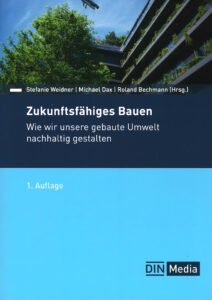
    Sustainable Construction. How we are shaping our built environment in a sustainable way.

    May 7, 2026

    Hebel, Dirk E., and Elena Boerman. “Projektstudie 2 (Schwerpunkt: Materialien): Der Kreislaufbasierte Architekturansatz.” In Zukunftsfähiges Bauen – Wie Wir Unsere Gebaute Umwelt Nachhaltig Gestalten, 64–78. Berlin: DIN Media Innovation, 2026.


    Circular! Foundations and principles of a circular construction industry.
    March 11, 2026

    Hebel, Dirk E., and Annette Hillebrandt, eds. 2026. Zirkulär! Fundamente und Postulate einer kreislaufbasierten Bauwirtschaft. Bauwelt Fundamente. Birkhäuser Verlag GmbH.


    A matter of consequence

    March 11, 2026

    Deutsches Architekt:innen Blatt. 2026. “Eine Frage der Konsequenz.” March.


    Circular Construction. Regenerative Building material management.

    January 8, 2026

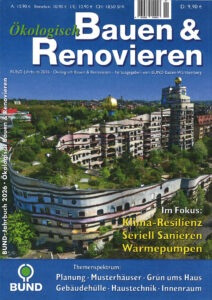
    Steiff, Peter. “Zirkuläres Bauen. Regeneratives Baustoff-Management.” BUND Jahrbuch 2026, January 2026.


    Wood as a foundation of a sustainable building culture

    January 8, 2026

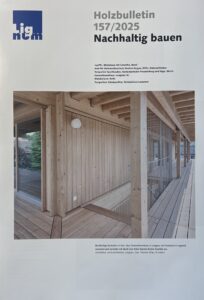
    Glanzmann, Jutta. “Holz Als Basis Für Eine Nachhaltige Baukultur.” Lignum Holzbulletin 157/2025, no. Nachhaltig bauen (2025): 4058–59.


    MycoTree

    January 5, 2026

    McLean, Will, Pete Silver, and Dirk Hebel. “MycoTree.” In Sustainable & Regenerative Materials for Architecture – A Source Book. 2025; Laurence King, 2025.


    Really Circular – Material Library at KIT

    October 29, 2025

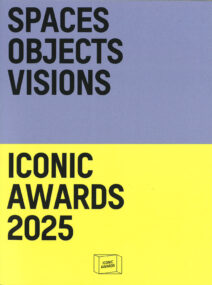
    Dietzold, Lutz, ed. Iconic Awards 2025 – Spaces Objects Visions. Frankfurt: Rat für Formgebung GmbH, 2025.


    Activating the Urban Mine

    October 2, 2025

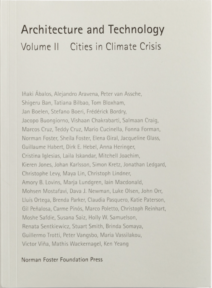
    Hebel, Dirk E. “Activating the Urban Mine.“ In Architecture and Technology Volume II: Cities in Climate Crisis. Madrid: Norman Foster Foundation Press, 2025.


    The city as a resource

    September 18, 2025


    Hebel, Dirk E. und Felix Heisel. “Die Stadt als Ressource.” In Für eine nachhaltige Architektur der Stadt. Berlin: Verlag Klaus Wagenbach, 2025.


    From a linear to a circular system

    September 15, 2025

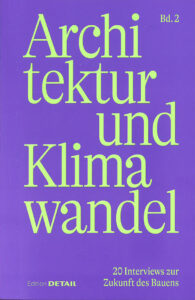
    Hebel, Dirk E. “Vom Linearen Zum Kreislaufsystem.” In Architektur Und Klimawandel. München: Edition DETAIL, 2025.


    Interview: “We must finally start measuring CO2 emissions – not just how thick the insulation is”

    July 29, 2025

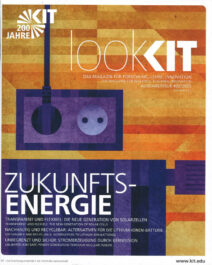
    Hebel, Dirk E. Interview: “Wir müssen endlich anfangen, den CO2-Ausstoß zu messen – nicht nur, wie dick die Dämmung ist.” Interview by Christoph Karcher. LooKIT 0225, 2025.


    WEtransFORM – On the Future of Building

    June 22, 2025

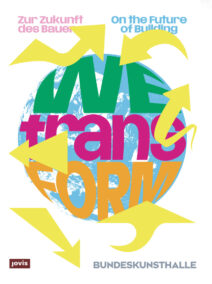
    BUNDESKUNSTHALLE, ed. WEtransFORM – Zur Zukunft Des Bauens. Berlin: jovis Verlag, 2025.


    Henkels Wuppertal

    June 4, 2025

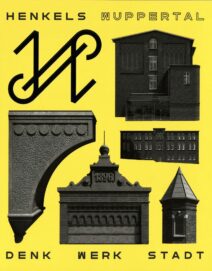
    Renaissance AG, ed. Henkels Wuppertal – DenkWerkStadt. Wuppertal: renaissance Immobilien und Beteiligungen Aktiengesellschaft, 2025.


    Building for the world of tomorrow

    April 24, 2025

    Monkenbusch, Helmut. „Bauen für die Welt von morgen.“ Hörzu, 24.1.2025


    Funghi – underground networkers

    April 24, 2025

    Hebel, Dirk E., Tanja Hildbrandt. „ Pilze – Netzwerker im Untergrund“. alverde, dm-Magazin, April 2025.


    Fungi are versatile

    February 24, 2025

    Merkert-Andreas, Carolin. “Pilze Sind Vielseitig.” Wohnglück, January 2025.


    “RoofKIT – Carbon storage and Material storage”

    January 9, 2025

    Boerman, Elena, and Dirk E. Hebel. “RoofKIT – Kohlenstoffspeicher Und Materiallager.” Architektur.Aktuell, vol. 12.2024, no. Tradition und Innovation, Dezember 2024, pp. 98–109


    The many applications of mycelium construtction

    December 8, 2024

    Grossarth, Jan. „Exkurs: Die vielen Einsatzbereiche von Myzel im Bauwesen“. In Bioökonomie und Zirkulärwirtschaft im Bauwesen, eine Einführung, 174–117. Wiesbaden: Springer Fachmedien, 2024.


    Interview: “From a Linear to a Circular System”

    November 13, 2024

    Hebel, Dirk E. Interview: “Vom linearen zum zirkulären Kreislaufsystem.” Interview by Sandra Hofmeister, DETAIL 11.2024, Nov. 2024.


    Building with renewable materials – Nature as a resource depot

    October 29, 2024

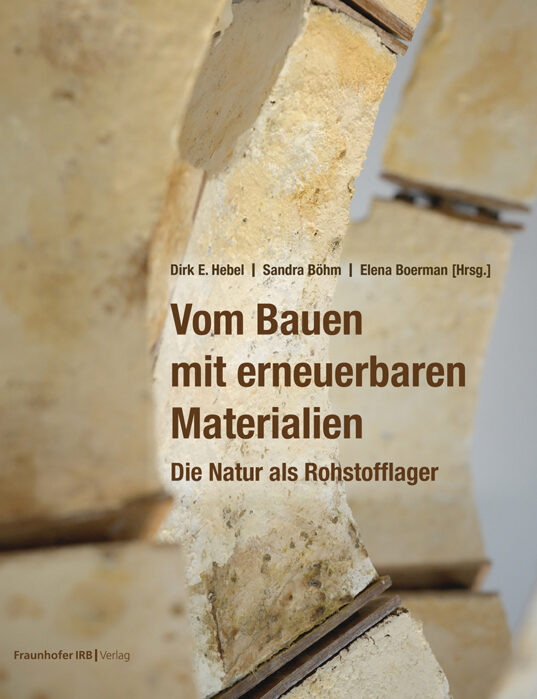
    Hebel, Dirk E., Sandra Böhm, Elena Boerman, Hrsg. Vom Bauen mit erneuerbaren Materialien – Die Natur als Rohstofflager. Stuttgart: Fraunhofer IRB Verlag, 2024.


    Guest contribution: ‘Thinking, designing and operating in circular ways.’

    June 27, 2024

    Hebel, Dirk E. “In Kreisläufen denken, entwerfen und wirtschaften.” MÄG – Mein Häfele Magazin, 2024.


    Interview: ‘Mycelium power for the construction industry’

    June 10, 2024

    Rubel, Maike, and Patricia Leuchtenberger. Interview: “Pilzpower für die Bauindustrie.” competitionline, 7 June 2024, https://www.competitionline.com/de/news/schwerpunkt/pilzpower-fuer-die-bauindustrie-7283.html.


    ‘Future building materials: mushroom, hemp and algae’ in neubau kompass

    May 27, 2024

    Müller, Janek. “Baumaterialien der Zukunft: Pilze, Hanf und Algen.” neubau kompass – Neubauprojekte in Deutschland, May 3, 2024. https://www.neubaukompass.de/premium-magazin/.


    Interview: ‘We have disposed of valuable materials’

    May 7, 2024

    Sören, S. Sgries. “Interview: ‘Wir haben wertvolle Materialien weggeworfen.’” Rhein-Neckar-Zeitung, April 27, 2024, SÜDWEST I 28 edition, sec. Sinsheimer Nachrichten.


    Built on mushroom

    April 24, 2024

    Schweikle, Johannes. “Auf Pilz gebaut.” Stuttgarter Zeitung, April 23, 2024, sec. Die Reportage.


    Organic Architecture – Fungus mycelium and flax as materials for the ecological building transition

    February 13, 2024

    Klaaßen, Lars. “Organische Architektur – Pilzmyzel und Flachs als Materialien für die ökologische Bauwende.” In Deutsches Architektur Jahrbuch 2024, edited by Peter Cachola Schmal, Yorck Förster, and Christina Gräwe, 198–209. Berlin, Germany: DOM publishers, 2024.


    Circular construction – Circulation instead of demolition in “BUND-Jahrbuch 2024”

    January 18, 2024

    Streiff, Peter. “Zirkuläres Bauen – Kreislauf statt Abriss.” BUND-Jahrbuch – Ökologisch Bauen & Renovieren 2024, January 2024.


    Redesigned Material Library at KIT in ‘Mitteilungsblatt des VDB-Regionalverbands Südwest’

    January 8, 2024

    Mönnich, Michael, and Sandra Böhm. “Neu gestaltete Materialbibliothek am KIT.” Südwest-Info: Mitteilungsblatt des VDB-Regionalverbands Südwest Nr. 36 (2023), 2023.


    RoofKIT Wuppertal, Germany; Interview with Prof. Dirk Hebel

    November 20, 2023

    Hebel, Dirk E. “RoofKIT Wuppertal, Germany; Interview with Prof. Dirk Hebel: The aim is clear, we must forge the path ourselves.” In Sustainable Architecture & Design 2023/ 2024, edited by Andrea Herold, Tina Kammerer, and InteriorPark., 46–55. Stuttgart, Germany: av edition GmbH, 2023.


    The existing building stock is the future resource

    November 16, 2023

    Hebel, Dirk E. “Der Bestand ist die künftige Ressource – Den linearen Umgang mit Baumaterialien schnellstmöglich stoppen.” Planerin – Mitgliederfachzeitschrift für Stadt-, Regional- und Landesplanung, Oktober 2023.