RoofKIT: Award-winning vision from Karlsruhe
Baden-Württemberg Stiftung GmbH. “RoofKIT: Preisgekrönte Vision aus Karlsruhe.” PERSPEKTIVEN, October 2022.
Baden-Württemberg Stiftung GmbH. “RoofKIT: Preisgekrönte Vision aus Karlsruhe.” PERSPEKTIVEN, October 2022.
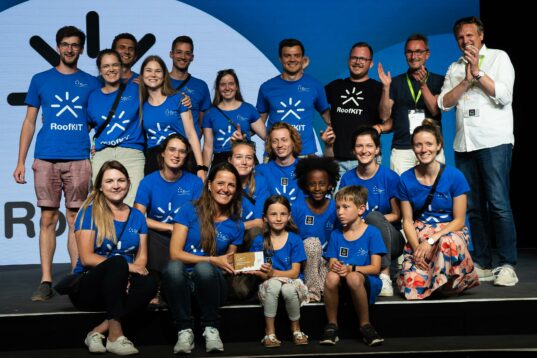
RoofKIT, the Karlsruhe winning project of the Solar Decathlon 2021/22 was re-located and re-errected in Karlsruhe on Wednesday 09 November 2022. Under the supervision of the project management, the wooden modules were dismantled in Wuppertal within two days, transported to Karlsruhe and now reassembled by the experienced carpenters of Kaufmann Zimmerei und Tischlerei in cooperation with the KIT Solar Decathlon team.
About the project:
The Karlsruhe Institute of Technology participated in the 2021/22 Solar Decathlon Competition in Wuppertal, Germany with its project RoofKIT. Designed as a top-up to an existing structure, it demonstrates a vision for the building industry: social adequate, energy positive and circular sustainable. Since 2020, more than 100 students from KIT within different faculties and under the leadership of the professorships of Sustainable Construction (Prof. Dirk E. Hebel) and Building Technologies (Prof. Andreas Wagner) worked on the project which cumulated in the construction of the House Demonstration Unit in May and June 2022 in Wuppertal, Germany.
For the next three years, the housing unit can be visited on the campus of the Karlsruhe Institute of Technology (Straße am Forum/Richard-Willstädter-Allee). Furthermore, from spring 2023 onwards, research projects subsequent to SDE 21/22 are planned by the Professorship of Building Technology in cooperation with the Professorship of Intelligent Living.
More information about RoofKIT here.
On Monday, 7 November, Dirk E. Hebel was invited to the Bundestag by Kassem Taher Saleh, Member of the German Parliament and Chairman of the Committee on Housing, Urban Development, Construction and Municipalities, to discuss which recommendations for political action can be derived from Dirk E. Hebel’s research. Mr Saleh, a civil engineer by profession and member of Bündnis 90/Die Grünen, was particularly interested in wood as a building material along the entire value chain (raw material availability and end-of-life scenarios) and strategies for a truely circular economy in the building sector.
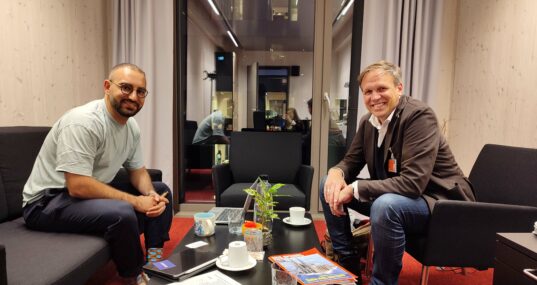
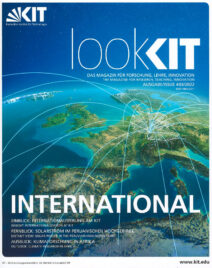
Justus Hartlieb, “Bauen Verbindet: Internationale Zusammenarbeit an der KIT-Fakultät für Architektur”, LookKITINTERNATIONAL, no. 03/2022 (November 2022).
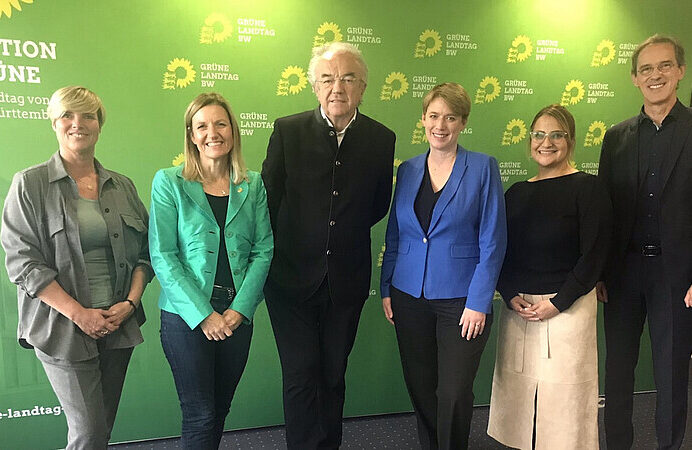
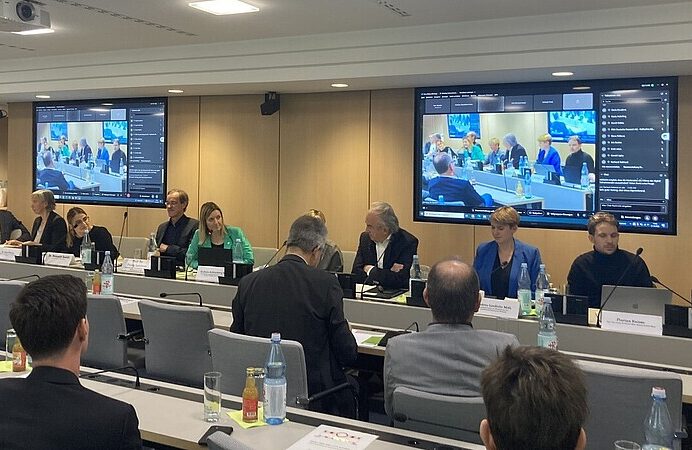
At the expert discussion on „Innovative and Sustainable Building Materials“ of the Green parliamentary group in the state parliament, to which Gudula Achterberg, member of the Heilbronn state parliament and member of the working group and committee on state development and housing, had invited on 21st October, science and practice met and identified future tasks for building and housing.
The speakers from science and research as well as from construction practice were united by the realisation that the current crises and global interdependencies can also accelerate developments in construction.
Keynote speaker Professor Werner Sobek received the Order of Merit of the Federal Republic of Germany in May as a thought leader for the built environment of tomorrow. The multi-award-winning engineer and architect insists on honest balancing when it comes to innovative and sustainable building materials: when it comes to the consumption of resources, be it sand, gravel, fossil fuels or precious metals. One of the other speakers advocated, for example, the introduction of a building type E for „experimental“ for lighthouse projects, for which simplified standards apply in order to facilitate innovation. Dr Anne Braune from the German Sustainable Building Council (DGNB) advocated the use of pure, sustainable building materials and suggested as a parameter for approval: My building should emit a certain amount of CO 2 per square metre per year. She advocated looking „in the package insert“ for building materials and for service life-adapted construction.
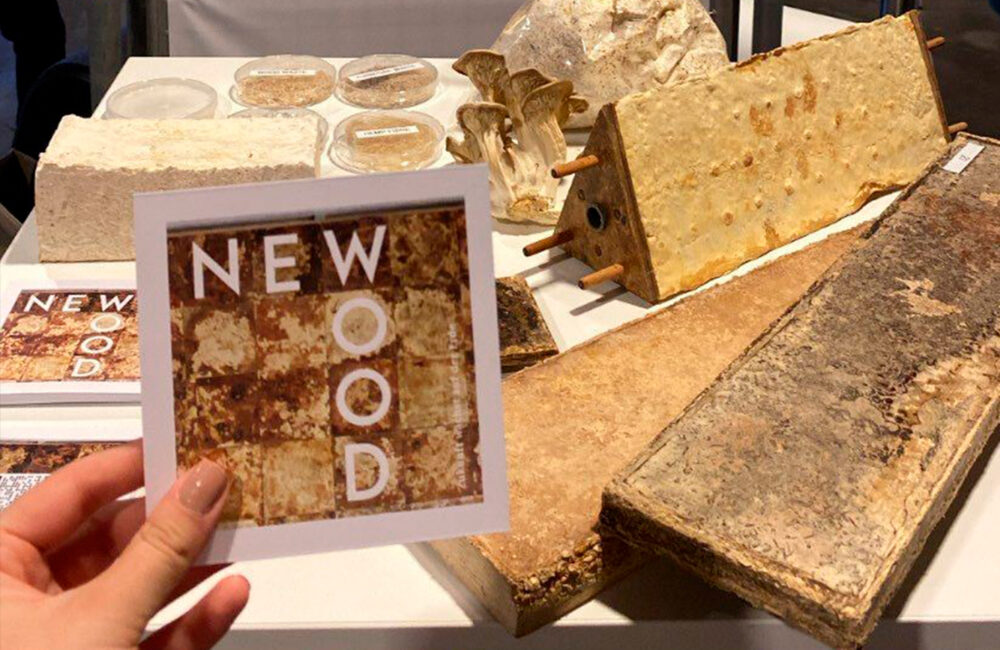
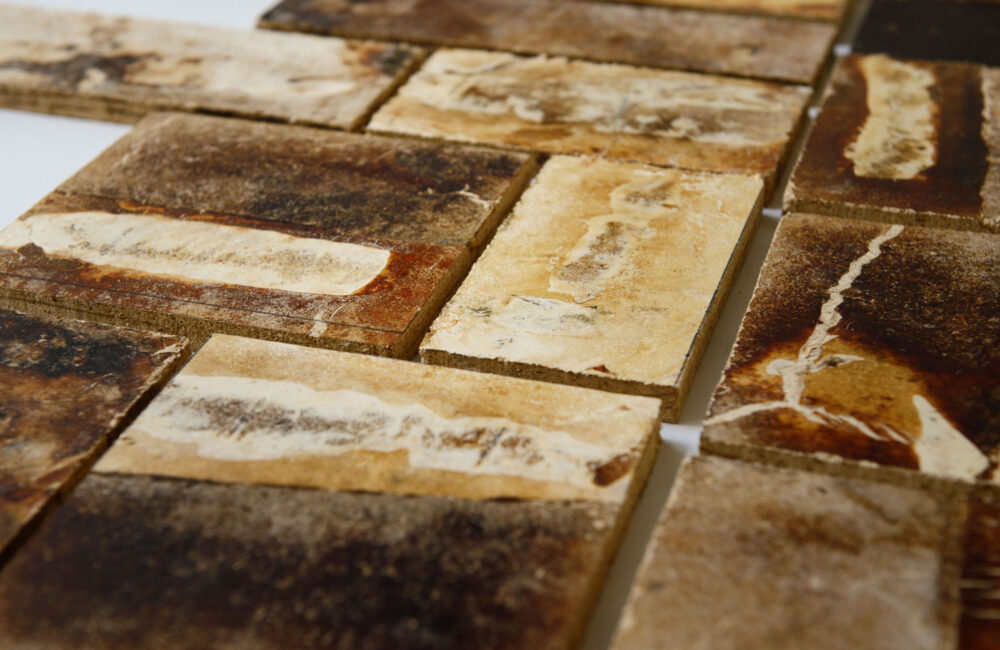
Dr Nazanin Saeidi, a researcher at the KIT Sustainable Building Professorship, presented an example of innovative building materials. Based on fungi, the award-winning material NeWood is suitable as a substitute for pressboard or for insulation. It is made from 100 per cent organic waste and is recyclable.
The event showed many developments that can and must revolutionise the way we build in the future. Nevertheless, the familiar and the tried and tested can help to overcome upcoming challenges in the construction industry.
The exhibition Plastic: Remaking Our World, which was initially on show at the Vitra Design Museum, will be on display at the V&A Dundee in Scotland from 29 October 2022. The contribution of the Sustainable Building Professorship will also travel from Weil am Rhein to Dundee.
Plastic: Remaking Our World will again feature prototypes, new technologies, and cutting-edge materials as designers grapple with a material that has changed our world.
The exhibition will feature product design, graphics, architecture and fashion from the collections of the V&A and Vitra Design Museum, as well as collections all over the world. This is the first exhibition produced and curated by V&A Dundee, the Vitra Design Museum and maat, Lisbon, with curators from V&A South Kensington.
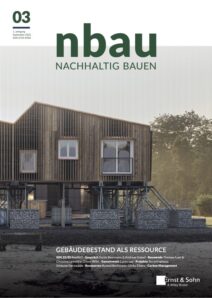
Lenz, Daniel, Elena Boerman, and Dirk E. Hebel. 2022. “Gebäudebestand als Ressource.” nbau, no. 03/2022 (Oktober). https://www.nbau.org/2022/10/12/gebaeudebestand-als-ressource/.

Two members of the RoofKIT team, Katharina Knoop and Johannes Hasselmann, had the opportunity to present the RoofKIT project and the Solar Decathlon at the Ingenieurgruppe Bauen (IGB) in Karlsruhe last Thursday.
All the listeners were very interested in the topics the two presented and were particularly impressed by the team spirit and the continuing enthusiasm and motivation. The event was able to show the company new perspectives for everyday work and planning.
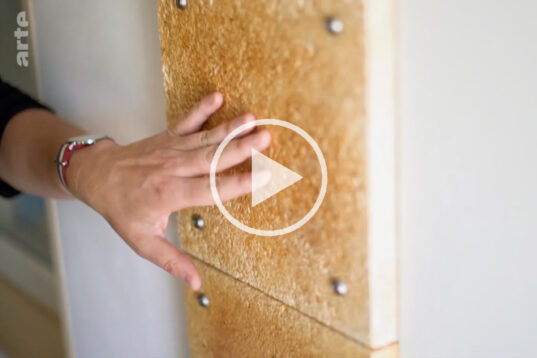
In this report, arte investigates the power of mushrooms and visits various actors. A Swiss mushroom expert, for example, wants to restore polluted soils. Researchers are also working together with students on a biological packaging material made from mushrooms. Mushroom leather or stable insulation and building materials are also examined in this episode of Re:.
The reporters also visit the Solar Decathlon in Wuppertal. Prof. Dirk E. Hebel explains why the mushroom, as a biologically renewable raw material, could become an important component of the future sustainable construction industry within planetary boundaries and in line with the European Green Deal.
Published in October 2022, edited by Dirk E. Hebel, Felix Heisel with Ken Webster


Sustainability is to become the guiding principle of social action and economic activity. At the same time, its ways and means are far from clear. As a holistic praxis, sustainability must combine technical and material as well as social, economic, ecological and also ethical strategies, which have multiple complex interactions and all too often also conflicting goals and priorities. In no other field can these be better observed, addressed and influenced than in architecture and building.
Each volume of “Building Better – Less – Different” details two fundamental areas of sustainability and explores their specific dynamics and interactions. After introductory overviews, innovative methods and current developments are described and analysed in in-depth essays, international case studies and pointed commentaries. The sustainability criteria of efficiency (“better’”), sufficiency (“less”‘) and consistency (‘different”) form the framework for each book.
The first volume “CIRCULAR BUILDING AND CIRCULAR ECONOMY” presents concepts, methods and examples of circularity in construction and the economy. Urban mining and circular construction are two approaches to the changes that architecture and urban design are facing, using techniques such as mono-material construction and design for disassembly, and tools such as material passports and databases. The circular economy is not solely about recycling but encompasses a wide range of strategies from local community projects to new ownership and service models and steering mechanisms such as carbon fees and dividends.
More information about the publication on www.degruyter.com.
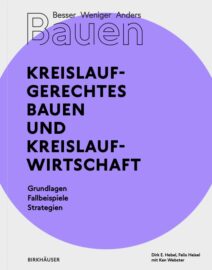
Hebel, Dirk E., Felix Heisel and Ken Webster, eds. Building Better – Less – Different: Circular Construction and Circular Economy. Building Better Less Different 1. Basel: Birkhäuser Verlag GmbH, 2022.
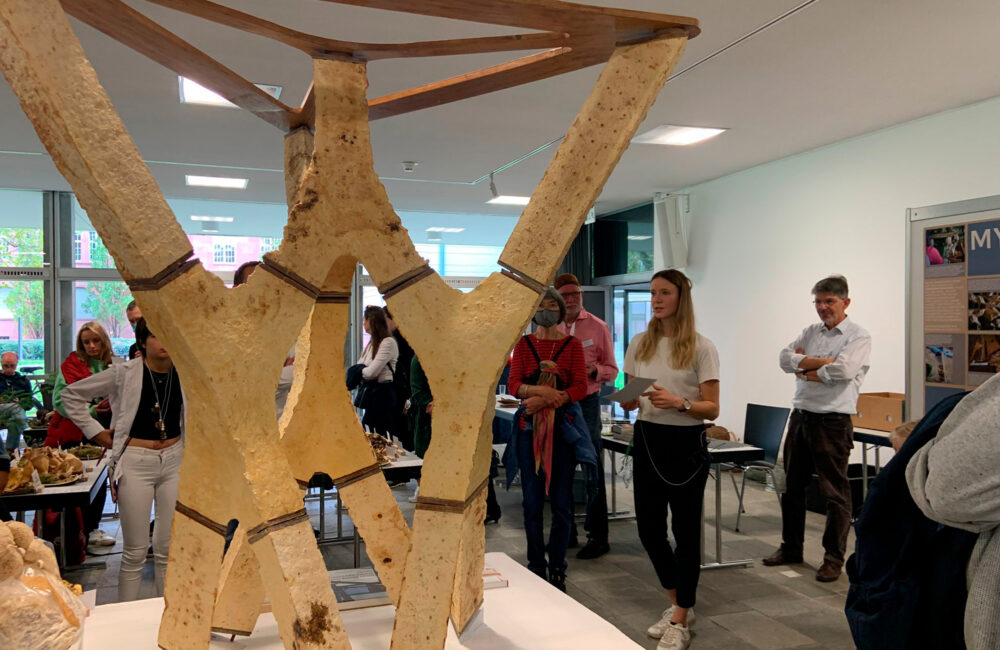
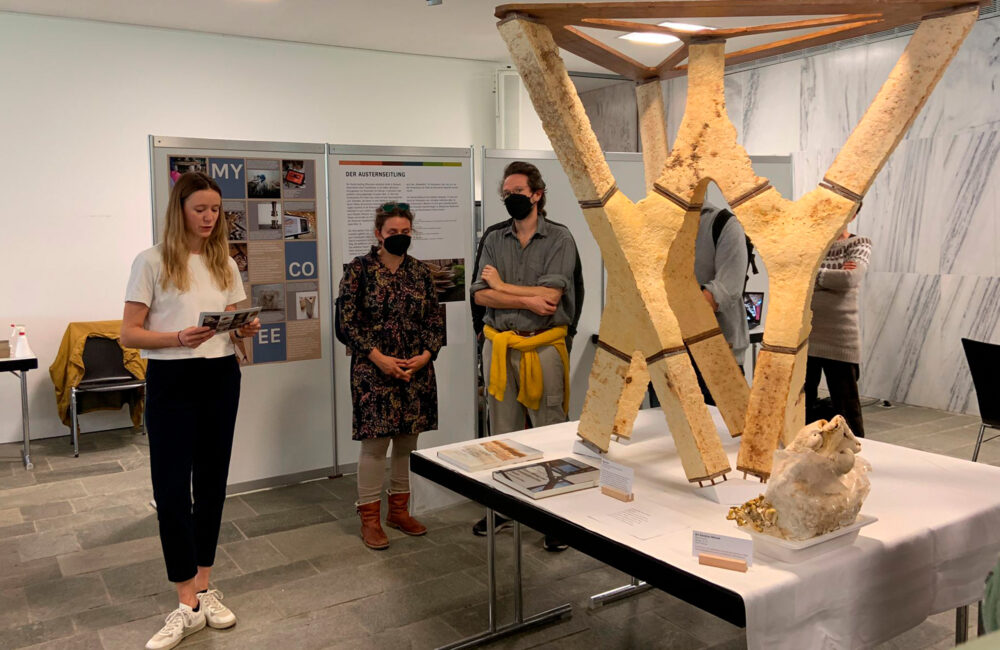
As part of the 17th „Karlsruher Frischpilzausstellung“ of the Natural History Museum in Karlsruhe, the MycoTree was exhibited in the pavilion in the Nymphengarten on the 8th and 9th October. The exhibition displayed 250-300 species of mushrooms and presented various literature on mushrooms. The weekend exhibition was visited by almost 1300 people interested in mushrooms.
The MycoTree, a spatial structure made of the cultivated materials mushroom mycelium and bamboo, supplemented the exhibition with the topic area ‚Building materials from natural resources‘. At 2 p.m. on both days, Sandra Böhm and Elena Boerman gave a short lecture on the exhibited project, which was created in 2017 as a cooperation project between the KIT Sustainable Building Professorship and the Block Research Group of ETH Zurich.
The assembled elements of the MycoTree can be disassembled again into their original materials and returned to the natural cycle as nutrients. In this way, it shows how digital design, technology and resource-saving materials could come together in the building industry in the future.
How can we build in an environmentally friendly way and redensify city districts in a sensible way? Süddeutsche Zeitung reports about the winning design of the Solar Decathlon 21/22.
The project was supervised by Prof. Dirk E. Hebel and Prof. Andreas Wagner at KIT.
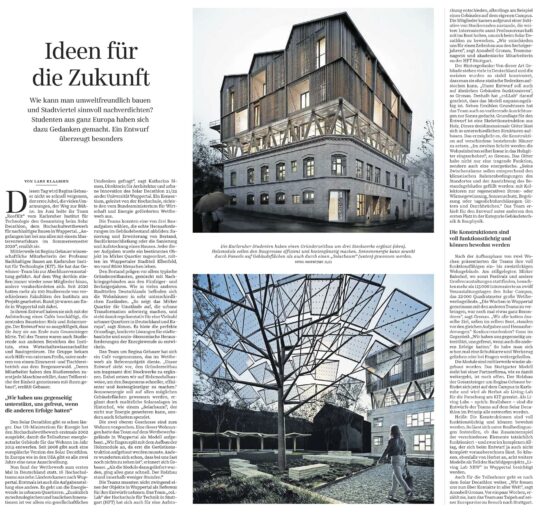
Mushrooms can be used to grow insulations or renewable „bricks“. This could lead to ecologically clean buildings in the future.
Welt am Sonntag reports about scientists like Prof. Dirk E. Hebel working in laboratories on the possibility of replacing metals or mineral materials with harvested materials like mycelium, the root network of mushrooms.
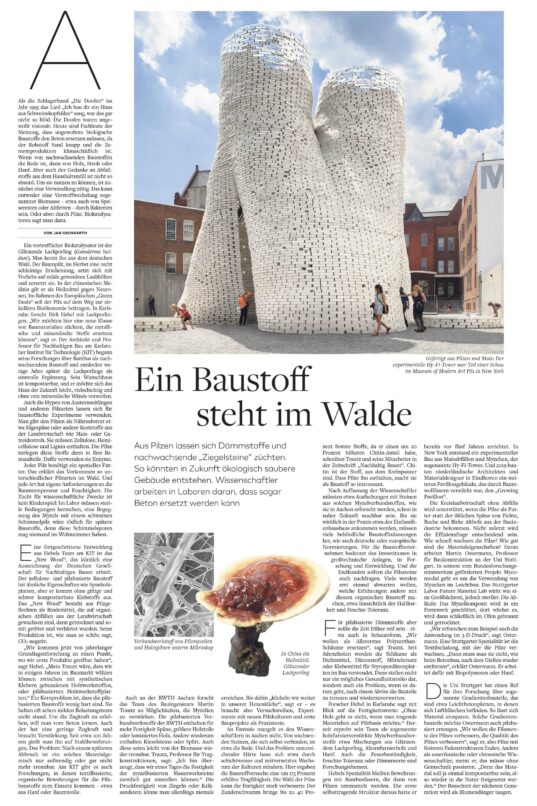
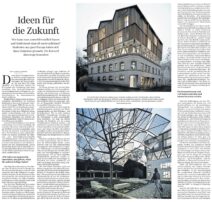
Klaaßen, Lars. 2022. “Ideen Für Die Zukunft.” Süddeutsche Zeitung, September 17, 2022.
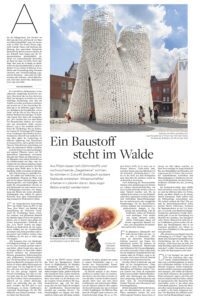
Grossarth, Jan. 2022. “Ein Baustoff Steht Im Walde.” Welt Am Sonntag, September 11, 2022.
Resource-efficient housing concepts for a growing city
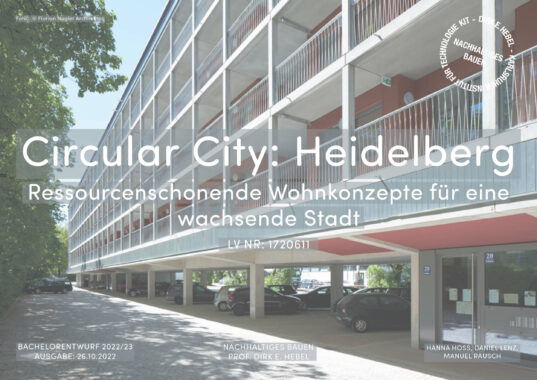
Cities play a crucial role in the struggle for a sustainable and climate-friendly future. This is where housing, production, trade, transport and energy consumption all come together. In addition, our cities are gigantic stores of raw materials. In some areas, the resources tied up in the current building stock have long since exceeded the raw material deposits that can be reached with reasonable effort in the earth’s crust. This urban mine needs to be tapped.
The city of Heidelberg has set itself ambitious sustainability goals and wants to lead the way as a pioneer of the circular economy in urban development and urban planning. To this end, among other things, the project „Circular City – Building Material Cadastre for the City of Heidelberg“ was launched, with which the city is relying on the urban mining principle. The building stock is being successively recorded and analyzed so that the data obtained can be made available to planners.
This semester, we will investigate how the application of circular building production and the use of materials from urban mining can succeed architecturally, using different design locations in Heidelberg.
The design will take place in collaboration with the integrated disciplines of structural engineering (Prof. Riccardo La Magna), FBTA (Prof. Andreas Wagner), and building economics (Hon. Prof. Kai Fischer).
1st meeting: 26.10.22 in the studio
Interim critique: 14./15.12.2022
Table critique: 25./26.01.2023
Submission/Presentation: 23.02.2023
A laboratory for future building
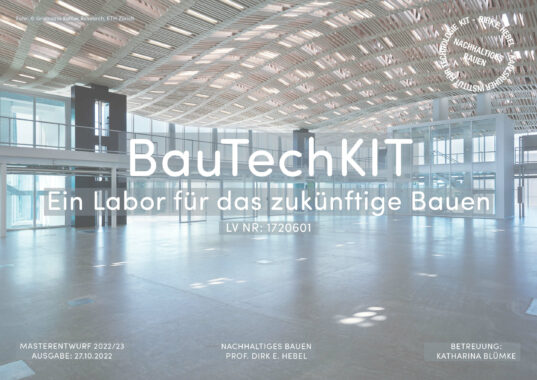
The Faculty of Architecture and the Department IV Natural and Built Environment of KIT have set themselves the goal to become a pioneer of circular and sustainable building in Germany and Europe. This requires a new research, teaching and experimental laboratory for future building, in which research, teaching and practical applications can be interlinked and practiced.
Topics of sustainable building should not only be researched, but the building should already show and demonstrate them. The laboratory is to become a showcase for research into future building for the entire society and an attractor for the city of Karlsruhe.
The semester task is to develop a construction laboratory located in area 10 on the south campus. An urban planning study is part of the task. A large ground-level hall is required, in which new possibilities for future construction will be researched with the help of digital manufacturing processes and robotics, and experimental buildings will be erected. Above the hall, teaching and learning spaces for students and researchers are to be created with common zones for exchange and networking. On the roof area, individual research and innovation modules are to be installed according to the „plug-in“ principle and can be dismantled again simply and easily. People will live and work in these changing units, so that they serve as busy experimental laboratories and at the same time shape and constantly change the appearance of the building.
Day and time: Thursdays, 9:00
1st meeting: 27.10.2022
Excursion to Zurich on 04.11.2022
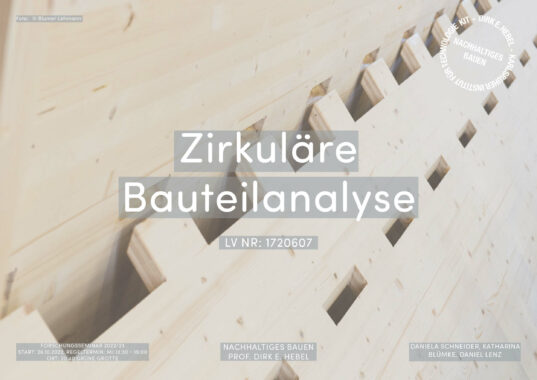
The deconstruction friendliness of a construction and the reusability of materials are decisive parameters for circular planning and building. For high-quality recycling and reuse of materials, material layers as well as components must be planned and installed in a detachable way. The aim of the seminar is to determine the qualitative material value of a separated component and to present it graphically, as well as to find new joining techniques. From the analysis, conclusions are to be drawn for the planning of new circular component constructions as well as to show ways for the design of alternative joining techniques. The analysis of the components is planned in a group work of two persons each.
Day and Time: Wednesdays, 13.30 – 15.00
First meeting: 26.10.22
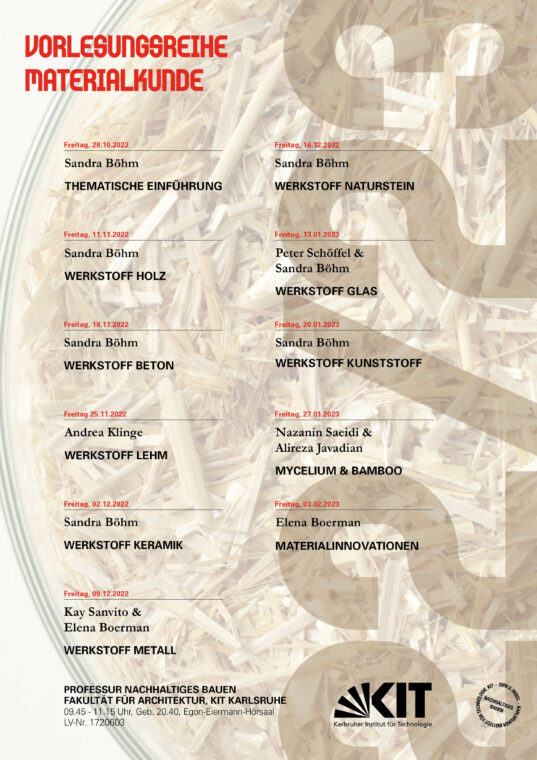
In the Winter Semester 2022/23, the KIT Department of Architecture will offer a lecture series on Materials, organized by the chair of Sustainable Construction, Dirk E. Hebel. In total 11 lectures will address conventional and alternative building materials and their use in construction. Speakers are: Andrea Klinge, Kay Sanvito, Peter Schöffel, Nazanin Saeidi, Alireza Javadian, Elena Boerman and Sandra Böhm. Please refer to the poster for actual dates. The lecture is held every Friday, 9.45 am at the Egon Eiermann HS in the building 20.40 at KIT Campus South.
Poster Design: Uta Bogenrieder
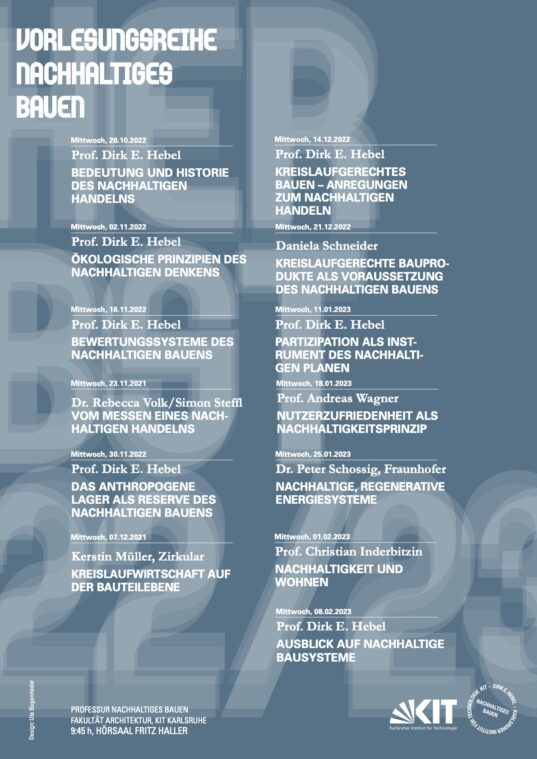
In the Winter Semester 2022/23, the KIT Department of Architecture will offer a lecture series on Sustainable Construction, organized by the Professorship of Sustainable Construction, Dirk E. Hebel. In total 12 lectures he will address the history, state of the art, and alternative futures within the theme. Please refer to the poster for actual dates. The lecture is held every Wednesday, 9.45 am in the HS37 in the building 20.40 at KIT Campus South.
Poster Design: Uta Bogenrieder
Lenz, Daniel, Luciana Alanis, Nicolas Carbonare, Regina Gebauer, Andreas Wagner, and Dirk E. Hebel. 2022. “RoofKIT – KIT Gewinnt Beim Solar Decathlon 2021/22 Mit Klimaneutraler Dachaufstockung.” AIT, no. 9.2022 (September): 36–40. https://ait-xia-dialog.de/ait-magazine/ausgabe-9-2022/.
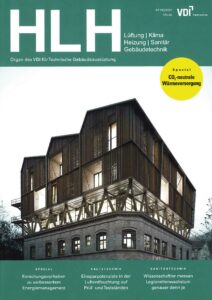
Verein Deutscher Ingenieure e.V., (unknown). „Karlsruher gewinnen Solar Decathlon Europe“ HLH, July 2022.
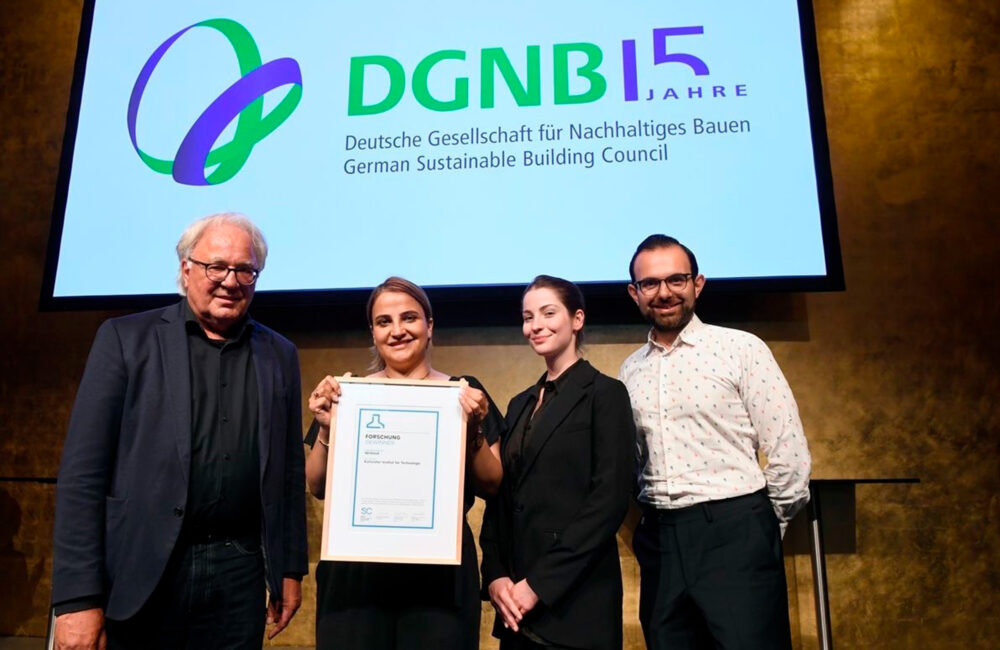
The German Sustainable Building Council (DGNB) announced the winners of this year’s Sustainability Challenge at the DGNB Sustainability Day in Fellbach on 8 July. In the category „Research“, the project „NEWood“ lead by Nazanin Saeidi and Alireza Javadian from the Professorship of Sustainable Construction Dirk E. Hebel at KIT in Karlsruhe, came out on top.
Among the start-ups, the jury chose mygreentop. The „Innovation“ category was won by Home Power Solutions with picea. The audience award went to the research project „Kalkspeicher“ from the German Aerospace Centre (DLR). A total of more than 100 projects and companies entered the DGNB Sustainability Challenge this year.
The selection of the award winners in the DGNB Sustainability Challenge was different this year than in the past. In addition to the finalists, the eleven-member jury also directly determined the winners in the categories „Innovation“, „Start-up“ and „Research“.
„The decision was enormously difficult for us as a jury,“ says Dr. Christine Lemaitre, Executive Director of the DGNB and part of the selection committee. „All the finalists presented themselves excellently, which is why I can only congratulate them all. They are the best proof that there are smart, forward-thinking people in our industry who can combine sustainability with innovation.“
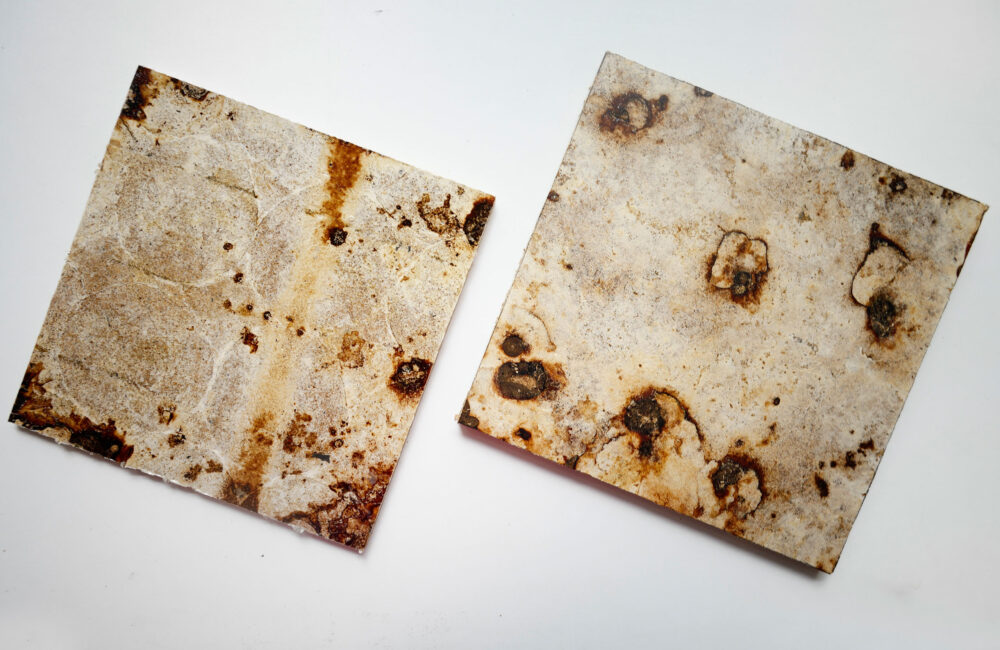
The „NEWood“ project is a novel class of bio-based, resource-efficient and CO2-negative materials based on mycelium. Since NEWood shows comparable properties to MDF and chipboard, it serves as a substitute for wood and wood-based materials. The wood alternative is developed exclusively from available organic waste, including wood and agricultural waste, and is manufactured using fungal mycelium as a natural binder.
This year, the jury was made up of Dr Anna Braune (DGNB), Gerhard Breitschaft (Deutsches Institut für Bautechnik), Dominik Campanella (Concular), Prof. Moritz Fleischmann (Düsseldorf University of Applied Sciences), Prof. Andrea Klinge (ZRS Architekten), Dr Christine Lemaitre (DGNB), Martin Prösler (Proesler Kommunikation), Martin Rodeck (EDGE Technologies), Prof. Dr.-Ing. Ing. Anja Rosen (Bergische Universität Wuppertal), Prof. Dr.-Ing. Patrick Teuffel (Eindhoven University of Technology), and Prof. Meike Weber (Hildesheim University of Applied Sciences and Arts).
More information on all award winners and finalists is available online in the DGNB press release or on the DGNB blog. (Text © DGNB)
08.07. / 09.07. / 11.07. / 23.07.
Termine jeweils von 8 – 19 Uhr
Rückfragen und Anmeldung an jonas.laeufer@kit.edu
Im Juli 2022 steht der Abriss des Hauptschulgebäudes der Konrad Kocher Schule in Ditzingen an. Ein ganz normaler Prozess im heutigen Baugeschehen. Die Stadt hat entschieden, die Schule entspricht nicht mehr den heutigen Ansprüchen, ein Wettbewerb für den Neubau einer Schule wurde ausgelobt, der Gewinner hat den Auftrag für das Projekt bekommen.
Viele Tonnen Baustoffe werden durch diese Entscheidung freigesetzt und nach dem üblichen Vorgang auf die Deponie befördert, recycelt oder thermisch verwertet. Vor zwei Wochen kam die Zusage der Stadt und des beauftragten Abbruchunternehmens, dass Material ausgebaut werden darf – der Abriss steht in vier Wochen an.
Ganz nach dem Motto „viele Hände, schnelles Ende“ wollen wir zusammen so viele Materialien wie möglich direkt oder indirekt „retten“ und so einen eigenen kleinen Beitrag zur Zirkulariserung leisten.
Als freies Kollektiv für zirkuläres Bauen ruft der Baukreisel gemeinsam mit dem Lehrstuhl für Nachhaltiges Bauen am KIT einen Ausbau Stegreif aus, um zusammen mit Studierenden die Linearität zu brechen und im Sinn der Kreislaufwirtschaft zu handeln. Hierbei geht es um das Katalogisieren und den Abbau der Materialien vor Ort, aber auch um die Planung, Logistik und Wiederverwendung der Materialien. Konkret sollen Materialien sowohl zur Wiederverwendung im Bau vorbereitet werden (Beispiel: Böden, Waschbecken, Armaturen) als auch für einen neue Nutzungsart aufbereitet werden (Beispiel: aus Türen entstehen Möbel). So wird neben der handwerklichen Abbauerfahrung auch die wirtschaftliche und gestalterische Komponente der Zirkularität beleuchtet.
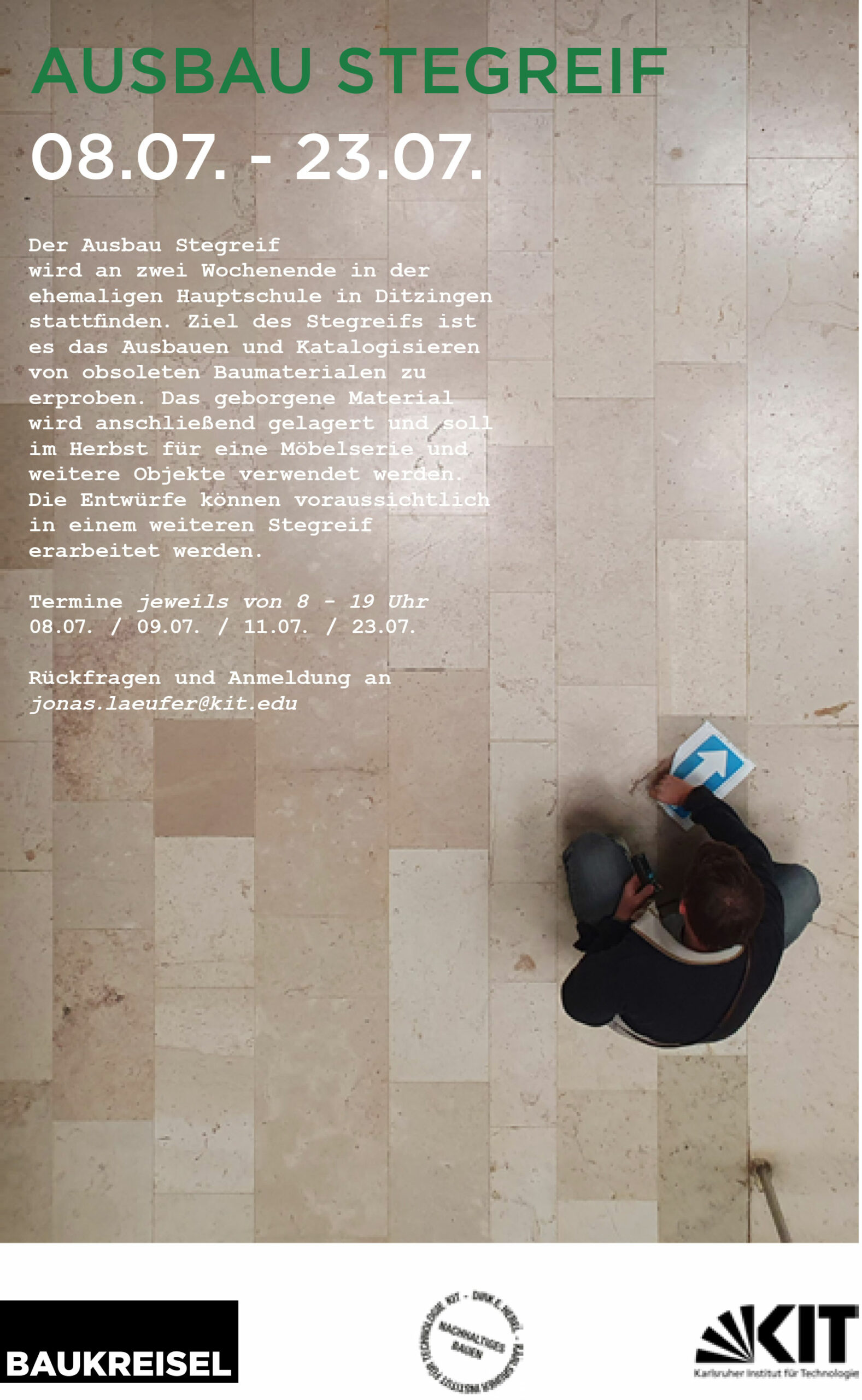
Der Ausbau Stegreif wird an zwei Wochenenden in der ehemaligen Hauptschule in Ditzingen stattfinden. Ziel des Stegreifs ist es das Ausbauen und Katalogisieren von obsoleten Baumaterialen zu erproben. Das geborgene Material wird anschließend gelagert und soll im Herbst für eine Möbelserie und weitere Objekte verwendet werden.
Die Entwürfe können voraussichtlich in einem weiteren Stegreif erarbeitet werden.
08.07. / 09.07. / 11.07. / 23.07.
Termine jeweils von 8 – 19 Uhr
Rückfragen und Anmeldung an jonas.laeufer@kit.edu
db online, (unknown). 2022. “Hochschulwettbewerb »Solar Decathlon Europe«: Team Aus Karlsruhe Gewinnt Mit Kreislauffähiger Aufstockung.” Deutsche Bauzeitung Online. July 1, 2022. URL: https://www.db-bauzeitung.de/news/team-aus-karlsruhe-gewinnt-mit-kreislauffaehiger-aufstockung/.
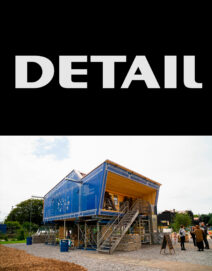
Schoof, Jakob. 2022. “Solar Decathlon Geht Nach Karlsruhe.” DETAIL Online. June 30, 2022. URL: https://www.detail.de/de/de_de/solar-decathlon-geht-nach-karlsruhe.
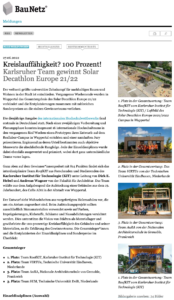
BauNetz. „Kreislauffähigkeit? 100 Prozent! Karlsruher Team gewinnt Solar Decathlon Europe 21/22“. BauNetz, 27. Juni 2022. URL: https://www.baunetz.de/meldungen/Meldungen-Karlsruher_Team_gewinnt_Solar_Decathlon_Europe_21-22_7966259.html.

The TECU® ARCHITECTURE AWARD 2022 once again honours outstanding projects that make exemplary and innovative use of the extensive application possibilities of the TECU® brand. The overall architectural concept and the considered use of the material are decisive. The competition includes the category ‚Realised Buildings‘ and ‚Project award for students‘.
Regina Gebauer, meanwhile teaching and research assistant at the Professorship of Sustainable Construction, won the 1st project prize for students with her design project „Until everything moves“. In this project, she proposes the addition of two residential storeys to the existing Café ADA in the Mirker Quarter in Wuppertal, which was part of the Solar Decathlon teaching achievements over the past two years at the KIT Faculty of Architecture. The award ceremony took place on 17 June at the Solar Decathlon Europe in Wuppertal.
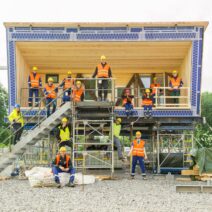
Lenz, Daniel, Regina Gebauer, Dirk E. Hebel, and Vanessa Falletta. 2022. “ROOFKIT: WIE BAUEN WIR IN ZUKUNFT?” Polis Online. June 10, 2022. https://polis-magazin.com/2022/06/roofkit-wie-bauen-wir-in-zukunft/.
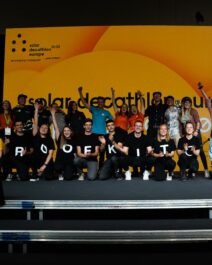
Christoph, Johanna, and Marvin Rosenhoff. 2022. “Der Solar Decathlon Europe 21/22 im Mirker Quartier ist für Besucher geöffnet.” Westdeutsche Zeitung. June 10, 2022. https://www.wz.de/nrw/wuppertal/wuppertal-solar-decathlon-europe-21-22-ist-fuer-besucher-geoeffnet_aid-71171755.

Kries, Mateo, Jochen Eisenbrand, and Mea Hoffmann, eds. 2022. “Wie steht’s mit dem Recyceln?” In Plastik. Die Welt neu denken, 190–95. Weil am Rhein: Vitra Design Museum.
Since 18 May 2022, Team RoofKIT has been in Wuppertal to build the House Demonstration Unit on the Solar Campus of the Solar Decathlon Europe 2021/22. In the first week, the foundation was prepared, the scaffolding, steel beams and gabions were erected. Then the modules were delivered by Kaufmann Zimmerei und Tischlerei and assembled in one spectacular day. The second week was dominated by the paving and electrical work as well as the interior design of the unit. Finally, the building was professionally photographed by architectural photographers Zooey Braun and Carolin Wengert.
On 3 June 2022, Team RoofKIT received the final approval from the organisers of the Solar Decathlon just in time and thus 10 bonus points. This concludes the assembly phase and the monitoring phase is currently underway in Wuppertal.
The Solar Decathlon event will take place in Wuppertal from 10 to 26 June 2022. Visitors will experience future-oriented architecture and creative climate protection at first hand. Free entry tickets are now available online at tickets.sde21.eu.
The Solar Decathlon is the meeting place for all architecture lovers, construction experts, sustainability supporters and interior design fans. Visitors can expect a veritable treasure trove of environmentally friendly, affordable and appealing building and living ideas. Whether it’s a flat made of wood with a roof garden, a home with cellulose-based components from the 3D printer or creative upcycled furniture: sixteen fully functioning, furnished house prototypes are waiting to be visited.
Over 30 local and national event partners are organising the accompanying programme. Visitors can enjoy the many offers and activities on the Solar Campus in Wuppertal free of charge. Concerts, exhibitions, award ceremonies and an international culinary offer complete the programme.
Event program on the Solar Campus: https://sde21.eu/de/event/programme
Directions to the Solar Campus: https://sde21.eu/de/event/anfahrt
Get free event tickets now at tickets.sde21.eu.
More information about the RoofKIT project here.
In order to drive the transformation of the construction and real estate industry towards more sustainability, researchers, young founders and companies are in demand: With the Sustainability Challenge, the DGNB seeks out pioneers who think boldly into the future, question existing systems and initiate new ideas.
In the „Research“ category, the project „NEWood – a novel mycelium-based composite made from organic waste“ from the KIT Professorship of Sustainable Construction was chosen as one of the three finalists.
The research project is based on three main strategies, which include resource efficiency, circular economy and renewable materials. A new class of bio-based, resource-efficient and CO2-negative materials called „NEWood“ has emerged from the project. As NEWood shows comparable properties to MDF (Medium Density Fibre) and chipboard, it serves as a substitute for wood and wood-based materials. The wood alternative is developed exclusively from available organic waste, including wood and agricultural waste, and is produced using fungal mycelium as a natural binder. In cooperation with an industrial partner, the Karlsruhe Institute of Technology team is also exploring the use of digital and advanced manufacturing technologies in the development of mycelium-based composites.
The research project has also been published in Nature as well as in the Sendung mit der Maus and another children’s programme on KIKA.
The public votings for the finalists will be open from 31st May 2022.

As part of a team meeting, the RoofKIT team prepared for the Solar Decathlon competition in Wuppertal in the courtyard of the department of architecture.
The student team leader Regina Gebauer hosted the evening. Topics addressed included the assembly and disassembly phase, as well as work shifts, accommodation and the event phase.
The event ended with a wine tasting with an associated evaluation with regard to the dinner evening.
Photos © Katharina Blümke

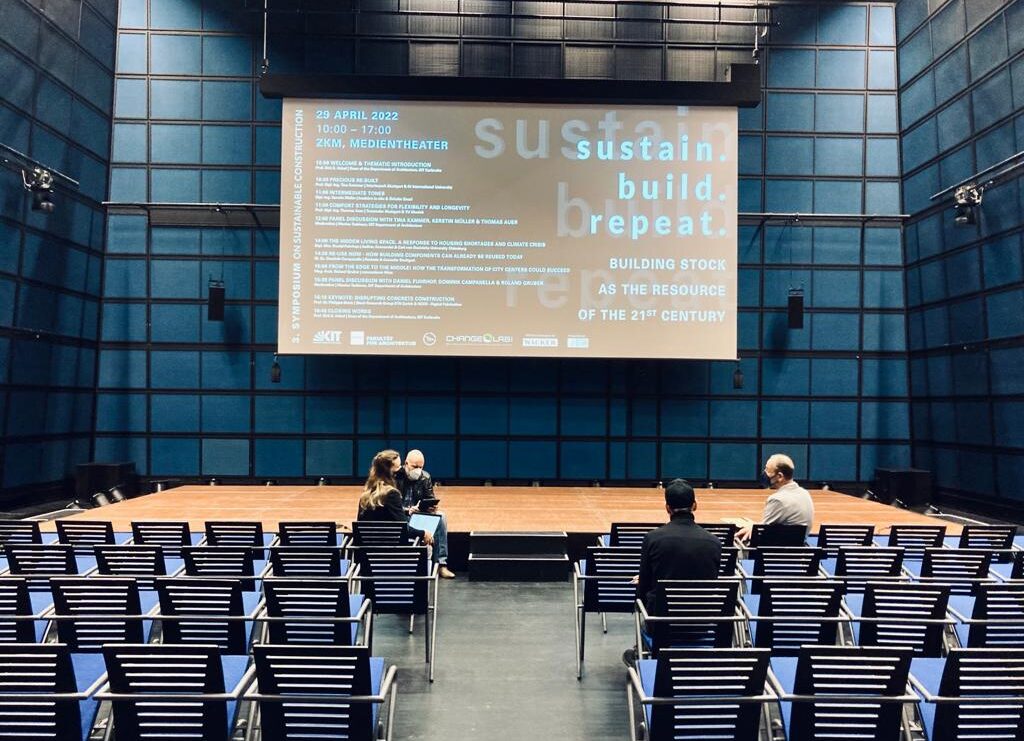
On 29 April, the Chair of Sustainable Construction was a guest at the Centre for Art and Media (ZKM) Karlsruhe to organise, in cooperation with the Faculty of Architecture, PINK Event Service, mint Café, Campusradio Karlsruhe and many more, the 3rd Symposium for Sustainable Construction „sustain.build.repeat. – building stock as the resource of the 21st Century“.
Invited speakers were Tina Kammer, Kerstin Müller, Thomas Auer, Daniel Fuhrhop, Dominik Campanella, Roland Gruber and Philippe Block. The panel discussions were moderated by Monica Tusinean, who was assisted by Elena Boerman with audience questions. Prof. Dirk E. Hebel guided the audience through the event.
Around 100 participants were present at the ZKM, and many viewers also followed the event online. Parallel to the event, we recorded a podcast with our speakers to further elaborate on the content of the presentations.
We would like to sincerely thank all those involved in the event for their commitment and organisational efforts, for the great encounters, conversations and new connections that were created at and through the symposium. Thank you!

Team RoofKIT (2022), “Veranstaltung: Solar Decathlon Europe 21/22”, in: polis – Urban Development, January 2022, p. 85

Özdemir, Eda, Nazanin Saeidi, Alireza Javadian, Andrea Rossi, Nadja Nolte, Shibo Ren, Albert Dwan, Ivan Acosta, Dirk E. Hebel, Jan Wurm, and Philipp Eversmann (2022), „Wood-Veneer-Reinforced Mycelium Composites for Sustainable Building Components“, in: Biomimetics 7, no. 2: 39, March 2022, https://doi.org/10.3390/biomimetics7020039, URL: https://www.zukunftbau.de/projekte/forschungsfoerderung

>>> Registration for the live event at ZKM expired on 21st April 2022
>>> Livestream openly available (without prior registration)
>>> Please register here after the event for Educations Points of the Architektenkammer BW
Our 3rd Symposium on Sustainable Construction at a glance:
date: 29th April 2022 from 10AM to 5PM (admission from 9AM)
location: ZKM Medientheater Karlsruhe, registration expired
livestream: The event will be livestreamed openly and without registration on changelab.exchange
The symposium sustain.build.repeat. is dedicated to the resource of the 21st century: our building stock. With growing waste volumes and ever scarcer raw materials, careless building demolitions and replacements must be avoided. Instead, existing buildings should be converted and rebuilt, components removed, reused and reused again.
It is important to preserve as much of the existing building stock as possible on the premise of resource- and climate-friendly architecture: on the one hand as a changeable space in which various usage scenarios are possible, and on the other hand as a material depot and secondary raw material supplier. Representatives from science and industry, research and practice will present ideas, strategies and impulses on how the ecological necessity of reconstruction and transformation of the existing can become an enriching element of a caring, needs-oriented and value-preserving architecture in ecological balance.
We are very pleased to welcome the following speakers to our event:
Thomas Auer, Philippe Block, Dominik Campanella, Daniel Fuhrhop, Roland Gruber, Tina Kammer, and Kerstin Müller.
Additionally, a thematic introduction will be given by Prof. Dirk Hebel, Professor of Sustainable Construction and Dean of the Department of Architecture, the panel discussions between the lectures will be moderated by Monica Tusinean. In the foyer in front of the Medientheater, there will be an accompanying exhibition of student works that deal with the preservation of existing stock.
The event is organised by the Professorship of Sustainable Construction of the KIT Department of Architecture. The symposium is part of ChangeLab, an innovation platform for sustainability in the building industry, sponsored by Wacker Chemie AG.
The event and the livestream will also be part of the education programme of the Architektenkammer Baden-Württemberg (AKBW registration number: 2022-151695-0001). In order to receive training points for participation in the livestream, it is absolutely necessary to verify participation in the form provided AFTER the event on arch.kit.edu.
Admission to the ZKM will begin at 9AM on the event day. The symposium will start at 10 am and last until 5pm. A get together and guided tours of the current ZKM exhibition „BioMedien“ will be offered for our participants from 5 to 6 pm.
We look forward to your participation in the event!
Kohring, Katharina, and Dirk E. Hebel. ‘Interview: “We’ve already made significant progress”’. topos. circularity in cities (München), 2026.

Holl, Christian. ‘Besser So’. Marlowes, 7 July 2026. https://www.marlowes.de/besser-so/.
Kohring, Katharina, and Dirk E. Hebel. ‘Interview: “Wir sind schon einen großen Schritt weiter”’. G+L – Magazin für Landschaftsarchitektur und Stadtplanung (München), 2026.

Boerman, E., & Hebel, D. E. (2026). Weniger Treibhausgasemissionen durch Wiederverwendung. In Umbauhof—Ein Ort für die Wiederverwendung von Bauteilen. Birkhäuser Verlag GmbH (Architektur Raumburgenland, Asphalt / Kollektiv für Architektur).
Hebel, Dirk E., and Elena Boerman. “Projektstudie 2 (Schwerpunkt: Materialien): Der Kreislaufbasierte Architekturansatz.” In Zukunftsfähiges Bauen – Wie Wir Unsere Gebaute Umwelt Nachhaltig Gestalten, 64–78. Berlin: DIN Media Innovation, 2026.

Hebel, Dirk E., and Annette Hillebrandt, eds. 2026. Zirkulär! Fundamente und Postulate einer kreislaufbasierten Bauwirtschaft. Bauwelt Fundamente. Birkhäuser Verlag GmbH.

Deutsches Architekt:innen Blatt. 2026. “Eine Frage der Konsequenz.” March.
Steiff, Peter. “Zirkuläres Bauen. Regeneratives Baustoff-Management.” BUND Jahrbuch 2026, January 2026.
Glanzmann, Jutta. “Holz Als Basis Für Eine Nachhaltige Baukultur.” Lignum Holzbulletin 157/2025, no. Nachhaltig bauen (2025): 4058–59.

McLean, Will, Pete Silver, and Dirk Hebel. “MycoTree.” In Sustainable & Regenerative Materials for Architecture – A Source Book. 2025; Laurence King, 2025.
Dietzold, Lutz, ed. Iconic Awards 2025 – Spaces Objects Visions. Frankfurt: Rat für Formgebung GmbH, 2025.
Hebel, Dirk E. „Activating the Urban Mine.“ In Architecture and Technology Volume II: Cities in Climate Crisis. Madrid: Norman Foster Foundation Press, 2025.

Hebel, Dirk E. und Felix Heisel. “Die Stadt als Ressource.” In Für eine nachhaltige Architektur der Stadt. Berlin: Verlag Klaus Wagenbach, 2025.
Hebel, Dirk E. “Vom Linearen Zum Kreislaufsystem.” In Architektur Und Klimawandel. München: Edition DETAIL, 2025.
Hebel, Dirk E. Interview: “Wir müssen endlich anfangen, den CO2-Ausstoß zu messen – nicht nur, wie dick die Dämmung ist.” Interview by Christoph Karcher. LooKIT 0225, 2025.
BUNDESKUNSTHALLE, ed. WEtransFORM – Zur Zukunft Des Bauens. Berlin: jovis Verlag, 2025.
Renaissance AG, ed. Henkels Wuppertal – DenkWerkStadt. Wuppertal: renaissance Immobilien und Beteiligungen Aktiengesellschaft, 2025.
Monkenbusch, Helmut. „Bauen für die Welt von morgen.“ Hörzu, 24.1.2025
Hebel, Dirk E., Tanja Hildbrandt. „ Pilze – Netzwerker im Untergrund“. alverde, dm-Magazin, April 2025.
Merkert-Andreas, Carolin. “Pilze Sind Vielseitig.” Wohnglück, January 2025.
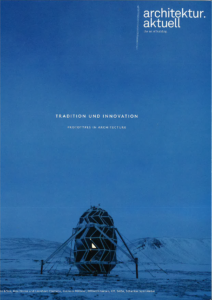
Boerman, Elena, and Dirk E. Hebel. “RoofKIT – Kohlenstoffspeicher Und Materiallager.” Architektur.Aktuell, vol. 12.2024, no. Tradition und Innovation, Dezember 2024, pp. 98–109
Grossarth, Jan. „Exkurs: Die vielen Einsatzbereiche von Myzel im Bauwesen“. In Bioökonomie und Zirkulärwirtschaft im Bauwesen, eine Einführung, 174–117. Wiesbaden: Springer Fachmedien, 2024.

Hebel, Dirk E. Interview: “Vom linearen zum zirkulären Kreislaufsystem.” Interview by Sandra Hofmeister, DETAIL 11.2024, Nov. 2024.

Hebel, Dirk E., Sandra Böhm, Elena Boerman, Hrsg. Vom Bauen mit erneuerbaren Materialien – Die Natur als Rohstofflager. Stuttgart: Fraunhofer IRB Verlag, 2024.
Hebel, Dirk E. “In Kreisläufen denken, entwerfen und wirtschaften.” MÄG – Mein Häfele Magazin, 2024.
Rubel, Maike, and Patricia Leuchtenberger. Interview: “Pilzpower für die Bauindustrie.” competitionline, 7 June 2024, https://www.competitionline.com/de/news/schwerpunkt/pilzpower-fuer-die-bauindustrie-7283.html.
Müller, Janek. “Baumaterialien der Zukunft: Pilze, Hanf und Algen.” neubau kompass – Neubauprojekte in Deutschland, May 3, 2024. https://www.neubaukompass.de/premium-magazin/.
Sören, S. Sgries. “Interview: ‘Wir haben wertvolle Materialien weggeworfen.’” Rhein-Neckar-Zeitung, April 27, 2024, SÜDWEST I 28 edition, sec. Sinsheimer Nachrichten.

Schweikle, Johannes. “Auf Pilz gebaut.” Stuttgarter Zeitung, April 23, 2024, sec. Die Reportage.
Klaaßen, Lars. “Organische Architektur – Pilzmyzel und Flachs als Materialien für die ökologische Bauwende.” In Deutsches Architektur Jahrbuch 2024, edited by Peter Cachola Schmal, Yorck Förster, and Christina Gräwe, 198–209. Berlin, Germany: DOM publishers, 2024.