Privacy & Cookies: This site uses cookies. By continuing to use this website, you agree to their use.
To find out more, including how to control cookies, see here:
KIT Datenschutzerklärung
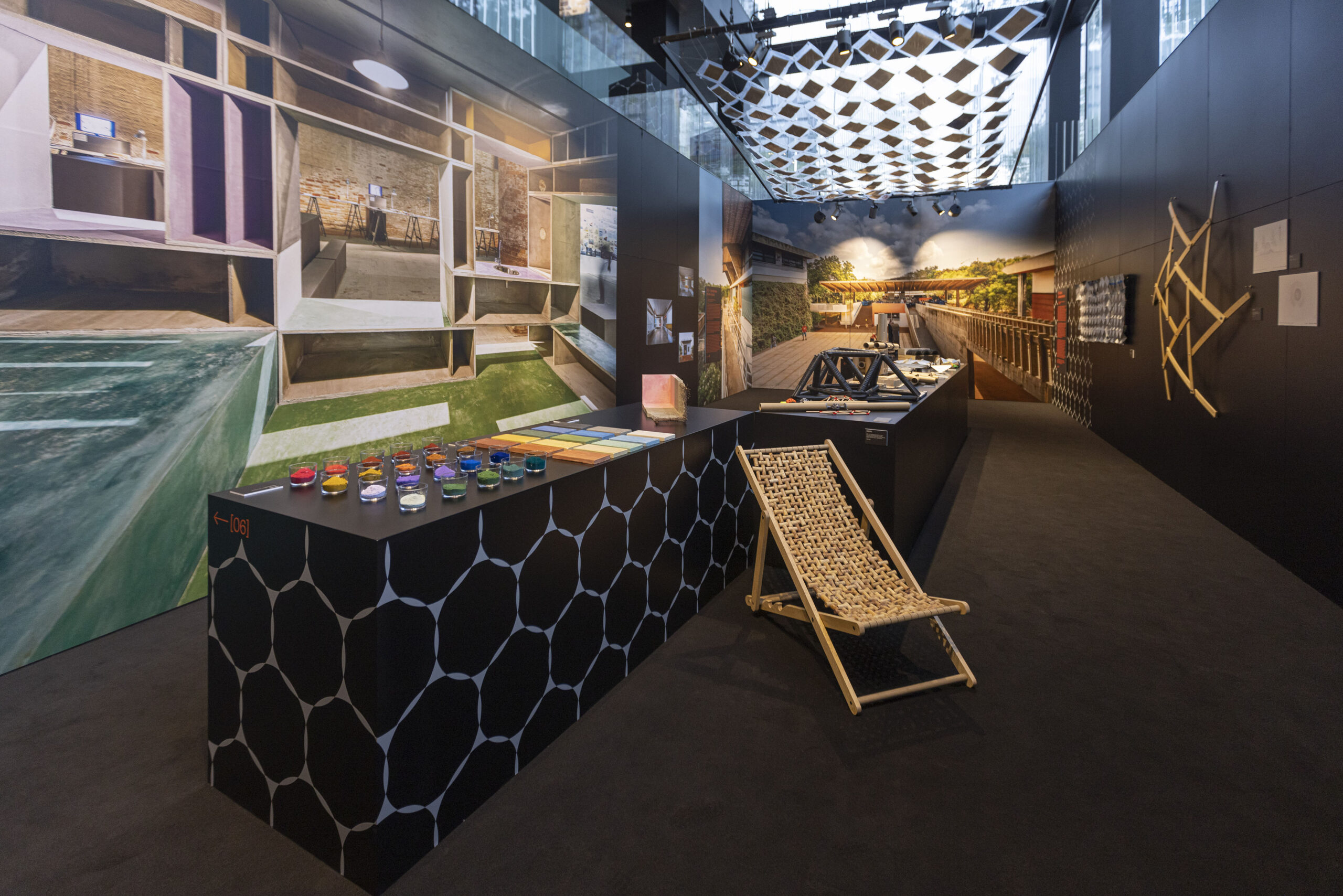
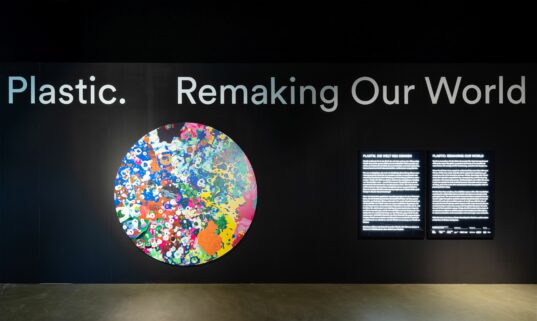
The exhibition Plastic: Remaking Our World, which was initially on show at the Vitra Design Museum, will be on display at the V&A Dundee in Scotland from 29 October 2022. The contribution of the Sustainable Building Professorship will also travel from Weil am Rhein to Dundee.
Plastic: Remaking Our World will again feature prototypes, new technologies, and cutting-edge materials as designers grapple with a material that has changed our world.
The exhibition will feature product design, graphics, architecture and fashion from the collections of the V&A and Vitra Design Museum, as well as collections all over the world. This is the first exhibition produced and curated by V&A Dundee, the Vitra Design Museum and maat, Lisbon, with curators from V&A South Kensington.
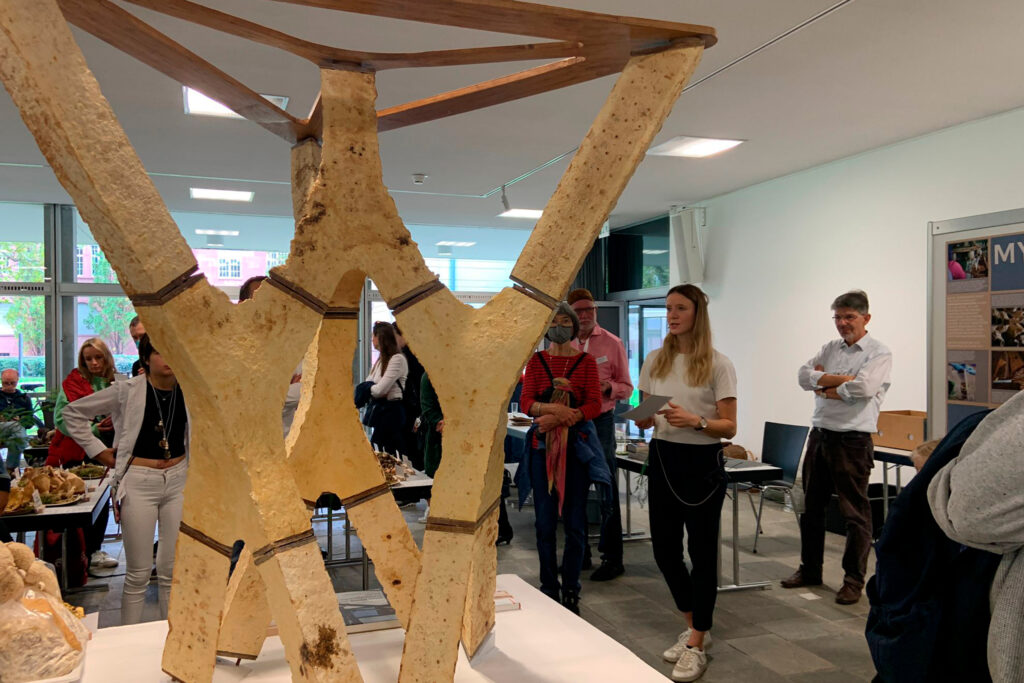
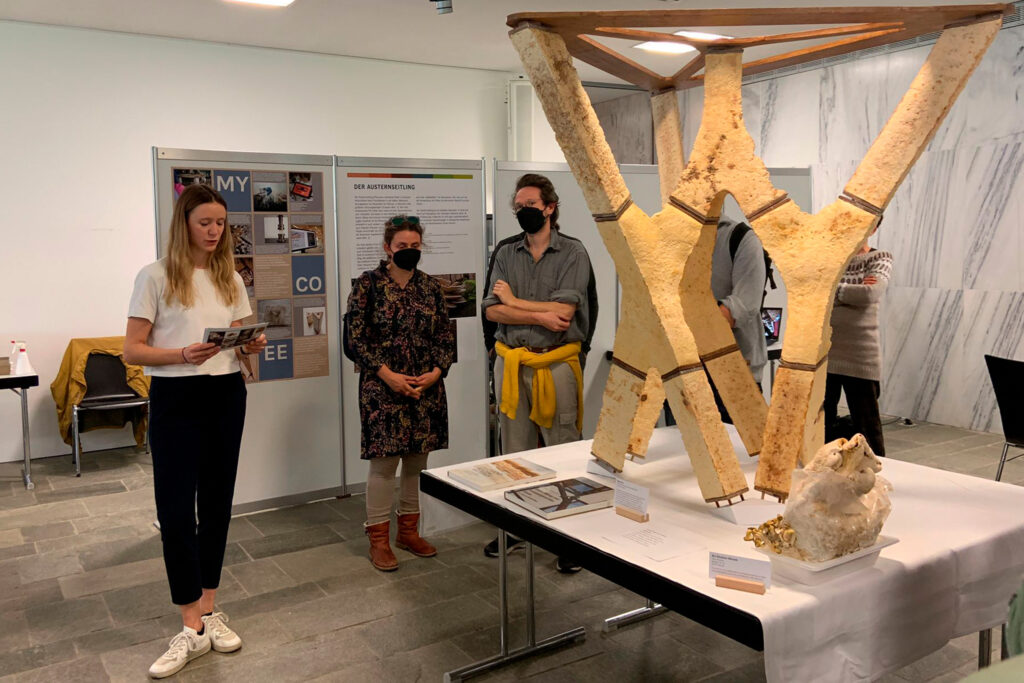
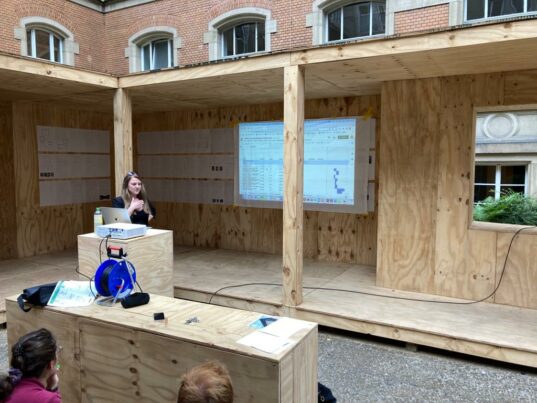
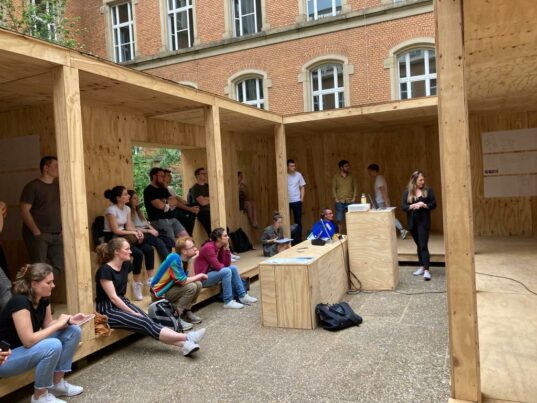
As part of the 17th “Karlsruher Frischpilzausstellung” of the Natural History Museum in Karlsruhe, the MycoTree was exhibited in the pavilion in the Nymphengarten on the 8th and 9th October. The exhibition displayed 250-300 species of mushrooms and presented various literature on mushrooms. The weekend exhibition was visited by almost 1300 people interested in mushrooms.
The MycoTree, a spatial structure made of the cultivated materials mushroom mycelium and bamboo, supplemented the exhibition with the topic area ‘Building materials from natural resources’. At 2 p.m. on both days, Sandra Böhm and Elena Boerman gave a short lecture on the exhibited project, which was created in 2017 as a cooperation project between the KIT Sustainable Building Professorship and the Block Research Group of ETH Zurich.
The assembled elements of the MycoTree can be disassembled again into their original materials and returned to the natural cycle as nutrients. In this way, it shows how digital design, technology and resource-saving materials could come together in the building industry in the future.
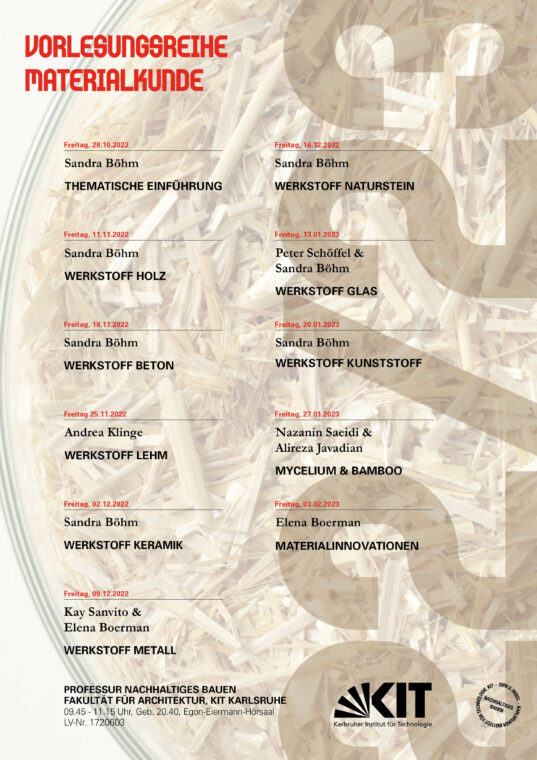
In the Winter Semester 2022/23, the KIT Department of Architecture will offer a lecture series on Materials, organized by the chair of Sustainable Construction, Dirk E. Hebel. In total 11 lectures will address conventional and alternative building materials and their use in construction. Speakers are: Andrea Klinge, Kay Sanvito, Peter Schöffel, Nazanin Saeidi, Alireza Javadian, Elena Boerman and Sandra Böhm. Please refer to the poster for actual dates. The lecture is held every Friday, 9.45 am at the Egon Eiermann HS in the building 20.40 at KIT Campus South.
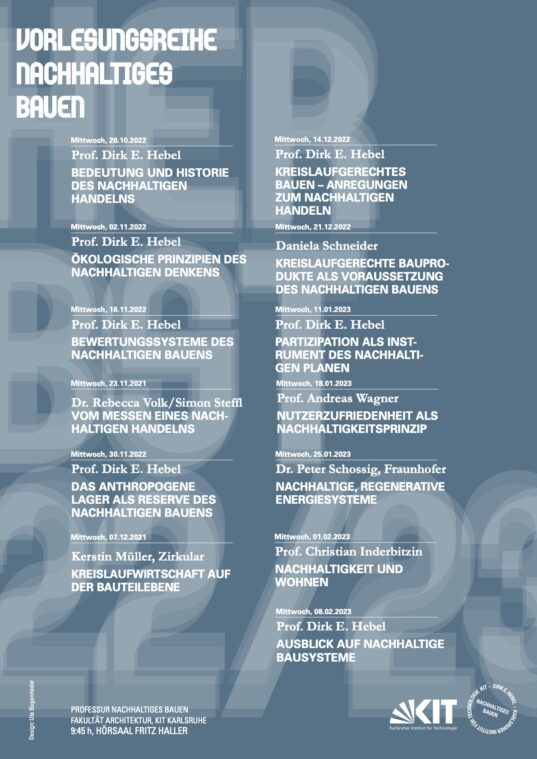
In the Winter Semester 2022/23, the KIT Department of Architecture will offer a lecture series on Sustainable Construction, organized by the Professorship of Sustainable Construction, Dirk E. Hebel. In total 12 lectures he will address the history, state of the art, and alternative futures within the theme. Please refer to the poster for actual dates. The lecture is held every Wednesday, 9.45 am in the HS37 in the building 20.40 at KIT Campus South.
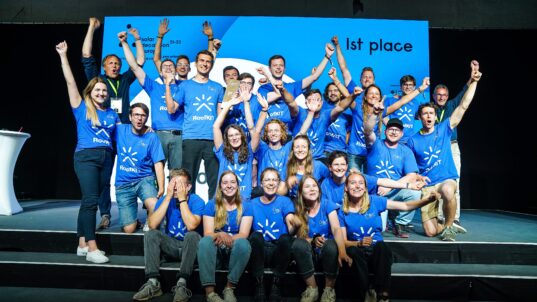
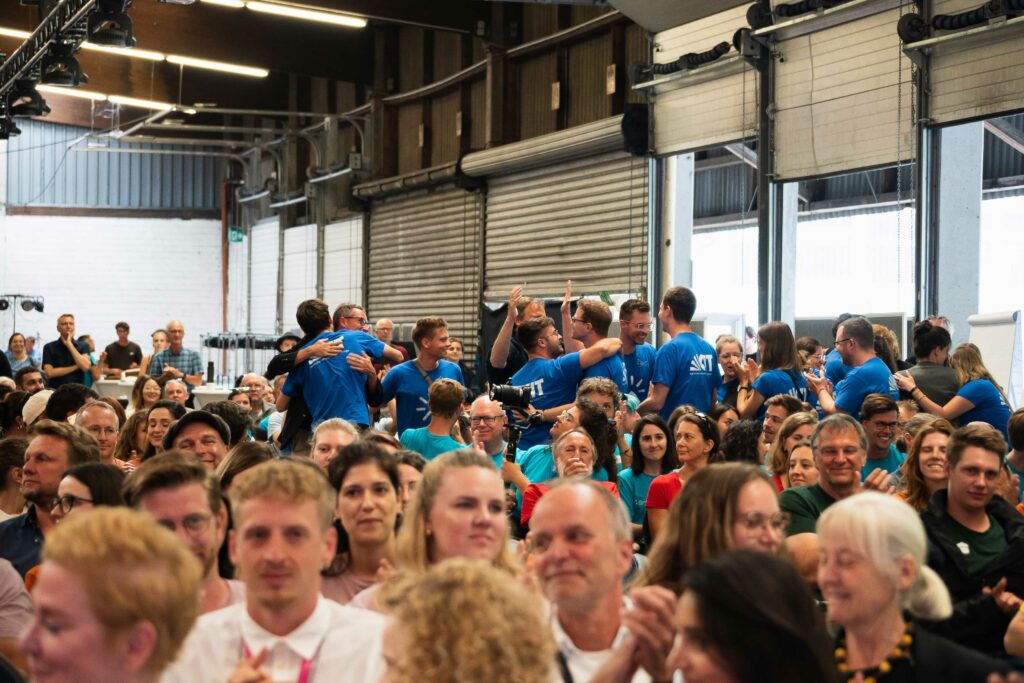
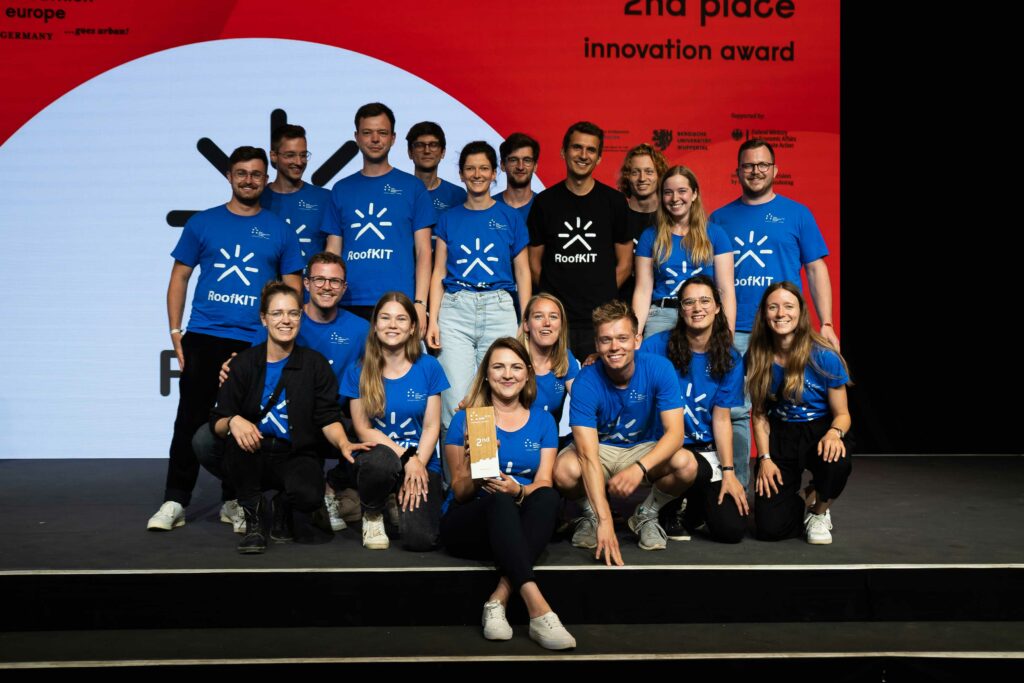
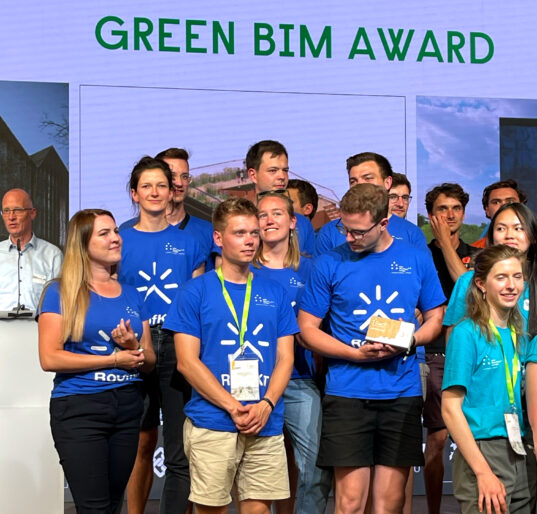
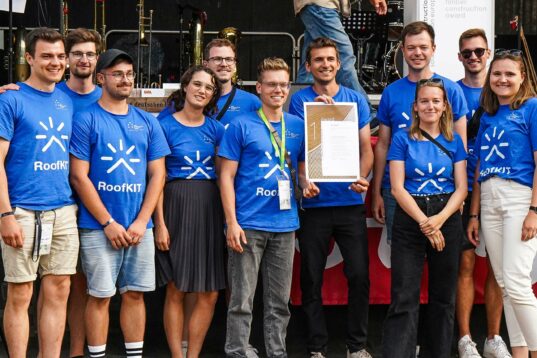
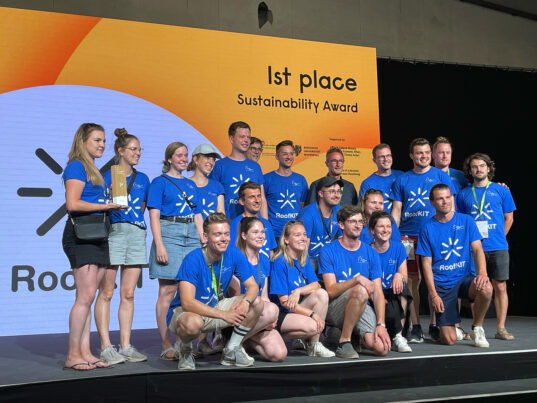
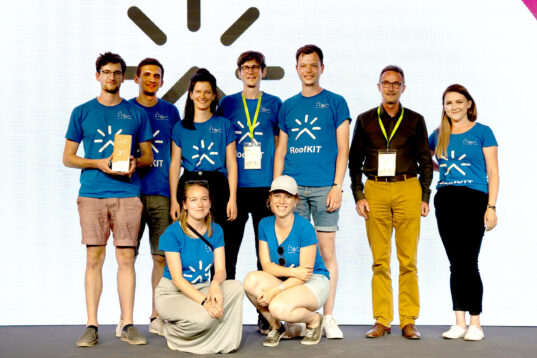
On Friday 24 June at about 6 pm, the time had finally come – the Competition Director of the Solar Decathlon Europe 2021/22, Karsten Voss, in Wuppertal announced the winning team of the student competition: Team RoofKIT from Karlsruhe! The team was very surprised about this development and expressed their relief, happiness and pride. The moment of the announcement was captured on video by SDE 2021/22:
Second place in the overall competition was taken by Team Virtue from Eindhoven, and third place was shared by Team SUM from Delft and Team Aura from Grenoble. On the website of the SDE 2021/22, all other placements and the intermediate results and awards of the competition can be viewed.
After the award ceremony, Team RoofKIT was visited by WDR and the winning house was shown live on WDR’s Lokalzeit (approx. from minute 20), where some team members were also interviewed about the project.
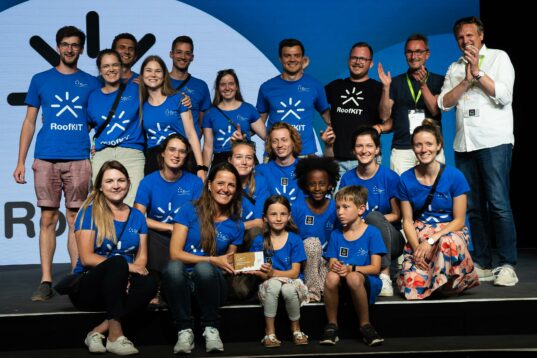
The Professorship of Sustainable Construction and the Professorship of Building Physics would like to thank all the students and staff of Team RoofKIT and congratulate them on this great competition result!
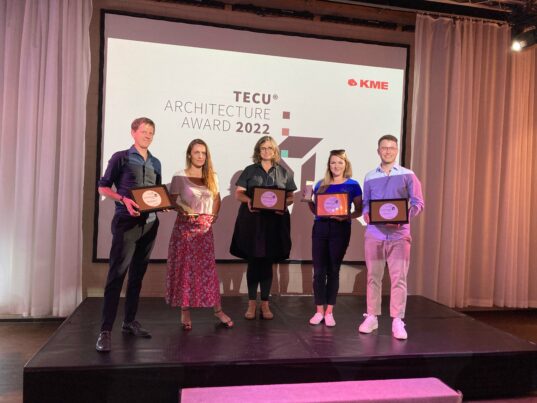
The TECU® ARCHITECTURE AWARD 2022 once again honours outstanding projects that make exemplary and innovative use of the extensive application possibilities of the TECU® brand. The overall architectural concept and the considered use of the material are decisive. The competition includes the category ‘Realised Buildings’ and ‘Project award for students’.
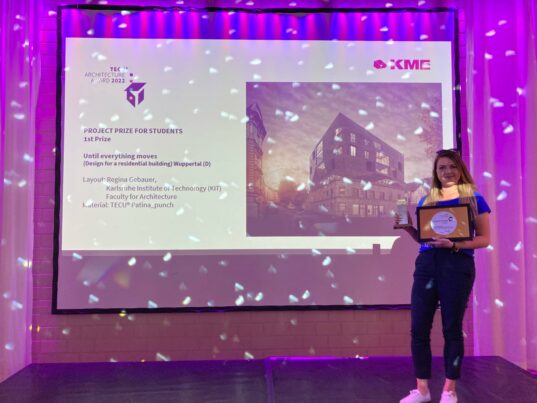
Regina Gebauer, meanwhile teaching and research assistant at the Professorship of Sustainable Construction, won the 1st project prize for students with her design project “Until everything moves”. In this project, she proposes the addition of two residential storeys to the existing Café ADA in the Mirker Quarter in Wuppertal, which was part of the Solar Decathlon teaching achievements over the past two years at the KIT Faculty of Architecture. The award ceremony took place on 17 June at the Solar Decathlon Europe in Wuppertal.
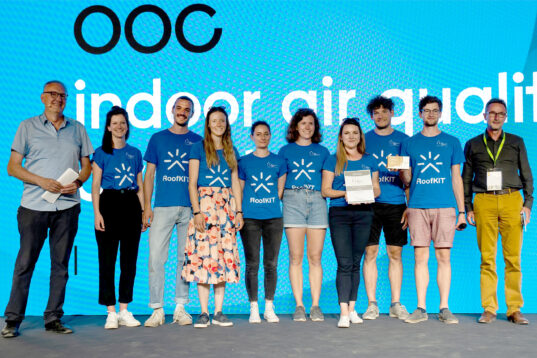
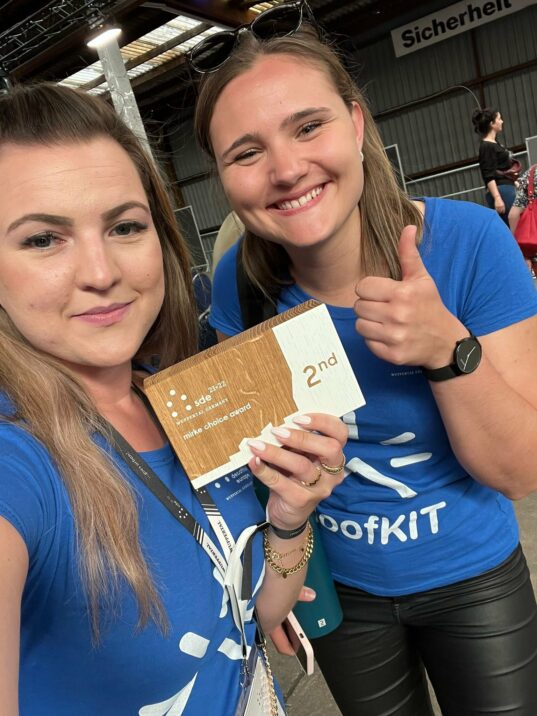
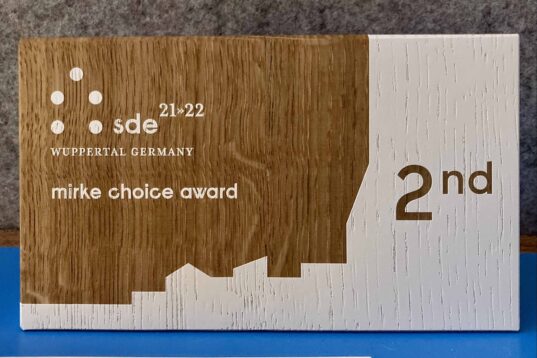
On Sunday 12th the Award Ceremony of the first “Out Of Competition Award” has taken place at the Solar Campus. Team RoofKIT ist very happy that the fist day of Award Ceremonies also brought the first trophy – The inhabitants of the Wuppertal neighborhood of Mirke, where the proposed plots of the SDE 21/22 are located, voted RoofKIT second place of the “Mirke Choice Award”. The team is especially proud that the proposal for topping up the Café ADA in the heart of the neighborhood is appreciated by the people it was designed for.
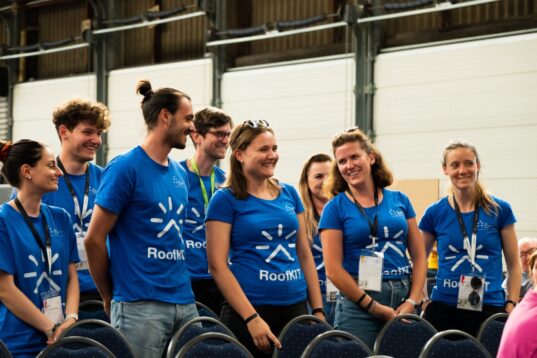
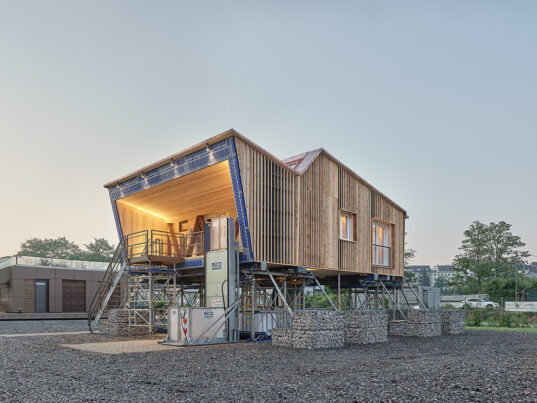
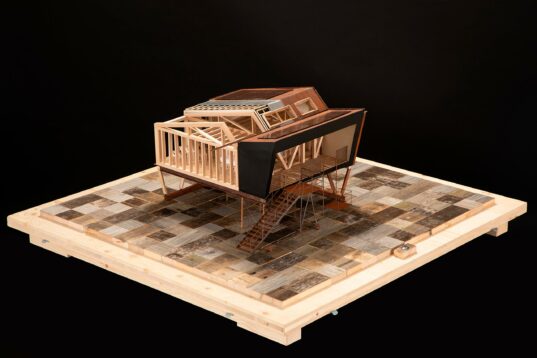
The Karlsruhe Institute of Technology is participating in the 2021/22 Solar Decathlon Competition in Wuppertal, Germany with its project RoofKIT. Designed as a top-up to an existing structure of the 19th century in the old city fabric, it demonstrates a vision for the building industry: social adequate, energy positive and circular sustainable.
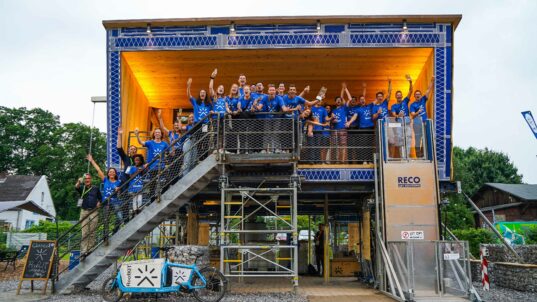
It is the unique character of the Solar Decathlon competition, that next to an overall design approach of a larger project, a characteristic element is constructed as a full scale demonstrator. Since 2020, more than 100 students from KIT within different faculties and under the leadership of the professorships of Sustainable Construction (Prof. Dirk E. Hebel) and Building Technologies (Prof. Andreas Wagner) worked on the project which cumulated in the construction of the House Demonstration Unit in May and June 2022 in Wuppertal, Germany.
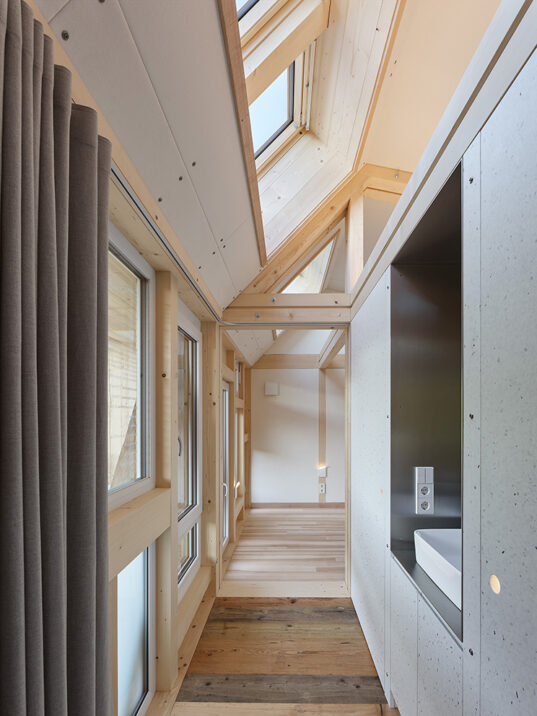
Designed as a prefabricated module system with a 100% circular construction method, the unit proofs already today, that with current technology and design capacities, we are able to fulfill the requirements of the European Green Deal. No glues, no paints, no foams or wet sealants were used, so that the circularity of the building and its materials is guaranteed. In addition, only mono-materials were used for construction, meaning no composites or mixtures of materials are to be seen.
But RoofKIT wants not only show what is possible in the future: many building components and materials are taken already out of the urban mine and are used in their second, third or even fourth circle: wood from old barns in the black forest, the entrance door from a building of the 19th century , windows from a demolished building in Basel, bathroom and kitchen sinks as well as fixtures from turn backs of fair exhibitions.
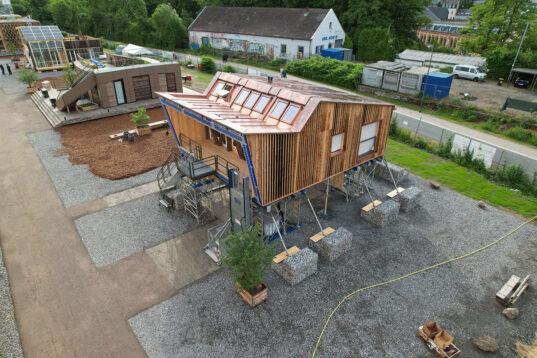
This circular approach only makes sense when it is powered by renewable energy. As the RoofKIT top-up is a new construction with a high energy efficiency standard, the total energy demand (including appliances and e-mobility) will be covered by solar systems on the building envelope. For solar harvesting PVT collectors are used which simultaneously provide electricity and heat, the latter serving as the source for a heat pump which feeds a floor heating system and hot water tank. The surface of the PV modules is colored with a special coating technology in order to merge with the copper roofing with almost no losses in efficiency. This important step is necessary to fully integrate solar panels into the design approach of future buildings. The overall light concept follows the idea of avoiding unnecessary fixtures where possible and using flexible hand-carried cable-free elements to illuminate only those areas where wanted. In addition, an artificial lighting system around the core delivers light with a luminous color adapted to the time of the day.
The unit sits on a scaffolding structure to demonstrate its character as a top-up design strategy. RoofKIT already today is a demonstrator for our future building culture and industry.
Project Credits: Core student team KIT Karlsruhe: Patrick Bundschuh, Stefanie Christl, Luca Diefenbacher, Florian D’Ornano, Jonas Ernst, Dominic Faltien, Nadine Georgi, Aaron Harter, Johannes Hasselmann, Louis Hertenstein, Michael Hosch, Martin Kautzsch, Jennifer Keßler, Nicolas Klemm, Katharina Knoop, Sebastian Kreiter, Anne Lienhard, Michelle Montnacher, Fabian Moser, Friederike Motzkus, Jana Naeve, Saskia Nehr, Julian Raupp, Alexander Resch, Nicolas Salbach, Julian Schmidgruber, Natascha Steiner, Niels Striby, Dennis Sugg, Moritz Tanner, Sven Teichmann, Benjamin Weber, Vincent Witt, Immanuel Zeh
Project Leader: Regina Gebauer (Architecture) and Nicolás Carbonare (Building Technology)
Architectural Design: Faculty of Architecture, KIT Karlsruhe, Professorship of Sustainable Construction, Prof. Dirk E. Hebel, Regina Gebauer, Sandra Böhm, Katharina Blümke, Elena Boerman, Hanna Hoss, Philipp Jager, Daniel Lenz, Manuel Rausch, Daniela Schneider, Alireza Javadian, Nazain Saeidi, Elke Siedentopp with Michael Hosch, Benjamin Weber, Martin Kautzsch, Julian Raupp
Building Technology: Faculty of Architecture, KIT Karlsruhe, Professorship of Building Technologies, Prof. Andreas Wagner, Nicolás Carbonare, Isabel Mino Rodriguez with Martin Kautzsch (cooperative partners: Klaus Rohlffs, ip5 Karlsruhe; Prof. Jens Pfafferott, University of Applied Sciences, Offenburg; Martin Wortmann-Vierthaler, Heinrich-Meidinger-Berufsschule, Karlsruhe, David Wölfle, FZI Forschungszentrum Informatik)
Structural Design demonstration unit: 2hs Architekten und Ingenieur, Prof. Karsten Schlesier HCU Hamburg with Johannes Hasselmann and Jonas Benjamin Ernst
Structural Design circulation, foundation and safety elements: Faculty of Architecture, KIT Karlsruhe, Professorship of Structural Design, Prof. Riccardo La Magna, David Andersson
Structural Design scaffolding system: DOKA, Alexandra Sell und Markus Wientzek
Light Design: Faculty of Architecture, KIT Karlsruhe, Professorship of Building Technologies, Prof. Andreas Wagner, Luciana Alanis with Erik Hofmann and Maikel Hollstein
Urban Mobility: Faculty of Architecture, KIT Karlsruhe, Professorship of Urban Design, Prof. Markus Neppl, Peter Zeile with Nicolas Salbach and Daniel Lenz
Feasibility & Affordability, Life cycle Assessment: Faculty of Economics and Management, KIT Karlsruhe, Professorship of Sustainable Management of Housing and Real Estate, Prof. Thomas Lützkendorf, Daniel Rochlitzer with Regina Gebauer and Julian Schmidgruber
Material Library: Elena Boermann und Sandra Böhm mit Anna-Lena Kneip
Corporate Design and Communication: Philip Brücher, Nadine Georgi, Dominic Faltien, Lukas Großmann, Jennifer Keßler, Katharina Knoop, Michelle Montnacher, Saskia Nehr, Sanda Sandic, Natascha Steiner, Katharina Blümke, Daniel Lenz, Manuel Rausch
Fabrication demonstration unit: Kaufmann Zimmerei und Tischlerei, Reuthe, Bregenzerwald, Österreich, Matthias Kaufmann, Mario Meusburger with KIT students
Supported by: KIT Karlsruhe, German Ministry for Economic Affairs and Climate Action, Holzbauoffensive Baden-Württemberg, Energy Endeavour Foundation
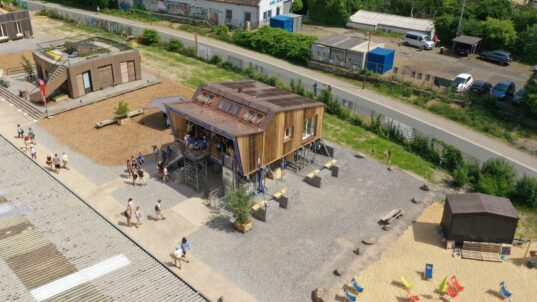
Since 18 May 2022, Team RoofKIT has been in Wuppertal to build the House Demonstration Unit on the Solar Campus of the Solar Decathlon Europe 2021/22. In the first week, the foundation was prepared, the scaffolding, steel beams and gabions were erected. Then the modules were delivered by Kaufmann Zimmerei und Tischlerei and assembled in one spectacular day. The second week was dominated by the paving and electrical work as well as the interior design of the unit. Finally, the building was professionally photographed by architectural photographers Zooey Braun and Carolin Wengert.
On 3 June 2022, Team RoofKIT received the final approval from the organisers of the Solar Decathlon just in time and thus 10 bonus points. This concludes the assembly phase and the monitoring phase is currently underway in Wuppertal.
The Solar Decathlon event will take place in Wuppertal from 10 to 26 June 2022. Visitors will experience future-oriented architecture and creative climate protection at first hand. Free entry tickets are now available online at tickets.sde21.eu.
The Solar Decathlon is the meeting place for all architecture lovers, construction experts, sustainability supporters and interior design fans. Visitors can expect a veritable treasure trove of environmentally friendly, affordable and appealing building and living ideas. Whether it’s a flat made of wood with a roof garden, a home with cellulose-based components from the 3D printer or creative upcycled furniture: sixteen fully functioning, furnished house prototypes are waiting to be visited.
Over 30 local and national event partners are organising the accompanying programme. Visitors can enjoy the many offers and activities on the Solar Campus in Wuppertal free of charge. Concerts, exhibitions, award ceremonies and an international culinary offer complete the programme.
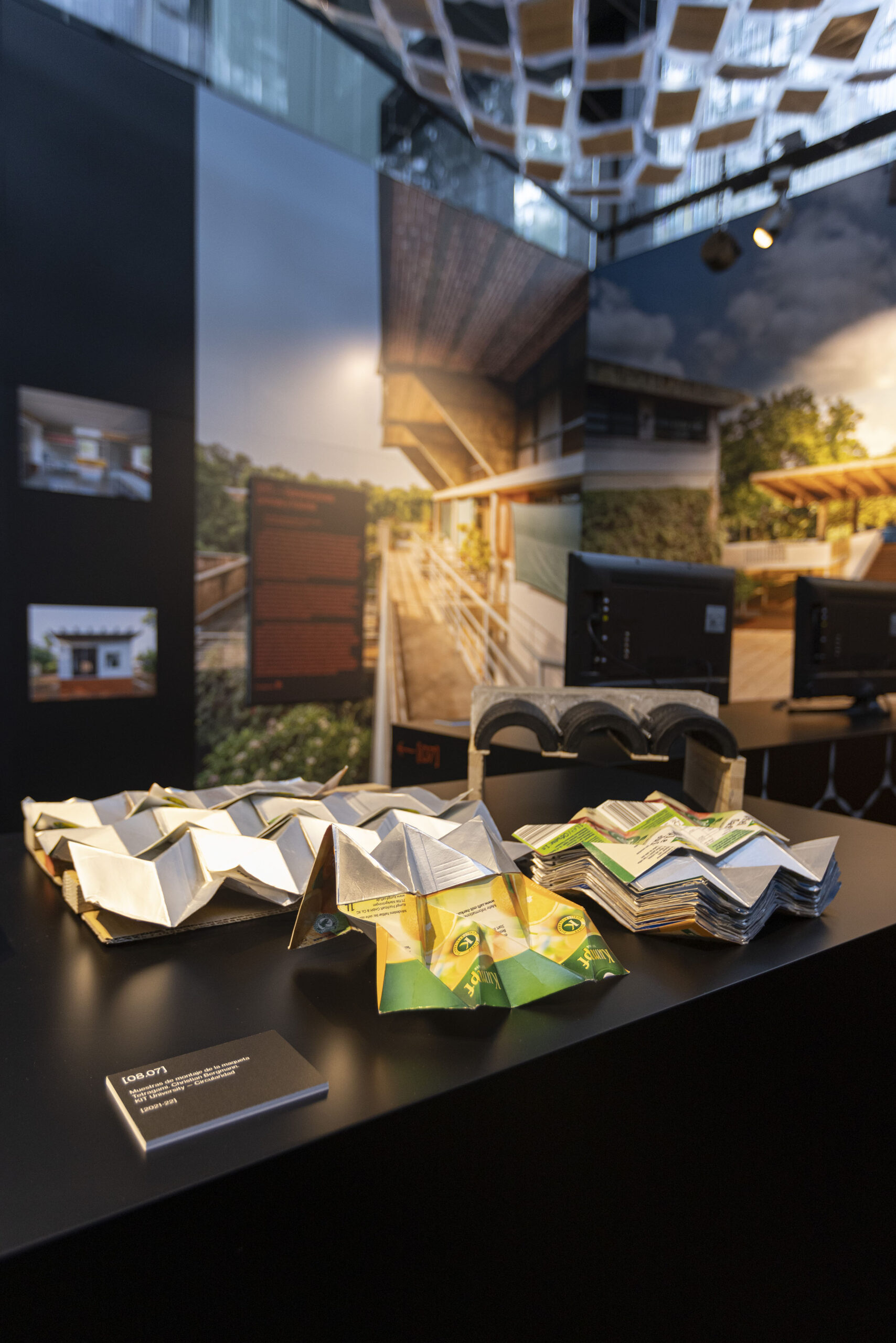
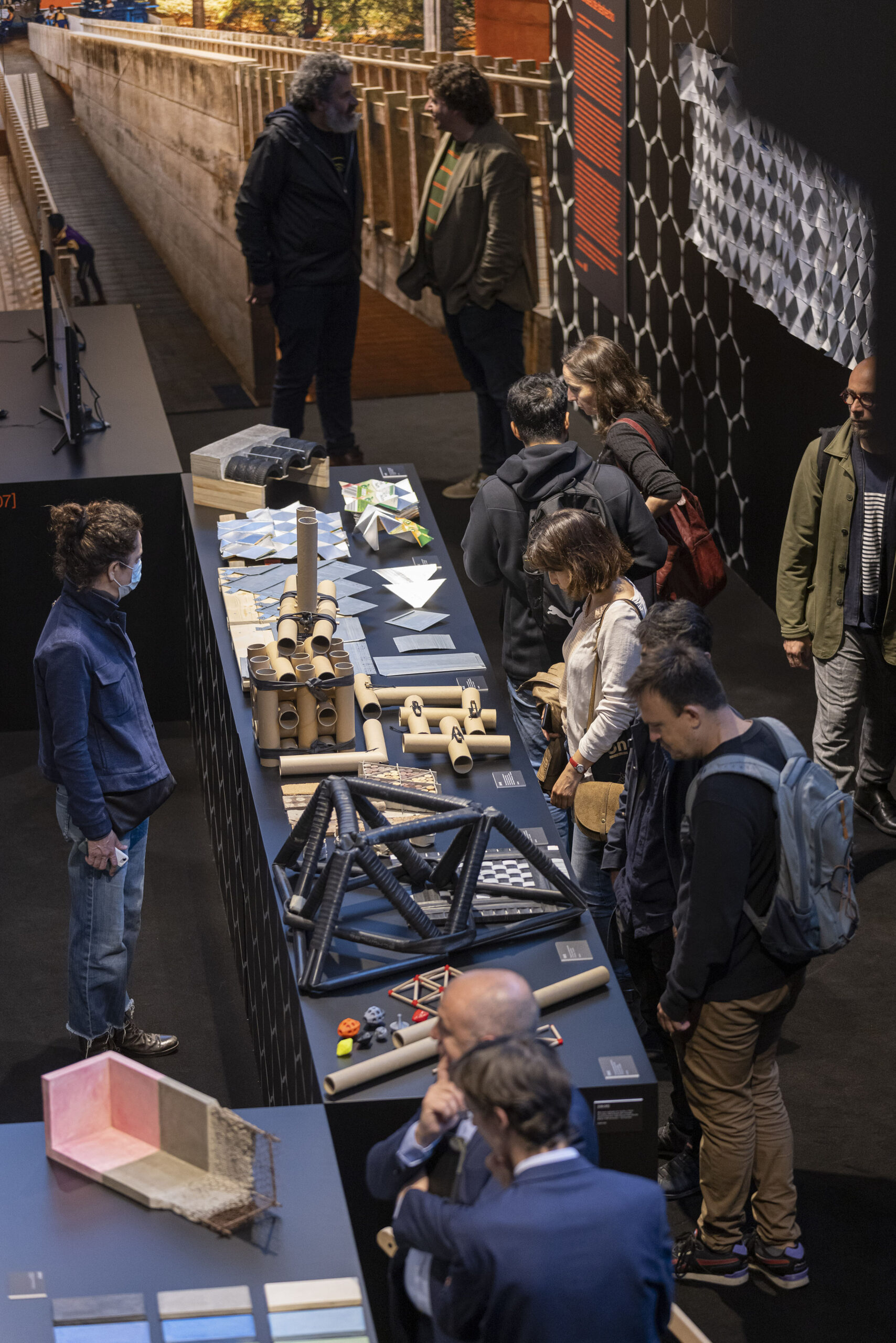
The exhibition shows, among other projects, student work from the design studio “Circularity – Architecture as a Mechanism of Waste Capture”, which took place in the winter semester 21/22 as part of Anupama Kundoo’s sto visiting professorship at KIT, Chair of Sustainable Building. Supervisors Prof. Dr. Anupama Kundoo and Daniel Lenz.
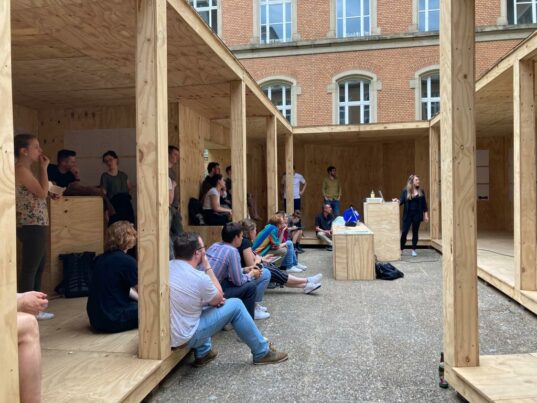
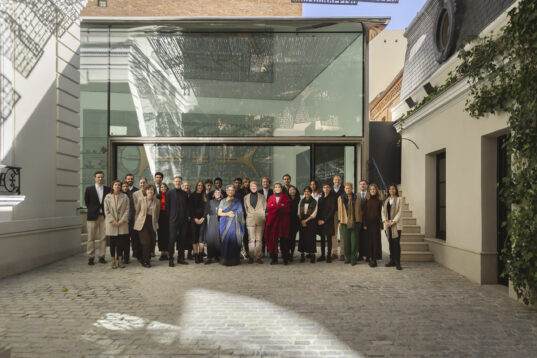
As part of a team meeting, the RoofKIT team prepared for the Solar Decathlon competition in Wuppertal in the courtyard of the department of architecture.
The student team leader Regina Gebauer hosted the evening. Topics addressed included the assembly and disassembly phase, as well as work shifts, accommodation and the event phase.
The event ended with a wine tasting with an associated evaluation with regard to the dinner evening.
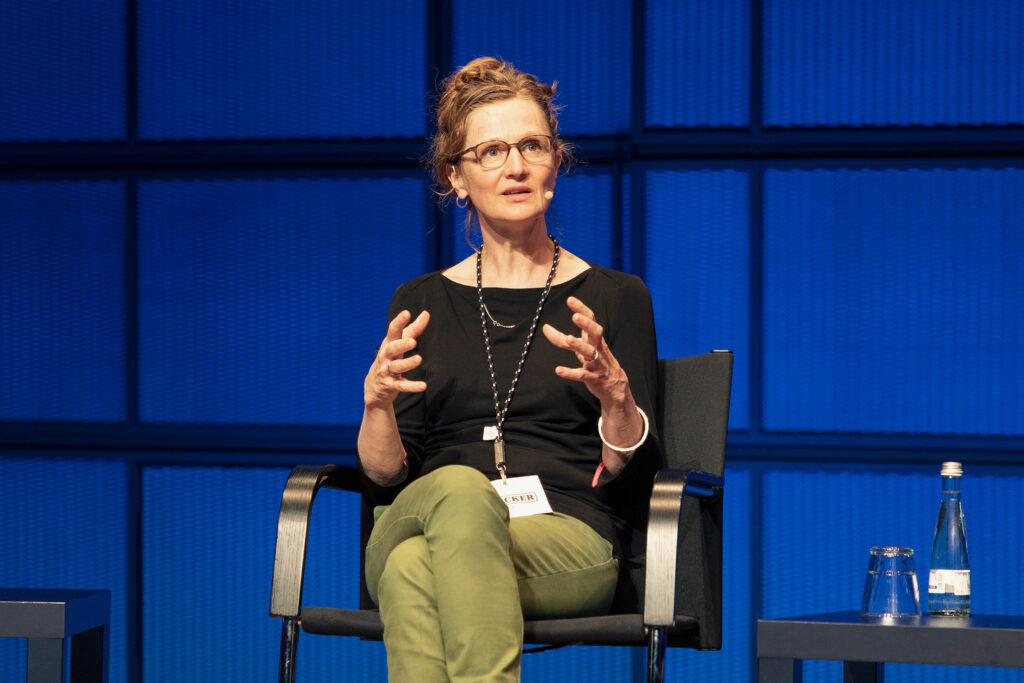
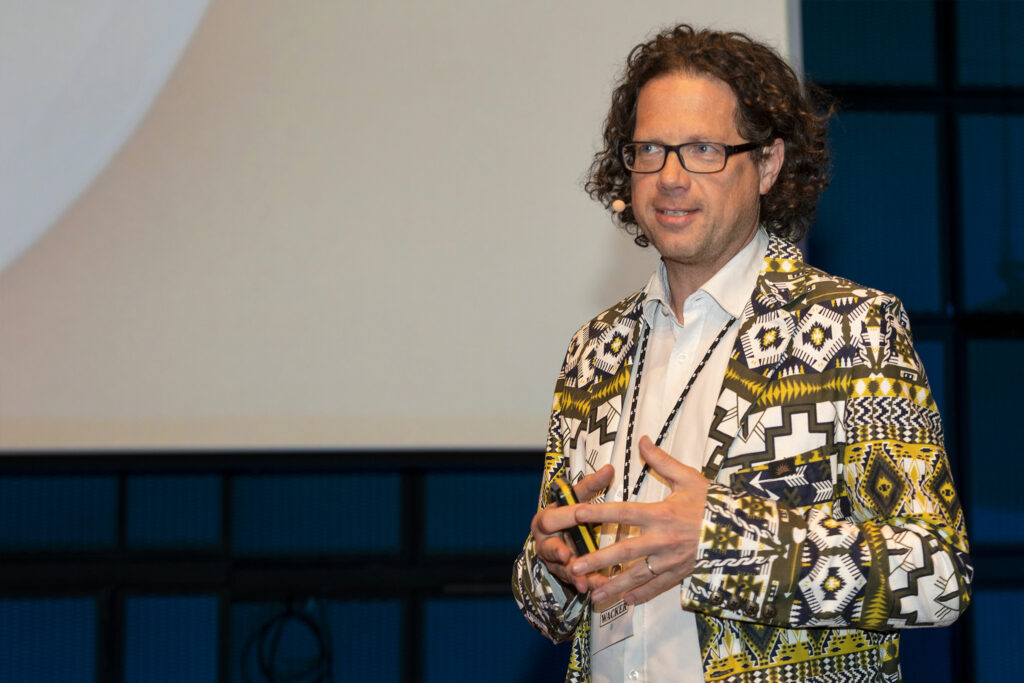
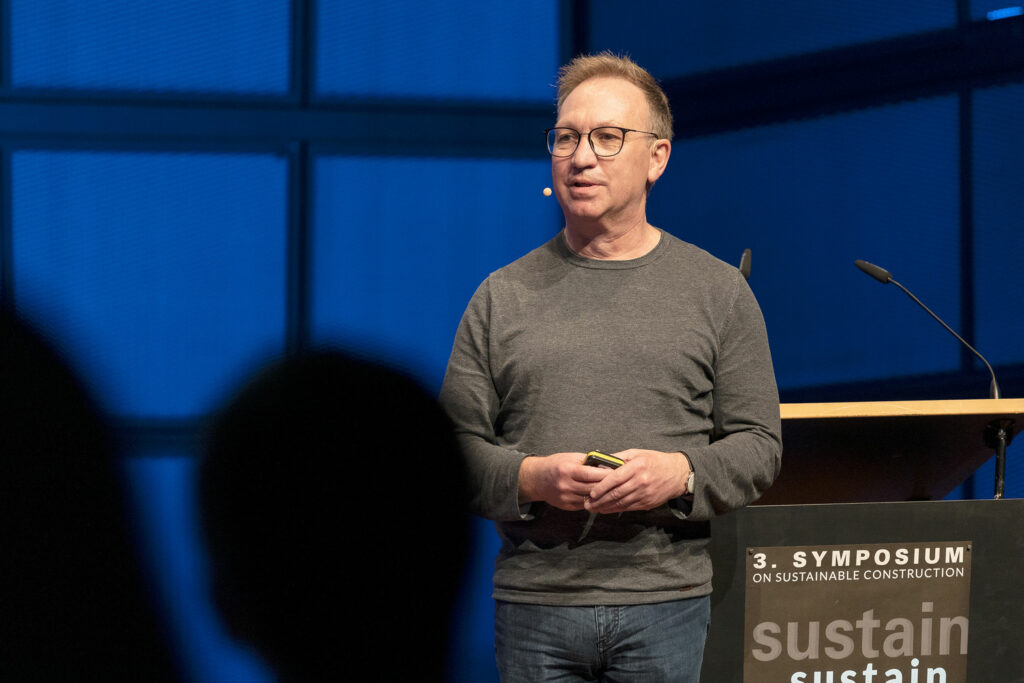
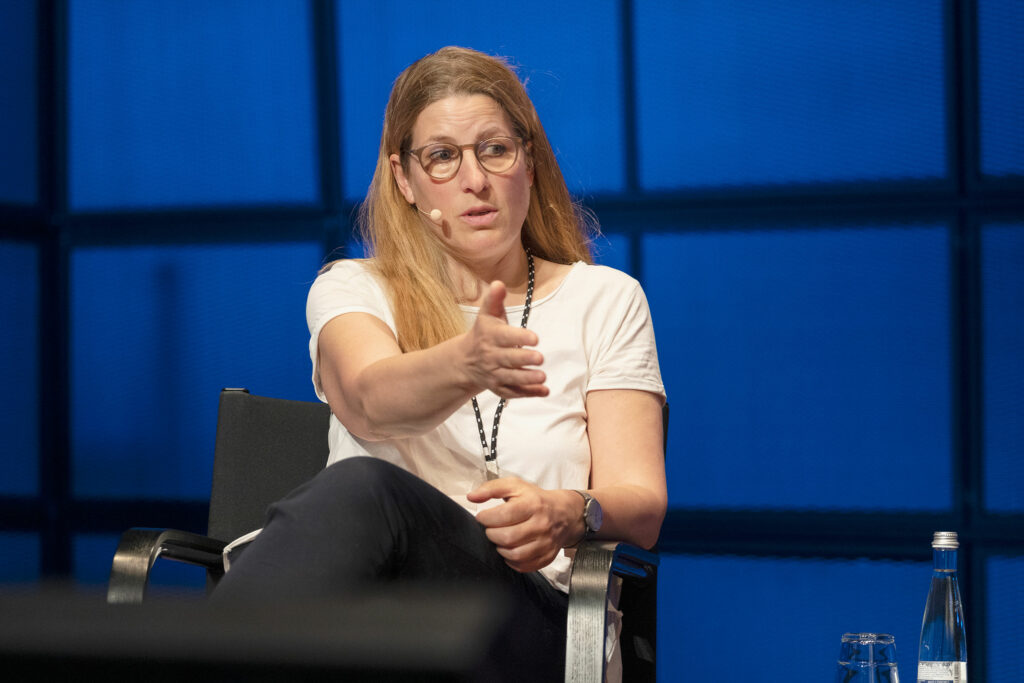
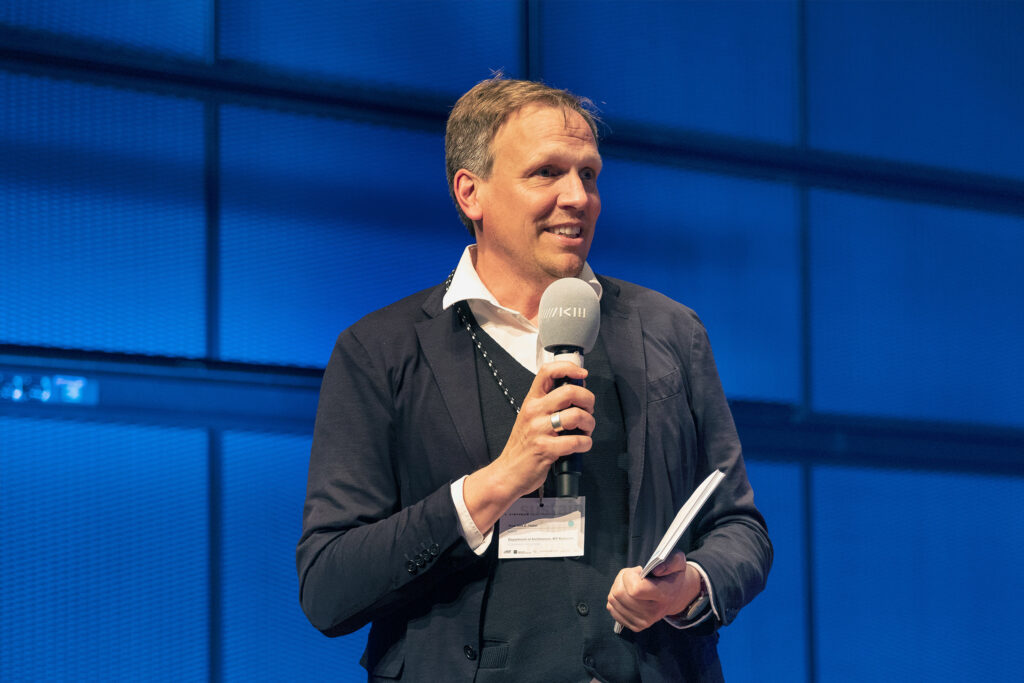
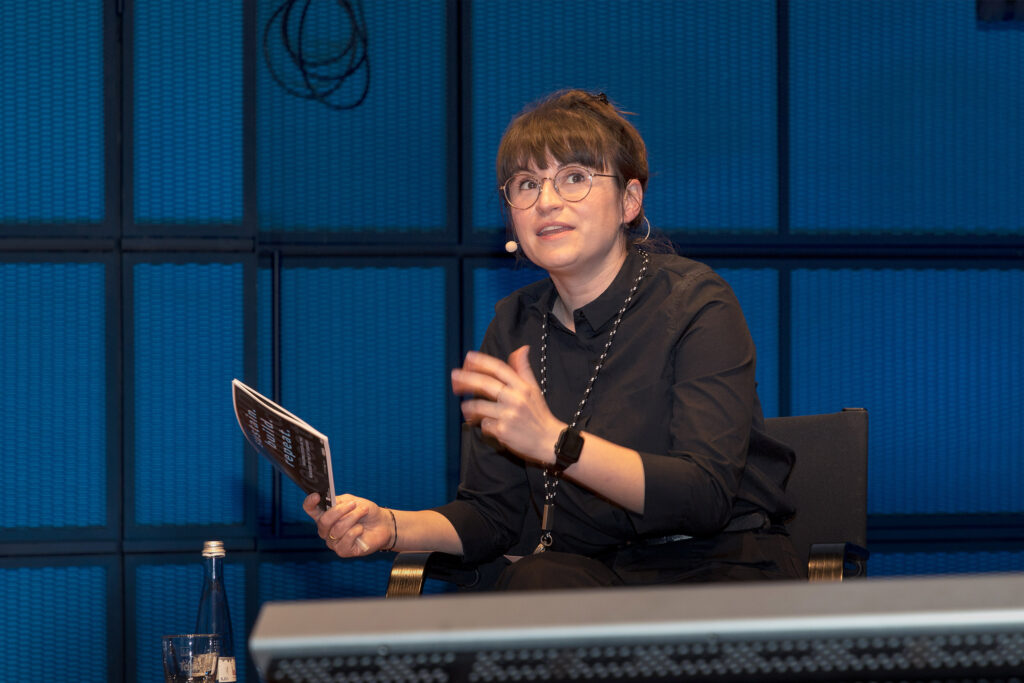
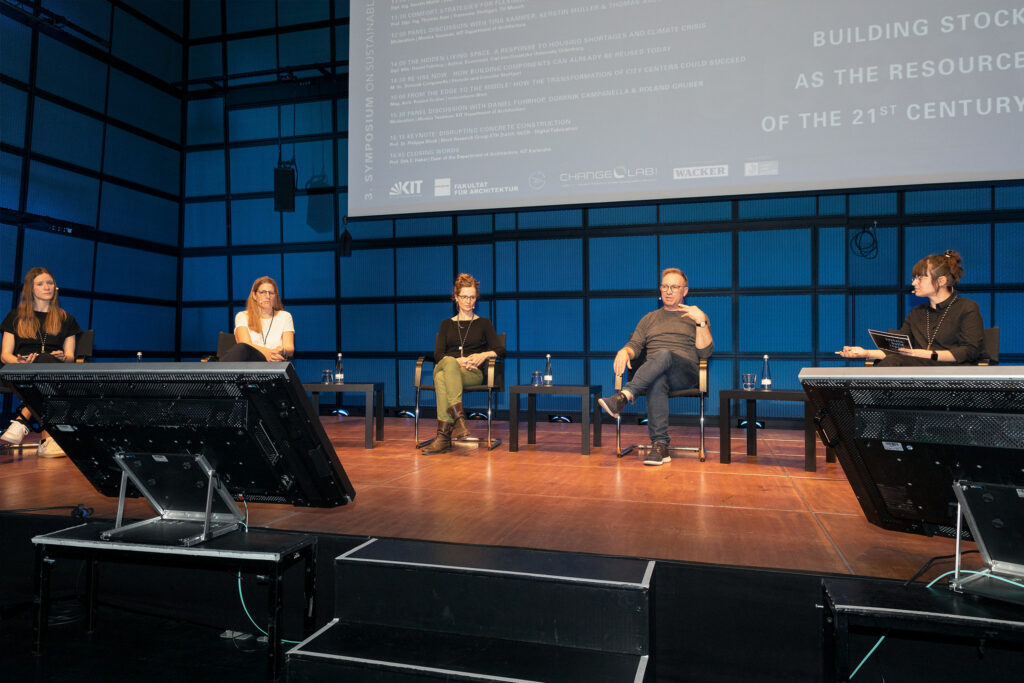
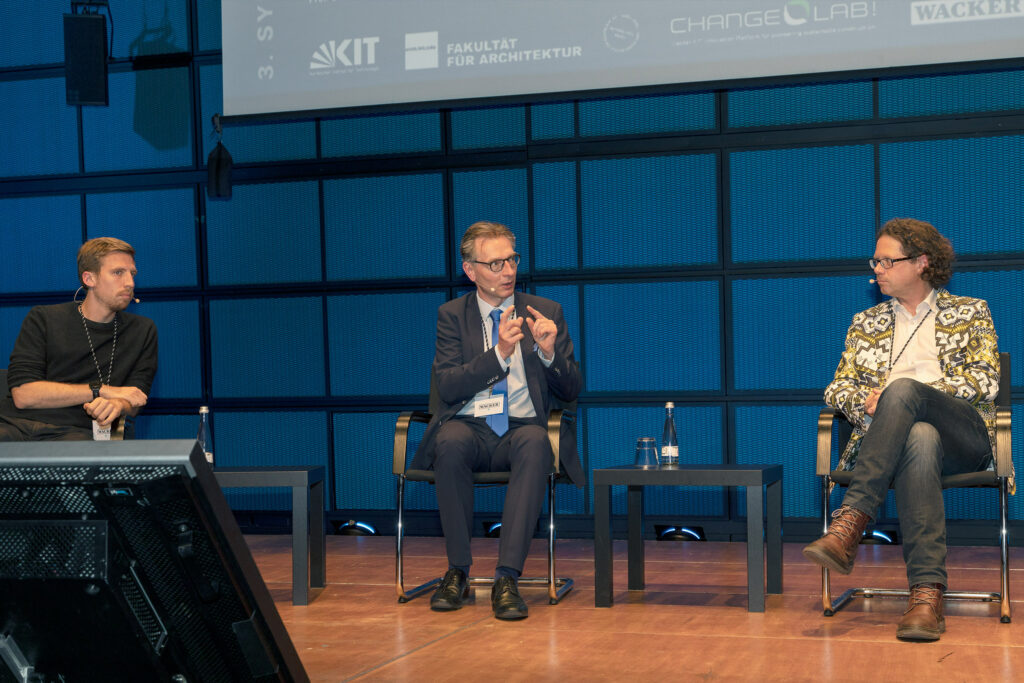
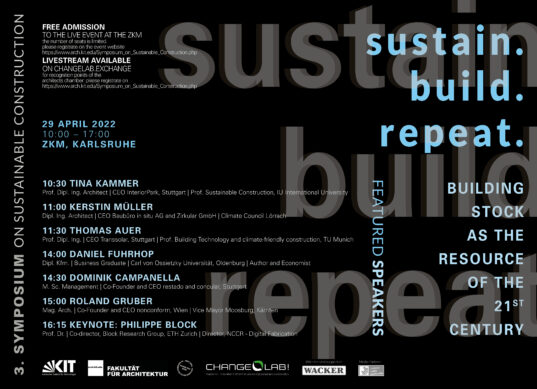
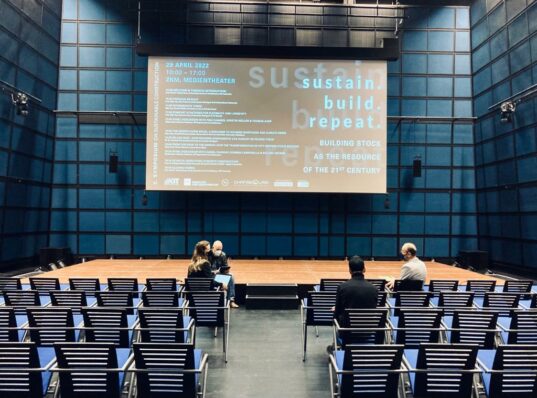
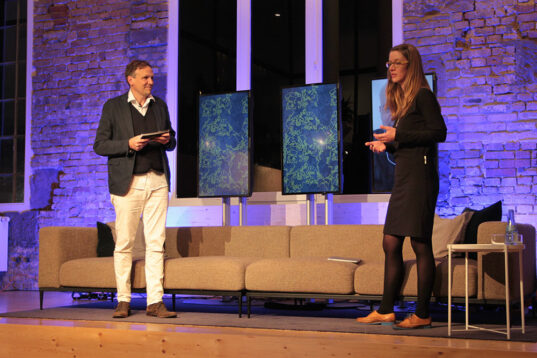
On 29 April, the Chair of Sustainable Construction was a guest at the Centre for Art and Media (ZKM) Karlsruhe to organise, in cooperation with the Faculty of Architecture, PINK Event Service, mint Café, Campusradio Karlsruhe and many more, the 3rd Symposium for Sustainable Construction “sustain.build.repeat. – building stock as the resource of the 21st Century”.
Invited speakers were Tina Kammer, Kerstin Müller, Thomas Auer, Daniel Fuhrhop, Dominik Campanella, Roland Gruber and Philippe Block. The panel discussions were moderated by Monica Tusinean, who was assisted by Elena Boerman with audience questions. Prof. Dirk E. Hebel guided the audience through the event.
Around 100 participants were present at the ZKM, and many viewers also followed the event online. Parallel to the event, we recorded a podcast with our speakers to further elaborate on the content of the presentations.
We would like to sincerely thank all those involved in the event for their commitment and organisational efforts, for the great encounters, conversations and new connections that were created at and through the symposium. Thank you!
>>> Registration for the live event at ZKM expired on 21st April 2022 >>> Livestream openly available (without prior registration) >>> Please register here after the event for Educations Points of the Architektenkammer BW
Our 3rd Symposium on Sustainable Construction at a glance: date: 29th April 2022 from 10AM to 5PM (admission from 9AM) location: ZKM Medientheater Karlsruhe, registration expired livestream: The event will be livestreamed openly and without registration on changelab.exchange
The symposium sustain.build.repeat. is dedicated to the resource of the 21st century: our building stock. With growing waste volumes and ever scarcer raw materials, careless building demolitions and replacements must be avoided. Instead, existing buildings should be converted and rebuilt, components removed, reused and reused again.
It is important to preserve as much of the existing building stock as possible on the premise of resource- and climate-friendly architecture: on the one hand as a changeable space in which various usage scenarios are possible, and on the other hand as a material depot and secondary raw material supplier. Representatives from science and industry, research and practice will present ideas, strategies and impulses on how the ecological necessity of reconstruction and transformation of the existing can become an enriching element of a caring, needs-oriented and value-preserving architecture in ecological balance.
We are very pleased to welcome the following speakers to our event: Thomas Auer, Philippe Block, Dominik Campanella, Daniel Fuhrhop, Roland Gruber, Tina Kammer, and Kerstin Müller.
Additionally, a thematic introduction will be given by Prof. Dirk Hebel, Professor of Sustainable Construction and Dean of the Department of Architecture, the panel discussions between the lectures will be moderated by Monica Tusinean. In the foyer in front of the Medientheater, there will be an accompanying exhibition of student works that deal with the preservation of existing stock.
The event is organised by the Professorship of Sustainable Construction of the KIT Department of Architecture. The symposium is part of ChangeLab, an innovation platform for sustainability in the building industry, sponsored by Wacker Chemie AG.
The event and the livestream will also be part of the education programme of the Architektenkammer Baden-Württemberg (AKBW registration number: 2022-151695-0001). In order to receive training points for participation in the livestream, it is absolutely necessary to verify participation in the form provided AFTER the event on arch.kit.edu.
Admission to the ZKM will begin at 9AM on the event day. The symposium will start at 10 am and last until 5pm. A get together and guided tours of the current ZKM exhibition “BioMedien” will be offered for our participants from 5 to 6 pm.
We look forward to your participation in the event!
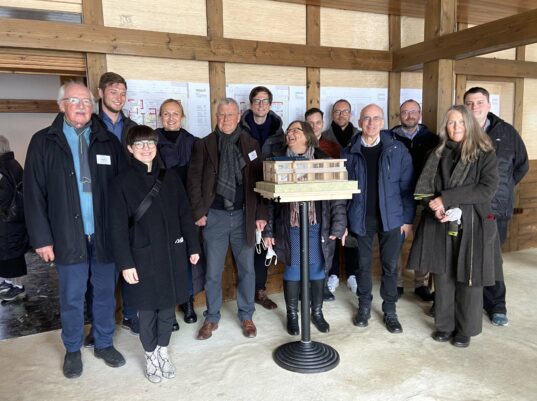
On 2 April 2022, nestbau AG Tübingen invited to an open day at the “Neschtle” in Pfrondorf. In addition to a greeting by Gunnar Laufer-Stark from nestbau AG and the presentation of the timber construction planned on site in Pfrondorf (architecture bürohauser), the event also included a small exhibition of student work from the design course “(H)Austausch!”, which was created in the winter semester 2020/21 at KIT.
The students dealt with the question of how a synergetic solution can be found for the two coinciding phenomena of housing shortage (e.g. for young families who need space) on the one hand and housing overflow (e.g. due to changed life situations such as children moving out, widowhood, etc.) on the other. Architectural ideas were developed on how such a “house swap” could look like: Close-to-the-environment, adapted, attractive, but also sufficiency-oriented living space for people who are willing to leave their flats and houses that have become too big.
Daniel Lenz represented the Chair of Sustainable Building and, together with the students present, answered questions from the visitors.
(de)
Am 2. April 2022 lud die nestbau AG Tübingen zum Tag der offenen Tür ins “Neschtle” nach Pfrondorf. Die Veranstaltung umfasste neben einem Grußwort von Gunnar Laufer-Stark von der nestbau AG und der Präsentation des am Ort in Pfrondorf geplanten Holzbaus (Architektur bürohauser) auch eine kleine Ausstellung der Studierendenarbeiten des Entwurfskurses “(H)Austausch!”, der im Wintersemester 2020/21 am KIT entstand.
Die Studierenden beschäftigten sich mit der Frage, wie für die beiden zusammentreffenden Phänomene Wohnungsknappheit (z.B. für junge Familien, die Platz benötigen) auf der einen Seite und Wohnraumüberfluss (z.B. durch veränderte Lebenssituationen wie Auszug der Kinder, Verwitwung, etc.) eine synergetische Lösung gefunden werden kann. Es wurden dabei architektonische Ideen entwickelt, wie solch ein “Haustausch” aussehen könnte: Umfeldnaher, angepasster, attraktiver, aber auch suffizienter Wohnraum für Menschen, die dafür bereit sind ihre zu groß gewordenen Wohnungen und Häuser zu verlassen.
Daniel Lenz vertrat die Professur Nachhaltiges Bauen und stand zusammen mit anwesenden Studierenden den Besuchern Frage und Antwort.
An exhibition by the Vitra Design Museum, V&A Dundee and maat, Lisbon
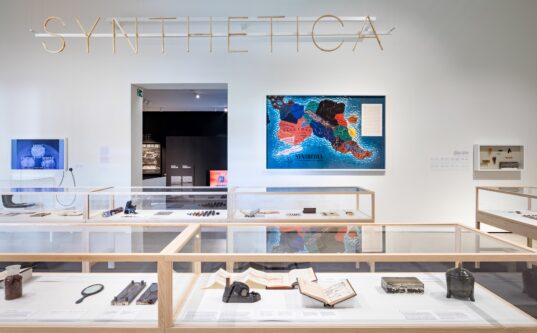
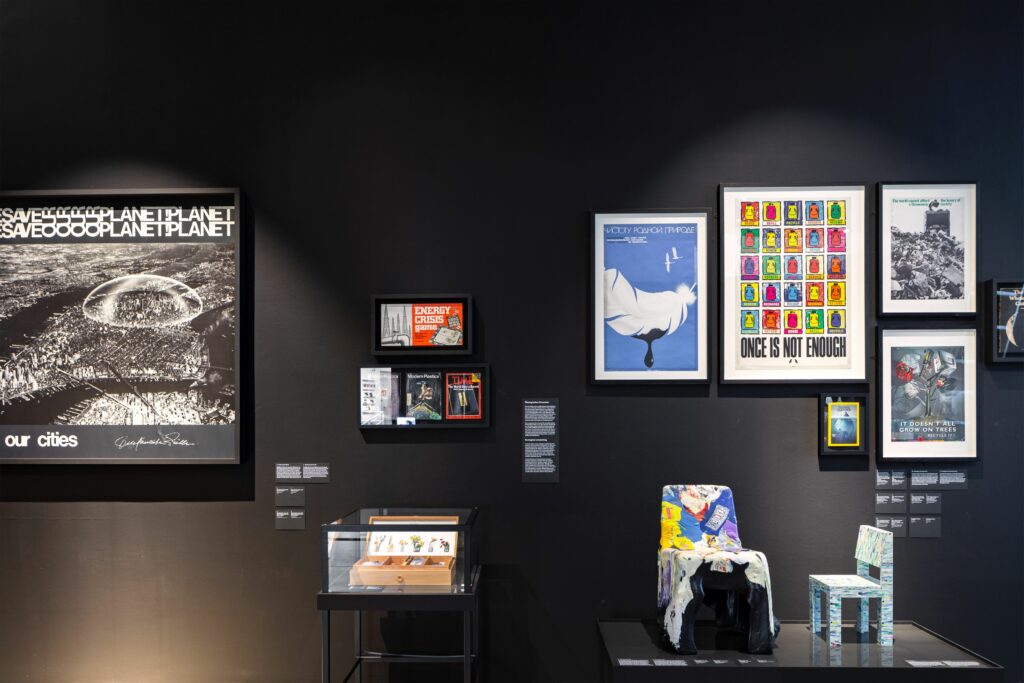
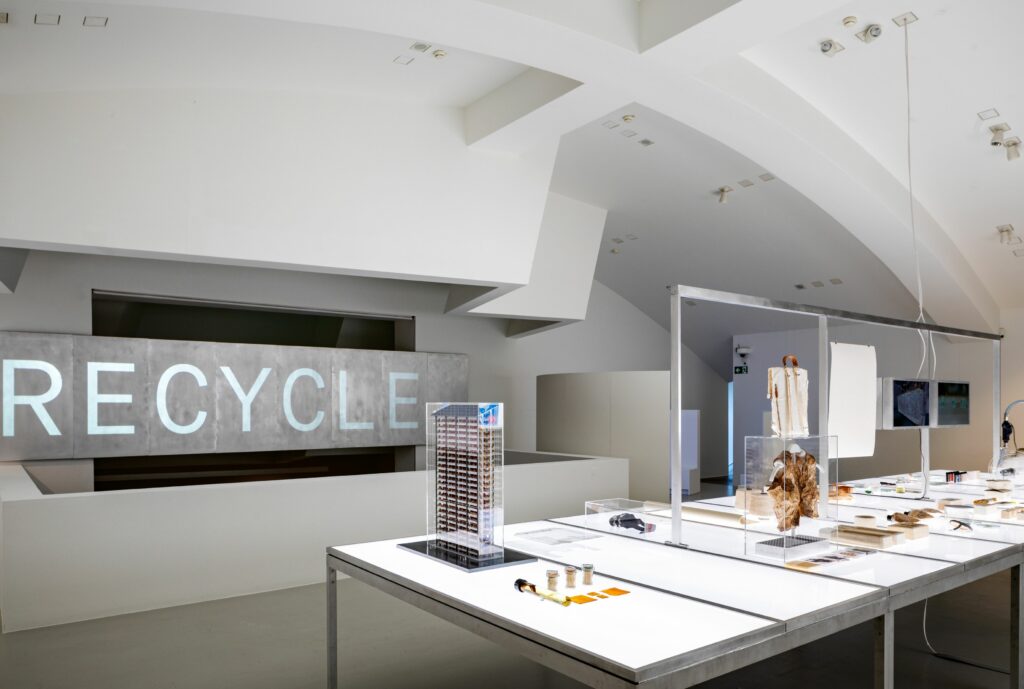
The Vitra Design Museum in Weil am Rhein presents the exhibition ‘Plastic: Remaking our World’ as an exploration of the history and future of the controversial material. Plastics have symbolized a world of carefree consumerism and revolutionary innovation, opening the doors for designers and architects for decades. Of course today, the dramatic consequences of the plastic boom have become so obvious that the material has lost its utopian connotation.
The exhibition begins with a large-scale video installation spotlighting the conflicts linked to the production and use of plastic. Timeless images of unspoilt nature are juxtaposed with film documents from one hundred years of plastic industry that convey the ambiguous fascination of increasingly fast-paced automated production at rapidly diminishing costs. The formation of fossil resources such as coal and oil took more than two hundred million years, while the synthetic materials made from them needed little more than a century to become a problem of planetary scale.
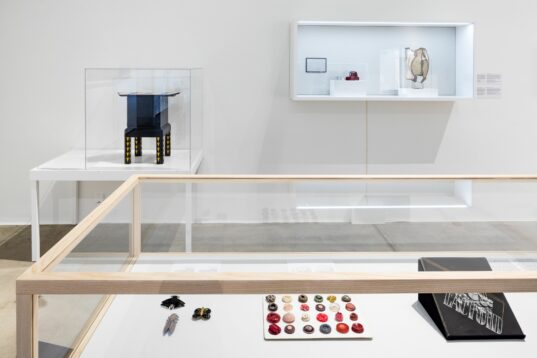
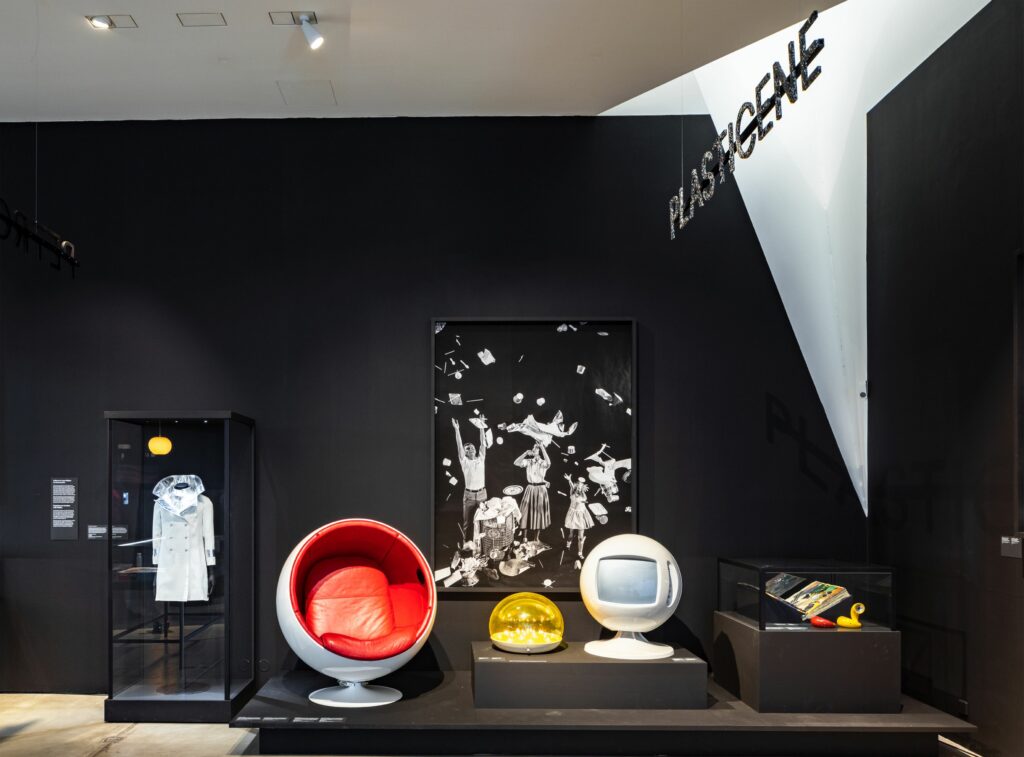
The second part of the exhibition describes the evolution and the shifting perceptions of plastics from their beginnings in the mid-nineteenth century to their global omnipresence today. The first plastic materials were plant- or animal-based: for centuries, horn and tortoiseshell were used to create drinking vessels and to embellish cutlery. In 1907, Leo Baekeland invented the first plastic made of purely synthetic components and named it Bakelite. It was hailed as the material of infinite uses. Being nonconductive, Bakelite was soon used for light switches, wall sockets, or radio sets and played a central role in the electrification of everyday life.
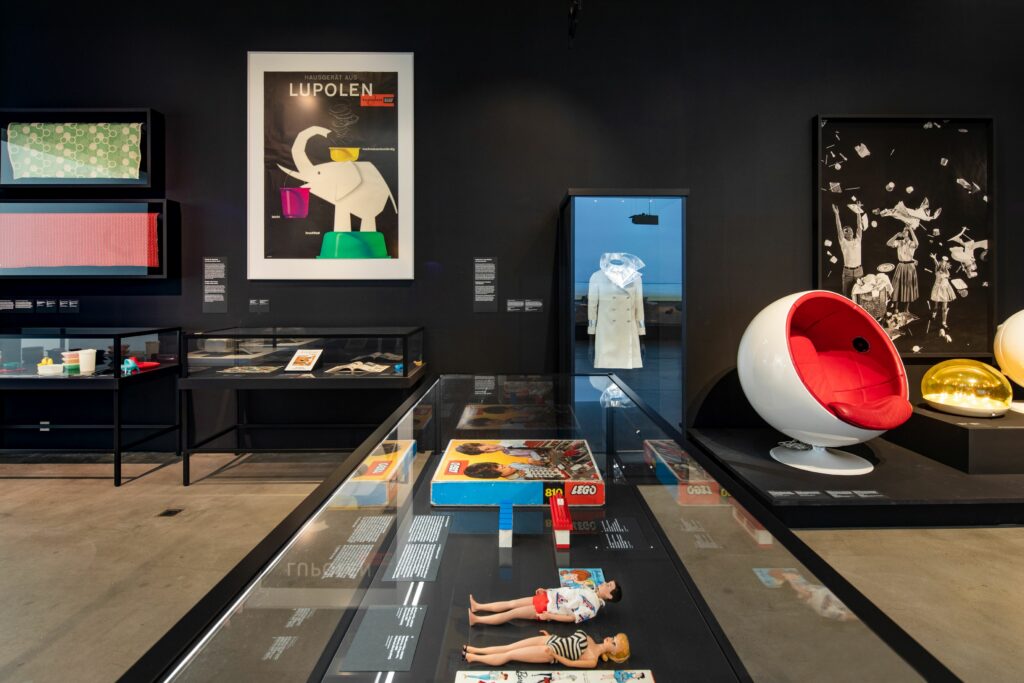
While early plastics were often developed by independent inventors and tinkerers, from the 1920s onwards the expanding petrochemical industry took a leading role. This marked the beginning of an era of »petromodernity«. When industrial design emerged as a profession of its own in the 1930s, its proponents were quick to embrace the possibilities of the new materials. Also Architects began to discover plastics as a building material and in 1957 Monsanto installed the all-plastic »House of the Future« at Disneyland.
A few years later, a growing fascination with space flight shifted the focus to plastic’s utopian potential, which was reflected in futurist shapes and new interior design concepts. In the 1960s, based on the notion of convenience and fuelled by the packaging industry, the idea of single-use plastics was introduced and a new throwaway culture began to spread. The oil crisis in 1973 meant lower supplies and higher prices for the resource from which most plastics were made, but it had little long-term effect on the plastic boom. While global plastic production soon picked up again, strategies for reducing plastic waste were slow to emerge.
Today, plastics are globally omnipresent and an intricate part of our lives. Like no other, the human health sector exemplifies the plastic paradox – its positive, sometimes lifesaving qualities as well as its negative, even life-threatening impacts. The issues arising from the plastic boom have etched themselves in our collective consciousness: from microplastic in the soil, in the oceans, and in our bodies to mountains of packaging waste that are often disposed of or burnt – with immense ecological consequences on a global scale.
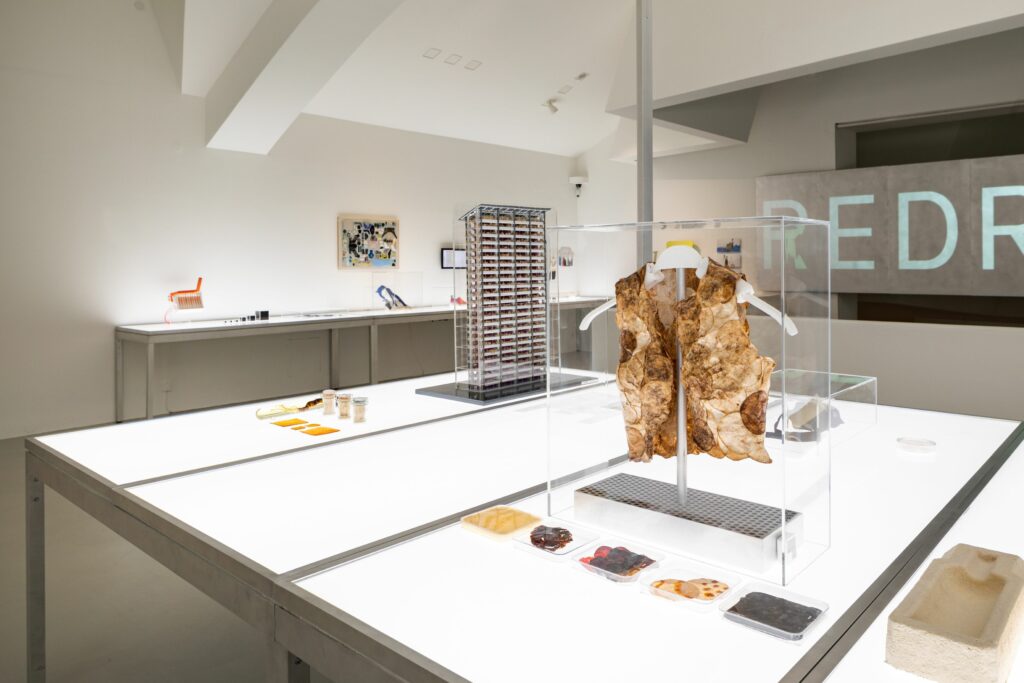
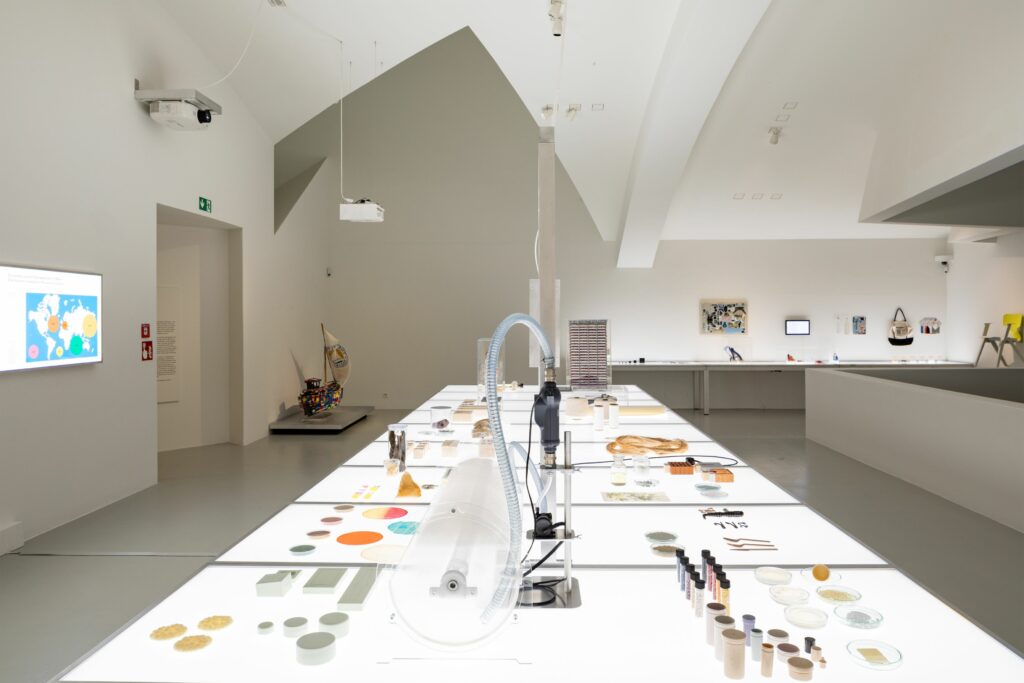
How can we overcome the global plastic waste crisis? And what role can design – alongside industry, consumers, and politics – play in the process? These are some fundamental questions addressed in the final part of the exhibition. In recent years, many scientists and designers have started exploring materials that are based on renewable rather than fossil resources and often referred to as bioplastics.
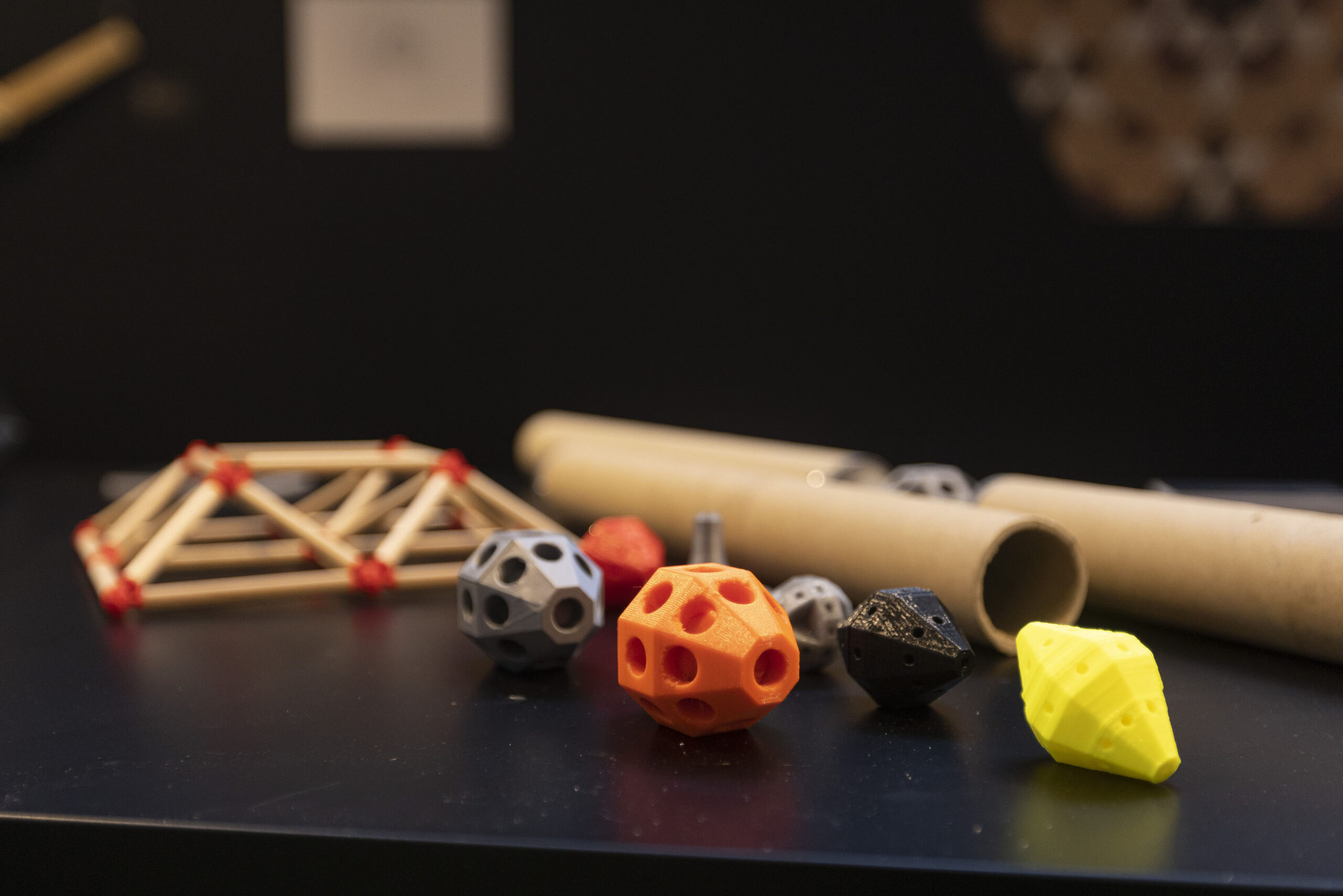
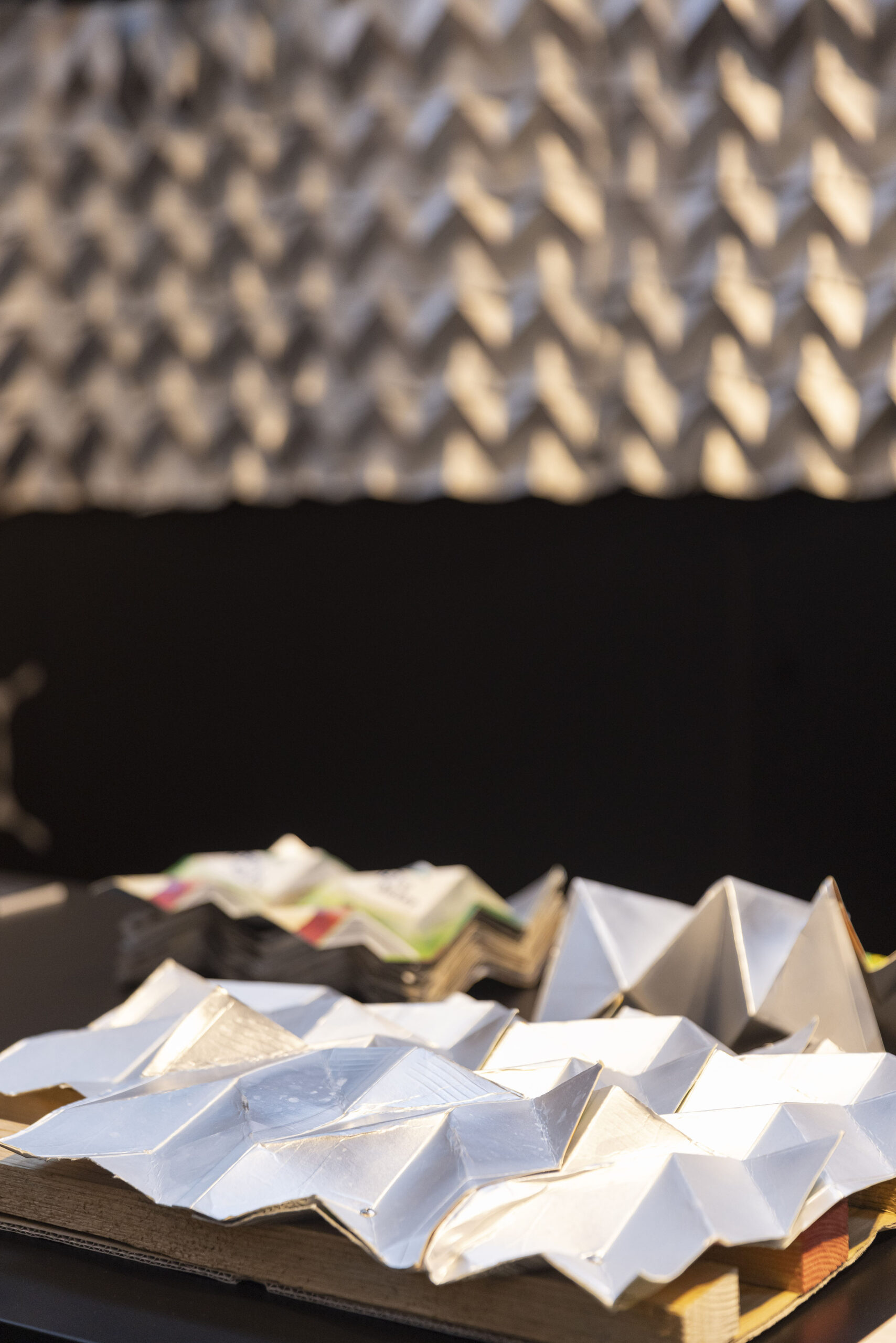
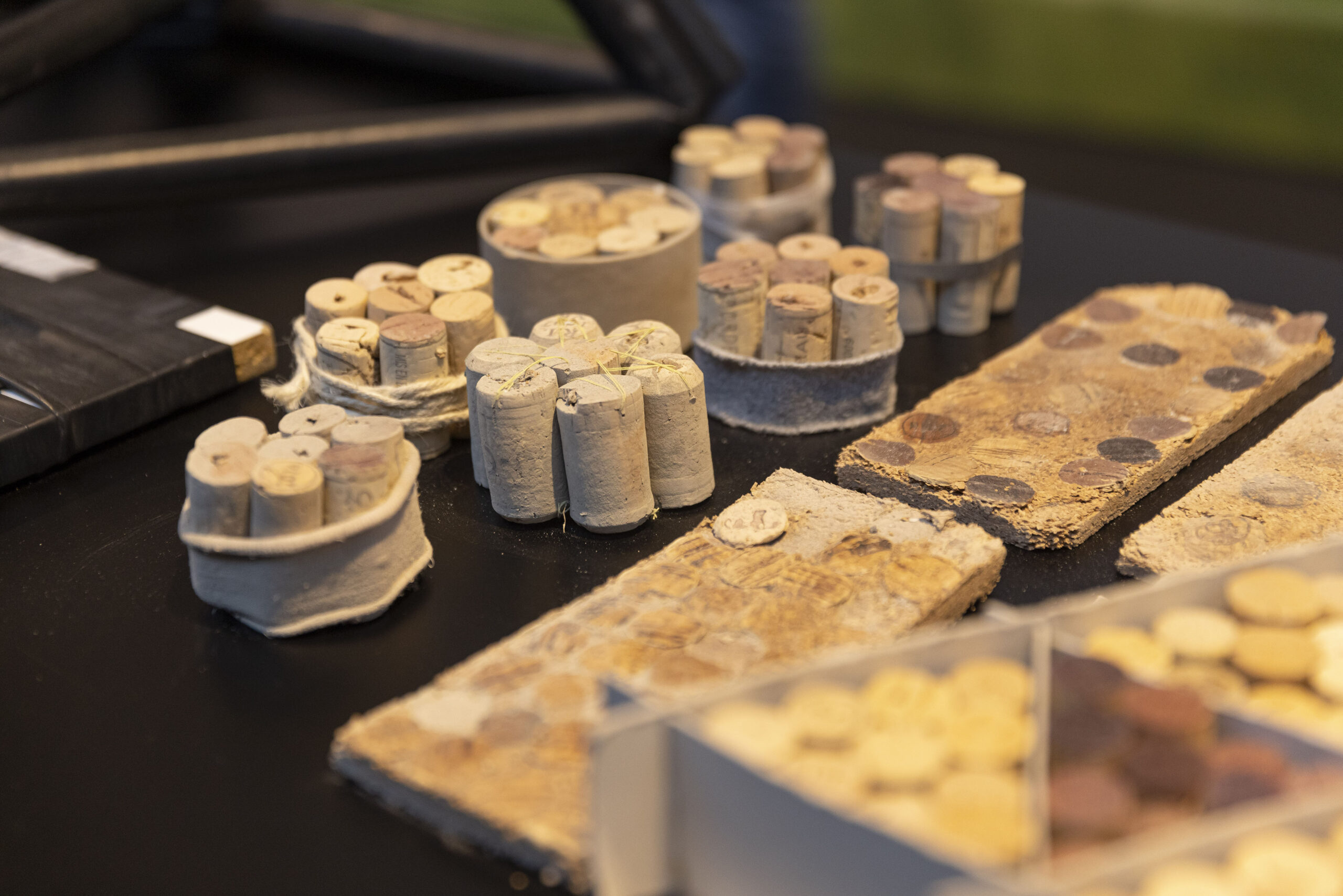
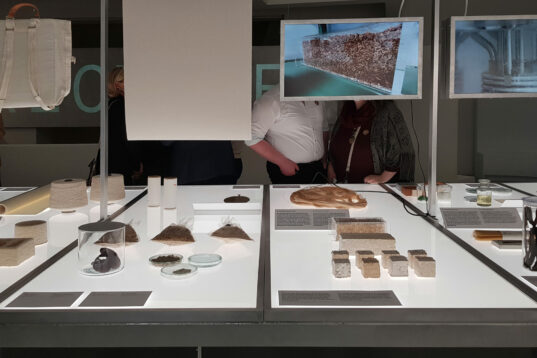
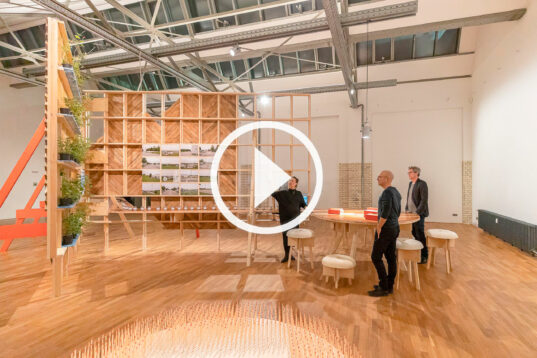
The Professorship of Sustainable Construction of the KIT Department of Architecture was asked to exhibit their ongoing research of building materials made from mycelium. Therefore the team prepared the different steps of growth of a mycelium brick to show biological alternatives for the building sector.
As a whole, the exhibition »Plastic: Remaking Our World« offers a critical and differentiated reassessment of plastic in today’s world. It aims to address the bigger picture of plastic and its complex role in our world: by analysing how we came to be so dependent on it, by reassessing where the use of plastic is essential and where it can be reduced or replaced, and by reimagining possible futures for this contested material.
The Opening Talk and the Vernissage of the exhibition took place on the 25th March 2022. It will be shown in the Vitra Design Museum until 4th September 2022 and then move to the V&A Dundee London and the maat in Lisbon. (Text: Vitra Design Museum)
“Plastics have shaped our daily lives like no other material: from packaging to footwear, from household goods to furniture, from automobiles to architecture. A symbol of carefree consumerism and revolutionary innovation, plastics have spurred the imagination of designers and architects for decades. Today, the dramatic consequences of the plastic boom have become obvious and plastics have lost their utopian appeal. The exhibition »Plastic: Remaking Our World« at the Vitra Design Museum will examine the history and future of this controversial material – from its meteoric rise in the twentieth century to its environmental impact and to cutting-edge solutions for a more sustainable use of plastic. Exhibits will include rarities from the dawn of the plastic age and spectacular objects of the pop era as well as numerous contemporary designs and projects ranging from pragmatic product innovations to solutions for cleaning up the oceans and bioplastics made from algae or mycelium.” (Official announcement by the curators)
The Professorship of Sustainable Construction has been invited to present extracts from their mycelium research in this exhibition. The exhibition will take place at the Vitra Design Museum from 26 March 2022 to 04 September 2022.
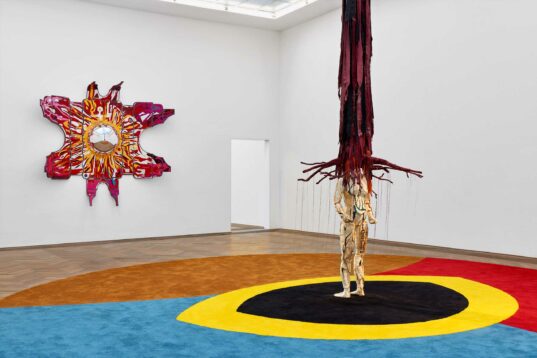
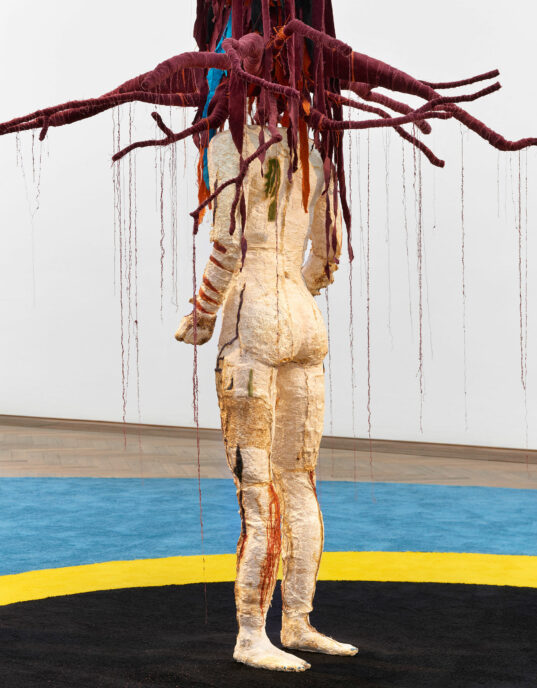
The KIT Professorship of Sustainable Construction (Nazanin Saeidi and Alireza Javadian) was asked by the Brazilian-Swiss artist Pedro Wirz to build a human figure out of mycelium, which has since become part of his exhibition at Kunsthalle Basel.
With the playful and colourful exhibition “Environmental Hangover”, the artist pleads for more sustainability. He draws attention to the fossil age in various ways and, on this occasion, also deliberately softens the boundaries between nature and technology in places. In addition, he uses the contents of the exhibition to criticise the unmistakable permanent traces that humans leave on the earth and in cities.
The legendary Curupira, the imposing protector of the forests and animals from mycelium, closes the exhibition. With this object, too, the artist draws attention to the importance of sustainability in all areas of life.
The exhibition can be seen in the Kunsthalle Basel until the 1st May 2022. More information on the website of the Kunsthalle Basel.
The “Solar Decathlon Europe” is one of the most important competitions for students in the field of architecture and construction. Here, in a multi-semester effort by interdisciplinary teams, solutions are to be found for the enormous challenges facing our society and its architecture.
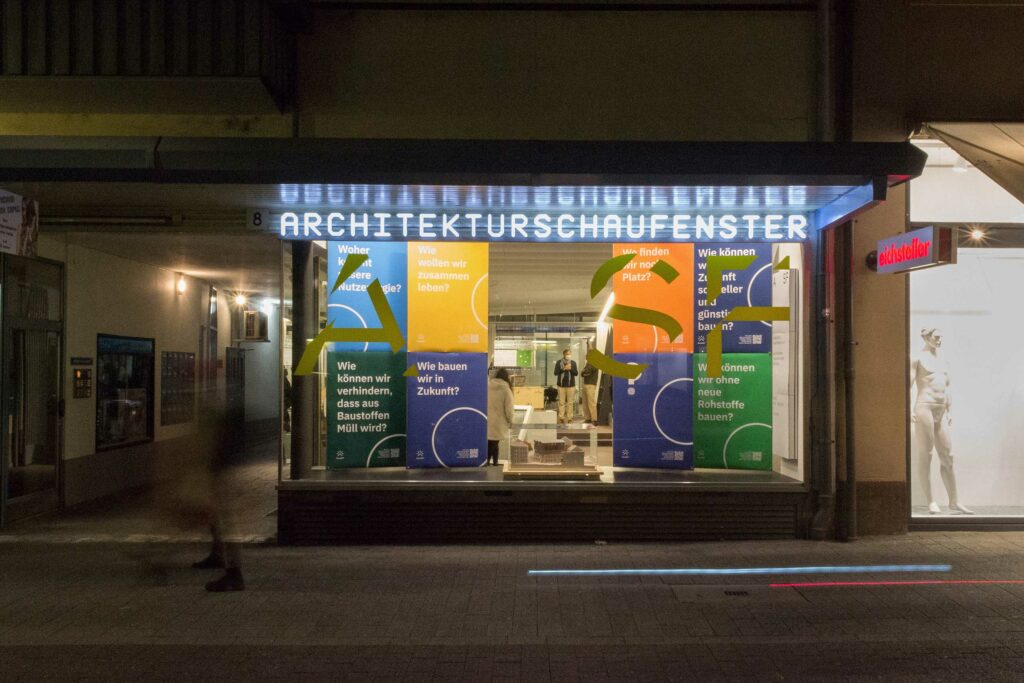
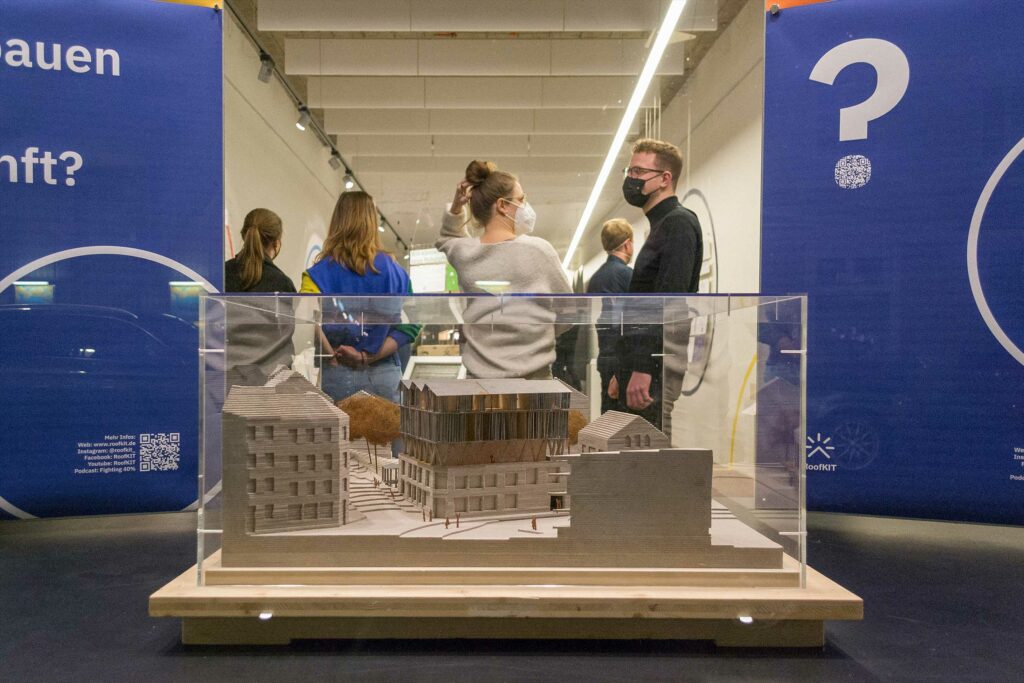
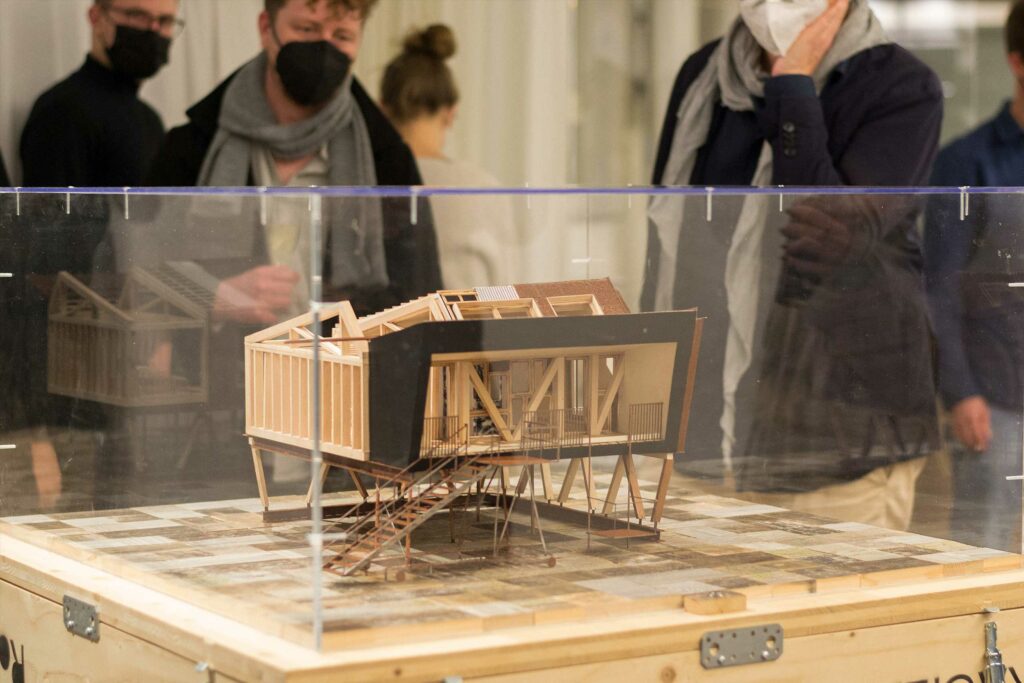
The KIT Faculty of Architecture is participating with the RoofKIT project. The exhibition uses the project as an example to show what these challenges are and how we can face them: Radical reduction of energy consumption, circular construction, use of the city as a resource, use of renewable raw materials in modular and single-variety construction, space-saving forms of living together and intelligent concepts of urban redensification.
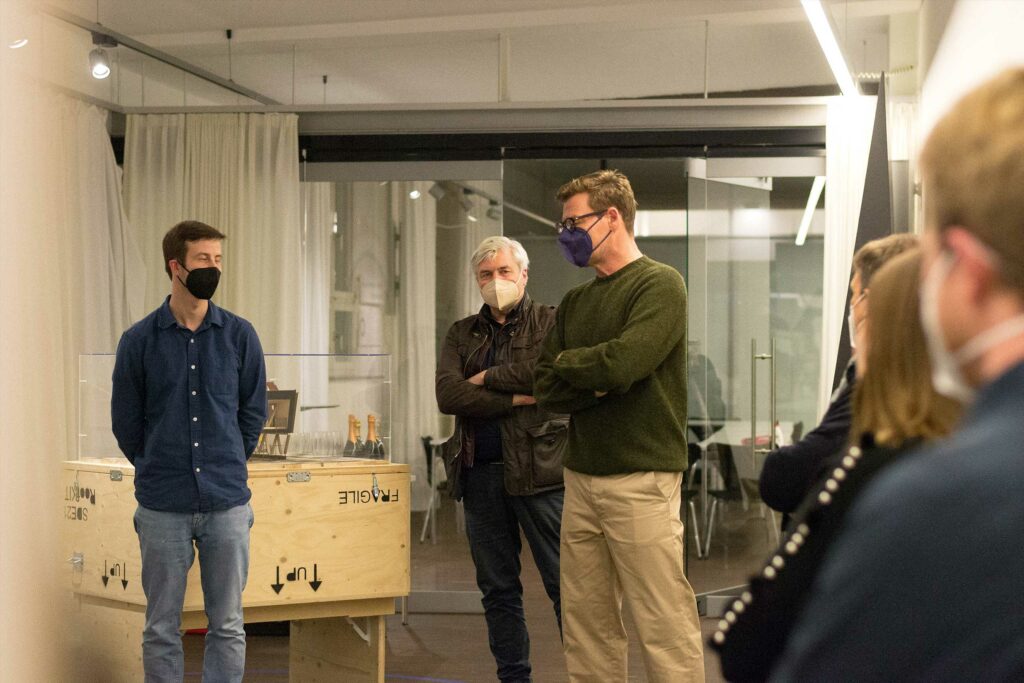
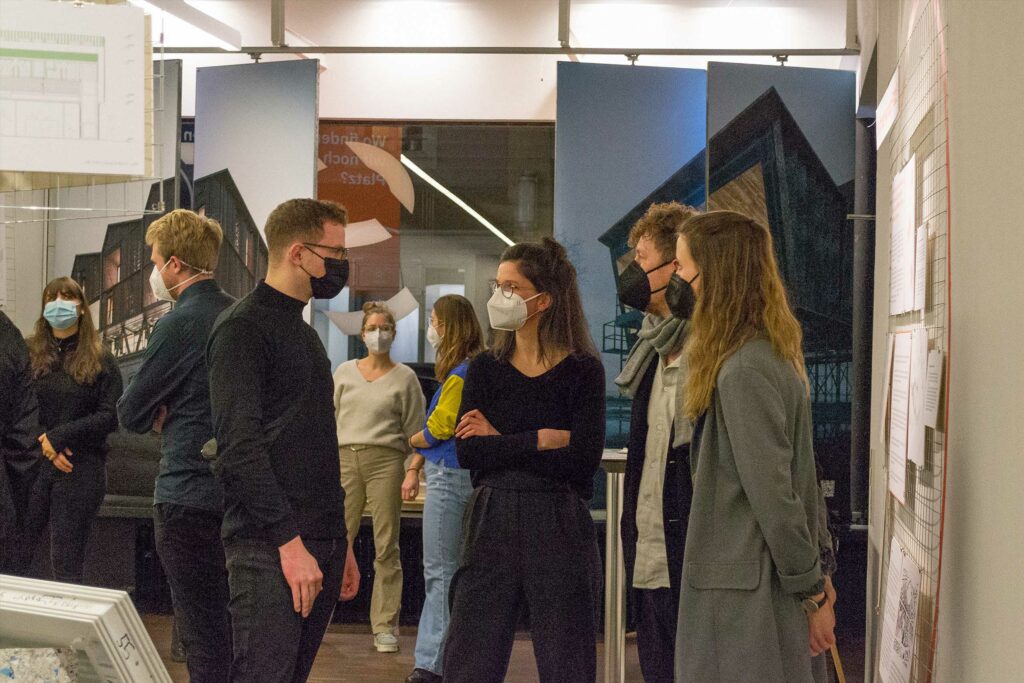
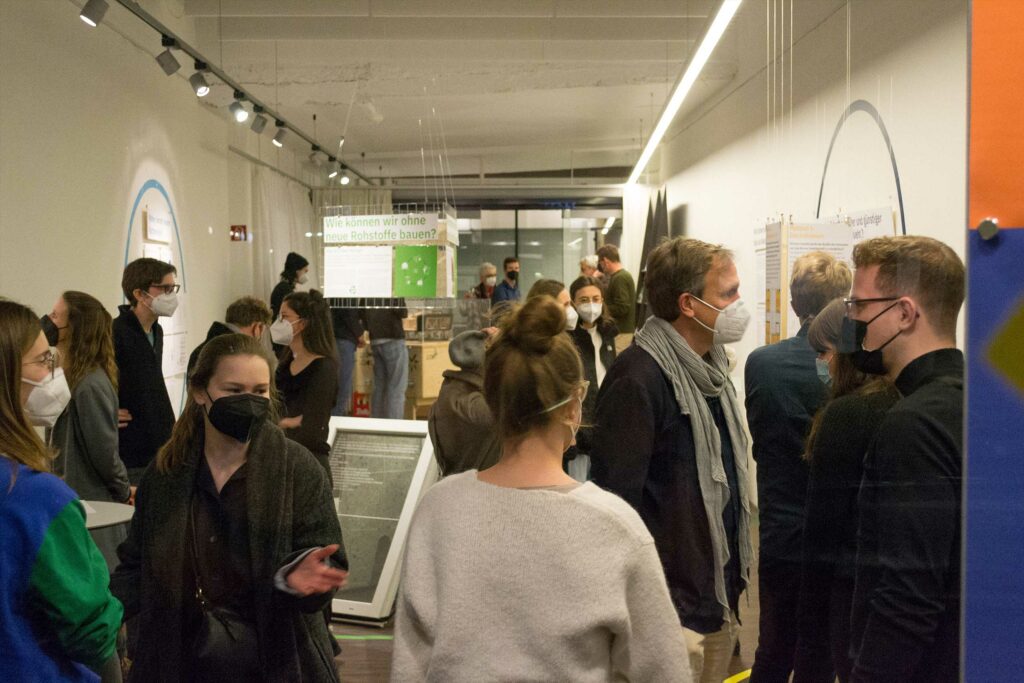
The exhibition shows in a concrete and comprehensible way how the coming generation of architects will put these ideas into practice and thus shape a more sustainable future for all of us. It can be visited from 11.01.2022 until 04.02.2022 in the Architekturschaufenster in the Waldstraße in Karlsruhe.
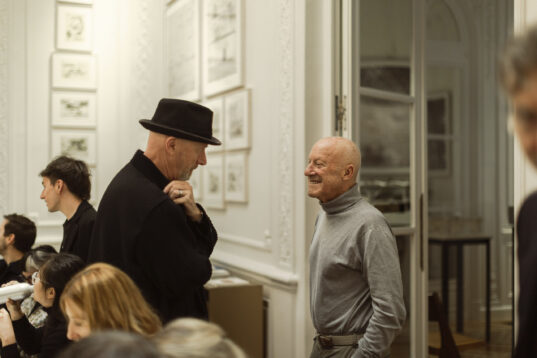
Supported by the Holcim Foundation, the Norman Foster Foundation ‘Re-Materializing Housing’ Workshop took place from 15-19 November 2021. As the Workshop’s Mentor, Dirk Hebel, pointed out, ‘mainstream building practices are unsustainable. The construction sector uses an extensive amount of material resources and is responsible for the use of material compounds that are harmful to both humans and the environment. It is not enough to talk about more efficient steps to take within the existing systems but time for a real paradigm shift’.
The Norman Foster Foundation’s 2021 Re-materializing Housing Workshop included seminars, lectures, one-to-one tutoring and architectural tours. The workshop consisted of a five-day event led by Dirk Hebel, Professor of Sustainable Construction, Karlsruhe Institut für Technologie (KIT).
The Workshop’s Academic Body spanned a wide range of practitioners from different fields related to architecture. This year’s Academic Body included Dirk Hebel, Professor of Sustainable Construction, Karlsruhe Institut für Technologie (KIT), Karlsruhe, Germany; Tom Bloxham, Founder and Chairman, Urban Splash, Manchester, United Kingdom; Anna Heringer, Founder and Director, Studio Anna Heringer, Laufen, Germany; Laila Iskandar, Former Minister of Urban Renewal and Informal Settlements, Cairo, Egypt; Johan Karlsson, Managing Director, Better Shelter, Stockholm, Sweden; Carme Pinós, Founder and Director, Estudio Carme Pinós, Barcelona, Spain; Stuart Smith, Director, Arup Berlin, Berlin, Germany; Brinda Somaya, Principal Architect and Managing Director, Somaya and Kalappa Consultants, Mumbai, India.
Hundreds of candidates from around the world applicated for the Workshop. The selection committee awarded ten scholarships to students from the following universities and institutions: Harvard University, United States, University of Cambridge, United Kingdom, Kamla Raheja Vidyanidhi Institute of Architecture and Environmental Studies, India, University of Stuttgart, Germany, Pontificia Universidad Católica de Chile, Chile, Massachusetts Institute of Technology (MIT), United States, Confluence Institute, France, Universidad Nacional de Córdoba, Argentina, University of Cape Town, South Africa, Namibia University of Science and Technology, Namibia.
31 October was the “Welttag der Städte” (“World Day of Cities”). Fittingly, the architectural models of the Solar Decathlon Europe 21/22 of the Bergische Universität Wuppertal are exhibited at prominent locations in Wuppertal. They can be viewed there in the coming days and weeks.
The “Welttag der Städte” (“World Day of Cities”) on 31 October is a call by the United Nations to work together for sustainable strategies for cities. Currently, about 75% of buildings in the EU are not energy efficient. They cause 36% of CO2 emissions. Increasing the energy efficiency of buildings not only saves heating costs, but also protects our climate.
This is exactly where the Solar Decathlon comes in. Together with local partners, Bergische Universität Wuppertal has managed to bring the most important international university competition for energy-efficient building and living to Wuppertal.
With the travelling exhibition, the models are now coming to the people of Wuppertal. From February/March 2022, they will be exhibited throughout NRW. From 10-26 June 2022, all interested parties are cordially invited to experience the built houses and the event and cultural programme live.
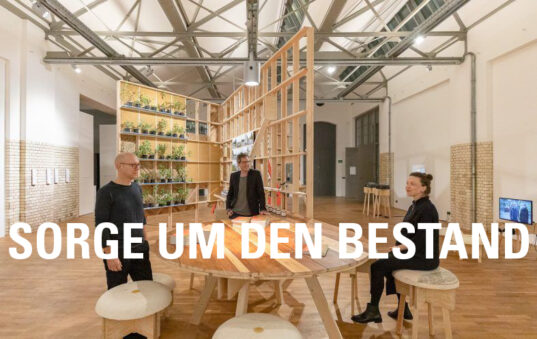
The DAZ in Berlin hosts an exhibition by the BDA as a plea for the preservation of the existing. In the exhibition, named after the publication “Sorge um den Bestand. Zehn Strategien für die Architektur” published in November 2020, architects and urbanists present their concern for the existing building stock, for grown social structures and for the continuation of the earth.
In addition to Dirk E. Hebel from the Professorship of Sustainable Building at KIT, Katja Fischer, Roland Gruber, Jörg Heiler, Ayşin İpekçi, Maria Isabettini, Simon Jüttner, Jan Kampshoff, Kamiel Klaasse, Andreas Krauth, Urs Kumberger, Tabea Michaelis, Peter Nageler, Michael Obrist, Ben Pohl, Eike Roswag-Klinge and Verena Schmidt are among the participating architects and urban planners.
The exhibition of the Bund Deutscher Architektinnen und Architekten BDA was curated by Olaf Bahner, Matthias Böttger and Laura Holzberg. They invite you to read the permanence of what has been built and what has grown and plead for further thinking and careful repair of living spaces and living cultures. They show how new perspectives arise in the urban and regional context through networked approaches, through cooperation oriented towards the common good and through participation concepts. For the future, the buildings erected today, strategies for the circular use of materials and an openness to future requirements are being developed.
The exhibition takes places in the DAZ in Berlin from 03 December 2020 until 27 June 2021. Visiting the exhibition is possible again since 21 May 2021.
More information about the exhibition on www.bda-bund.de or on www.daz.de . Take a look at the book publication here .
From 22 May until 21 November 2021 La Biennale will take place in the Arsenale and the Giardini in Venice. The curator Hashim Sarkis calls on architects to imagine spaces in which we can generously live together in different ways, in the context of widening political divides and growing economic inequalities.
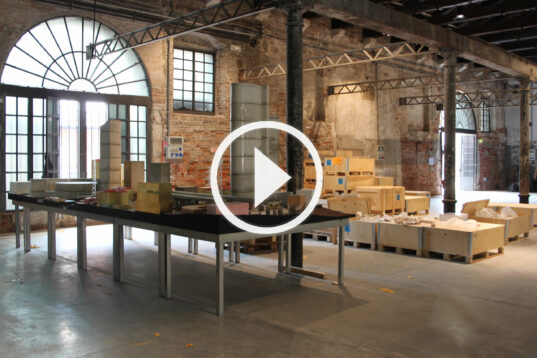
Last year, the team ‘ETH Zurich | KIT Karlsruhe | EiABC Addis Ababa’, led by Marc Angélil and Dirk E. Hebel, developed a contribution entitled “Quo Addis? Conflicts of Coexistence” to the major architecture exhibition. In an urban model of Addis Ababa, the historical and architectural development of the Ethiopian capital from the age of Menelik’s empire in the 19th century until today is depicted in an abstract and at the same time precise and clear way. A film produced by Jenny Rodenhouse completes the exhibition contribution and brings the visitor closer to life and coexistence in the different quarters of the city.
The entire installation was brought to Venice at the end of April by a team of six around Dirk E. Hebel and Katharina Blümke and was set up in the Arsenale. The construction of the model was documented by the team in a short film:
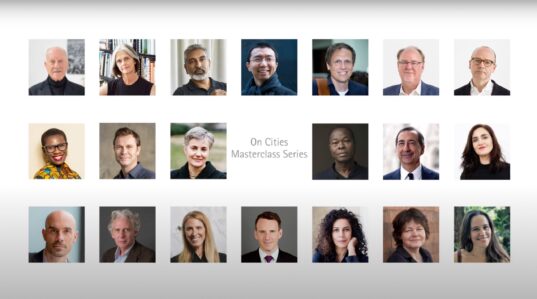
The Norman Foster Foundation (NFF) presents the ‘On Cities’ Masterclass Series, a series of thirty-minute-long masterclasses which explores the most pressing and compelling topics related to contemporary cities. Given by twenty leading experts in the fields of architecture, urbanism, economics and mobility, this video series supports the NFF’s extensive educational programme by promoting an exchange of knowledge across a range of geographic and disciplinary perspectives.
Although cities may offer significant advantages for inhabitants, urbanisation is widely regarded as one of the fundamental challenges for public health, social equity and sustainability. To meet these challenges, speakers touch themes such as urban leadership, equity, urban informality, urban food systems, urban sustainability, urban materiality, urban mobility, and urban economics, among other key topics.
In his introductory masterclass to the series, Norman Foster (President, Norman Foster Foundation) considers the future of cities and the crises that cities have overcome throughout their history, arguing that the current pandemic has accelerated important trends already in motion, such as a return to green and open public space and compact urban areas that provide inhabitants with services and leisure within a walking distance:
In light of the finite nature of the world’s resources, Prof. Dirk E. Hebel (Professorship of Sustainable Construction, Karlsruhe Institute of Technology) explores the ways in which materials can be reused through ‘urban mining’, referencing the research of new recycled and organic materials in his masterclass, titled ‘Sustainable Materials’:
The contributing speakers also include the following experts: Yvonne Aki-Sawyerr (Mayor of Freetown, Sierra Leone) Joseph G Allen (Director of the Healthy Buildings Program T. H. Chan School of Public Health, Harvard University) Deborah Berke (Dean, Yale’s School of Architecture) Luis Bettencourt (Inaugural Director, Mansueto Institute for Urban Innovation, University of Chicago) Richard Burdett (Director, LSE Cities) Vishaan Chakrabarti (William W. Wurster Dean, College of Environmental Design, University of California, Berkeley) Robin Chase (Cofounder, ZipCar) Fonna Forman (Founding Director, Center on Global Justice, University of California, San Diego) Sou Fujimoto (Founder, Sou Fujimoto Architects) Edward Glaeser (Fred and Eleanor Glimp Professor of Economics, Harvard University) Francis Kéré (Founder, Kéré Architecture and Kéré Foundation) Anupama Kundoo (Principal, Anupama Kundoo Architects) Kent Larson (Director, MIT City Science Research Group) Giuseppe Sala (Mayor of Milan, Italy) Carolyn Steel (Director, Kilburn Nightingale Architects) Tim Stonor (Managing Director, Space Syntax) Belinda Tato (Cofounder and Codirector, Ecosistema Urbano) Theresa Williamson (Founder and Director, Catalytic Communities)
Watch the full ‘On Cities’ Masterclass Series on YouTube here.
The KIT professorship of Sustainable Construction at the Faculty of Architecture is part of an exhibition and publication by the Association of German Architects BDA. In ten strategies, architects and urbanists present their concern for the existing building: taking care of the building stock, for growing social structures and for the continued existence of the earth. They invite you to read the permanence of what has been built and what has grown and plead for further thinking and careful repair of living spaces and living cultures. They show how new perspectives arise in the urban and regional context through networked approaches, through cooperation oriented towards the common good and through participation concepts. For the future, i.e. the buildings erected today, strategies for the circular use of materials and an openness to future requirements are being developed.
The exhibition of the Association of German Architects BDA was curated by Olaf Bahner, Matthias Böttger and Laura Holzberg. Exhibition design: Marius Busch – ON / OFF and Christian Göthner – lfm2 “Sorge um den Bestand” is a project in the “Experimental Housing and Urban Development” research program of the BMI / BBSR and is financially supported by the Federal Ministry of the Interior, Building and Home Affairs. Comprehensive information on the exhibition project can be found at www.bda-bund.de/sorgeumdenStock
Yesterday our symposium grow.build.repeat. took place. It was a great day with exciting and high-class lectures and interesting discussions. The Professorship of Sustainable Construction would like to thank all participants!
Many thanks to all viewers for watching, asking questions and for the great feedback.
Many thanks for the Organization: KIT Faculty for Architecture The kind support: Wacker Chemie AG Live Translation: KIT Lecture Translator, Karlsruhe Information Technology Solutions – kites GmbH Social Media Support: Frank Metzger, Denis Elbl
Special thanks to our speakers: Prof. Dr. Hanaa Dahy, Prof. Eike Roswag-Klinge, Andrea Klinge, Dr. Henk Jonkers, Dr. Alireza Javadian, Prof. Dr. Marie-Pierre Laborie, Martin Rauch, Werner Schmidt, Diana Drewes, Dr. Michael Sailer, Mitchell Joachim
Many thanks to our panel discussion partners from Wacker Chemie AG: Peter Summo, Dr. Theo Mayer, Dr. Tobias Halbach, Dr. Peter Jerschow
Thank you for planning, organizing and preparing the event with us: AMP Aurora Motion Pictures, Jessica Decker, Sylvia Aust and Dr. Theo Mayer representing the whole team of Wacker Chemie AG
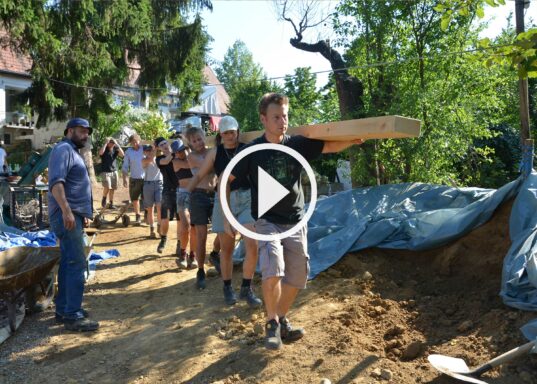
From technique to application: in a joint seminar of the KIT Professorships of Sustainable Construction and Building Technology, a small rammed earth garden house was being built near Freiburg. The seminar consisted of testing the material, building the suitable formwork, bringing the clay in and compacting it by manual work.
In addition the students received the basic and background knowledge in advance and had the possibility to learn about the geological local conditions afterwork on site.
This way they gained practical experience in this construction method under adapted conditions to obtain technical know-how and to experience the possibilities and the materiality of rammed earth on a building site.
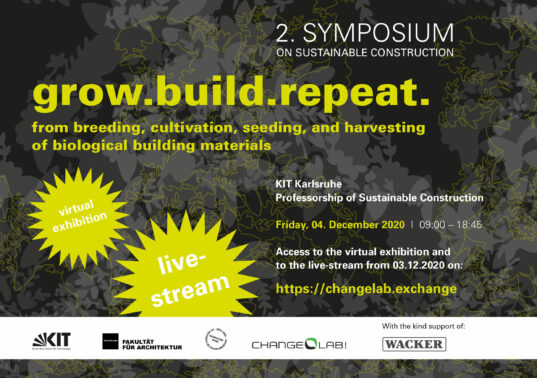
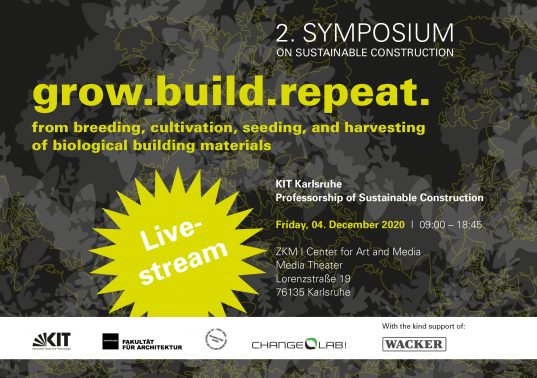
Due to the increasing number of infections caused by the Covid-19 pandemic, we have decided to hold the symposium grow.build.repeat. online, which will take place on December 4, 2020.
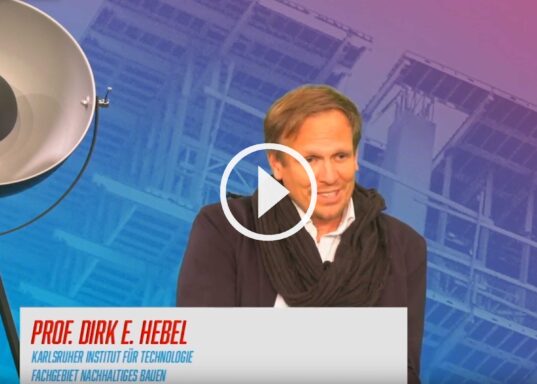
Prof. Dirk E. Hebel in discussion about a rising circular building economy.
A talk in “Zukunft Bauen” with Prof. Dirk E. Hebel (Sustainable Construction, Faculty of Architecture, KIT Karlsruhe) and Dr. Lamia Messari-Becker (Building Technology and Building Physics, Institute of Architecture, University of Siegen) about rethinking the construction industry and its bound building materials as a raw materials warehouse in order to preserve the earth’s resources and about the paradigm change in future architectural planning and construction.
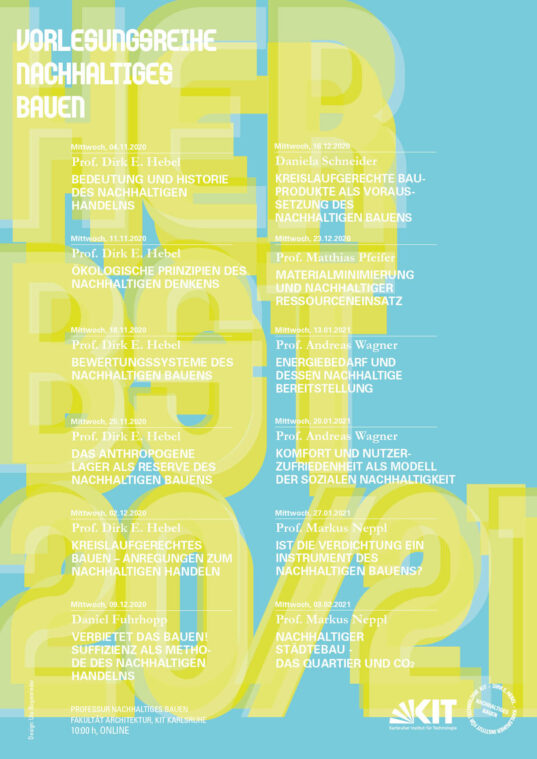
In the Winter Semester 2020/21, the KIT Faculty of Architecture will offer a lecture series on Sustainable Construction, organized by the Professorship of Sustainable Construction, Dirk E. Hebel. In total 12 lectures will address the history, state of the art, and alternative futures within the theme. Speakers are: Daniela Schneider, Prof. Daniel Fuhrhop, Prof. Andreas Wagner, Prof. Matthias Pfeifer, Prof. Markus Neppl, and Prof. Dirk E. Hebel. Please refer to the poster for actual dates. The lecture is held every Wednesday, 10:00 am online.
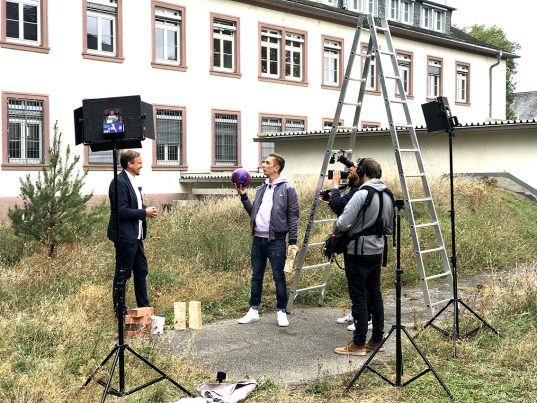
The public German TV station ZDF films at the KIT MycoLab for their format PUR+. PUR + is the discovery magazine in the children’s and youth program ZDFtivi. Each episode deals with one topic. Reports, explanations, and experiments shed light on the topic from different angles. The program focuses on the experiences and assessments of children. At KIT, Eric, the protganist of the format, explores together with the team of Prof. Dirk E. Hebel and Nazanin Saeidi the idea of using mycelium as an innovative building material of the future.
The symposium grow.build.repeat. at the KIT Faculty of Architecture deals with one of the most urgent questions of our time: how can we drive forward a radical change of the existing construction industry while increasingly considering the breeding, cultivation, seeding, and harvesting of biological building materials and their system cycles? The symposium is the second in a series on the topic of sustainable construction. The first event (take.build.repeat. in autumn 2018) dealt mainly with mineral and metallic material cycles in the field of urban mining and its potential for sustainable construction. The second symposium, grow.build.repeat, now addresses the biological material cycle and presents future-oriented examples from construction practice and research. Representatives from science and industry, research, practitioners, decision-makers within our democratic society, as well as teachers and students will come together to discuss the future of construction in lectures and discussions and subsequently to actively participate in shaping it.
The event is organized by the Professorship of Sustainable Construction (Faculty of Architecture, Karlsruhe Institute of Technology KIT) and is kindly supported by Wacker Chemie AG.
Sustainable Construction. How we are shaping our built environment in a sustainable way.
May 7, 2026
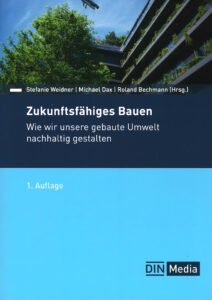
Hebel, Dirk E., and Elena Boerman. “Projektstudie 2 (Schwerpunkt: Materialien): Der Kreislaufbasierte Architekturansatz.” In Zukunftsfähiges Bauen – Wie Wir Unsere Gebaute Umwelt Nachhaltig Gestalten, 64–78. Berlin: DIN Media Innovation, 2026.
Circular! Foundations and principles of a circular construction industry.
March 11, 2026
Hebel, Dirk E., and Annette Hillebrandt, eds. 2026. Zirkulär! Fundamente und Postulate einer kreislaufbasierten Bauwirtschaft. Bauwelt Fundamente. Birkhäuser Verlag GmbH.
A matter of consequence
March 11, 2026
Deutsches Architekt:innen Blatt. 2026. “Eine Frage der Konsequenz.” March.
Circular Construction. Regenerative Building material management.
Wood as a foundation of a sustainable building culture
January 8, 2026
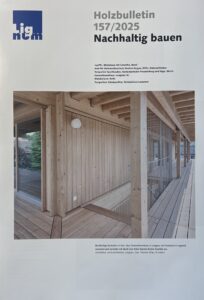
Glanzmann, Jutta. “Holz Als Basis Für Eine Nachhaltige Baukultur.”Lignum Holzbulletin 157/2025, no. Nachhaltig bauen (2025): 4058–59.
MycoTree
January 5, 2026
McLean, Will, Pete Silver, and Dirk Hebel. “MycoTree.” In Sustainable & Regenerative Materials for Architecture – A Source Book. 2025; Laurence King, 2025.
Really Circular – Material Library at KIT
October 29, 2025
Dietzold, Lutz, ed. Iconic Awards 2025 – Spaces Objects Visions. Frankfurt: Rat für Formgebung GmbH, 2025.
Activating the Urban Mine
October 2, 2025
Hebel, Dirk E. “Activating the Urban Mine.“ In Architecture and Technology Volume II: Cities in Climate Crisis. Madrid: Norman Foster Foundation Press, 2025.
The city as a resource
September 18, 2025
Hebel, Dirk E. und Felix Heisel. “Die Stadt als Ressource.” In Für eine nachhaltige Architektur der Stadt. Berlin: Verlag Klaus Wagenbach, 2025.
From a linear to a circular system
September 15, 2025
Hebel, Dirk E. “Vom Linearen Zum Kreislaufsystem.” In Architektur Und Klimawandel. München: Edition DETAIL, 2025.
Interview: “We must finally start measuring CO2 emissions – not just how thick the insulation is”
July 29, 2025
Hebel, Dirk E. Interview: “Wir müssen endlich anfangen, den CO2-Ausstoß zu messen – nicht nur, wie dick die Dämmung ist.” Interview by Christoph Karcher. LooKIT 0225, 2025.
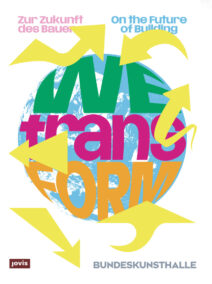
WEtransFORM – On the Future of Building
June 22, 2025
BUNDESKUNSTHALLE, ed. WEtransFORM – Zur Zukunft Des Bauens. Berlin: jovis Verlag, 2025.
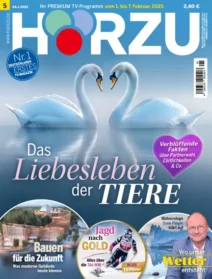
Monkenbusch, Helmut. „Bauen für die Welt von morgen.“ Hörzu, 24.1.2025
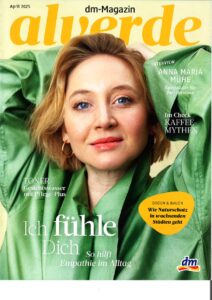
Funghi – underground networkers
April 24, 2025
Hebel, Dirk E., Tanja Hildbrandt. „ Pilze – Netzwerker im Untergrund“. alverde, dm-Magazin, April 2025.
Fungi are versatile
February 24, 2025
Merkert-Andreas, Carolin. “Pilze Sind Vielseitig.”Wohnglück, January 2025.
“RoofKIT – Carbon storage and Material storage”
January 9, 2025
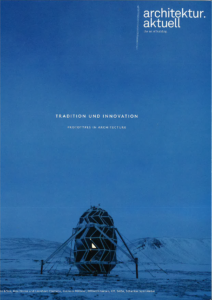
Boerman, Elena, and Dirk E. Hebel. “RoofKIT – Kohlenstoffspeicher Und Materiallager.”Architektur.Aktuell, vol. 12.2024, no. Tradition und Innovation, Dezember 2024, pp. 98–109
The many applications of mycelium construtction
December 8, 2024
Grossarth, Jan. „Exkurs: Die vielen Einsatzbereiche von Myzel im Bauwesen“. In Bioökonomie und Zirkulärwirtschaft im Bauwesen, eine Einführung, 174–117. Wiesbaden: Springer Fachmedien, 2024.
Interview: “From a Linear to a Circular System”
November 13, 2024
Hebel, Dirk E. Interview: “Vom linearen zum zirkulären Kreislaufsystem.” Interview by Sandra Hofmeister, DETAIL 11.2024, Nov. 2024.
Building with renewable materials – Nature as a resource depot
October 29, 2024
Hebel, Dirk E., Sandra Böhm, Elena Boerman, Hrsg. Vom Bauen mit erneuerbaren Materialien – Die Natur als Rohstofflager. Stuttgart: Fraunhofer IRB Verlag, 2024.
Guest contribution: ‘Thinking, designing and operating in circular ways.’
June 27, 2024
Hebel, Dirk E. “In Kreisläufen denken, entwerfen und wirtschaften.”MÄG – Mein Häfele Magazin, 2024.
Interview: ‘Mycelium power for the construction industry’
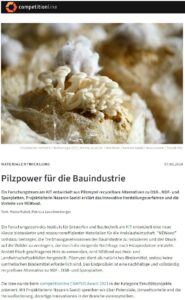
June 10, 2024
Rubel, Maike, and Patricia Leuchtenberger. Interview: “Pilzpower für die Bauindustrie.” competitionline, 7 June 2024, https://www.competitionline.com/de/news/schwerpunkt/pilzpower-fuer-die-bauindustrie-7283.html.
‘Future building materials: mushroom, hemp and algae’ in neubau kompass
May 27, 2024
Müller, Janek. “Baumaterialien der Zukunft: Pilze, Hanf und Algen.”neubau kompass – Neubauprojekte in Deutschland, May 3, 2024. https://www.neubaukompass.de/premium-magazin/.
Interview: ‘We have disposed of valuable materials’
May 7, 2024
Sören, S. Sgries. “Interview: ‘Wir haben wertvolle Materialien weggeworfen.’”Rhein-Neckar-Zeitung, April 27, 2024, SÜDWEST I 28 edition, sec. Sinsheimer Nachrichten.
Built on mushroom
April 24, 2024
Schweikle, Johannes. “Auf Pilz gebaut.”Stuttgarter Zeitung, April 23, 2024, sec. Die Reportage.
Organic Architecture – Fungus mycelium and flax as materials for the ecological building transition
February 13, 2024
Klaaßen, Lars. “Organische Architektur – Pilzmyzel und Flachs als Materialien für die ökologische Bauwende.” In Deutsches Architektur Jahrbuch 2024, edited by Peter Cachola Schmal, Yorck Förster, and Christina Gräwe, 198–209. Berlin, Germany: DOM publishers, 2024.
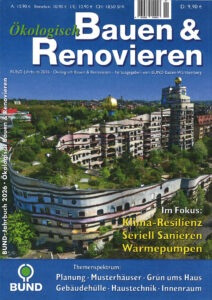
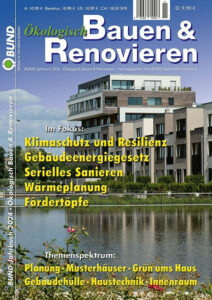
Circular construction – Circulation instead of demolition in “BUND-Jahrbuch 2024”
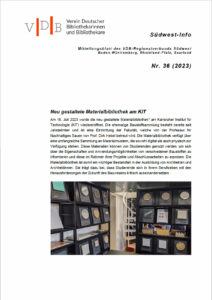
Redesigned Material Library at KIT in ‘Mitteilungsblatt des VDB-Regionalverbands Südwest’
January 8, 2024
Mönnich, Michael, and Sandra Böhm. “Neu gestaltete Materialbibliothek am KIT.”Südwest-Info: Mitteilungsblatt des VDB-Regionalverbands Südwest Nr. 36 (2023), 2023.
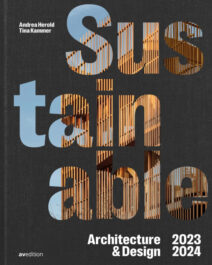
RoofKIT Wuppertal, Germany; Interview with Prof. Dirk Hebel
November 20, 2023
Hebel, Dirk E. “RoofKIT Wuppertal, Germany; Interview with Prof. Dirk Hebel: The aim is clear, we must forge the path ourselves.” In Sustainable Architecture & Design 2023/ 2024, edited by Andrea Herold, Tina Kammerer, and InteriorPark., 46–55. Stuttgart, Germany: av edition GmbH, 2023.
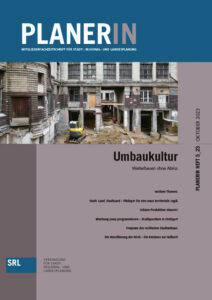
The existing building stock is the future resource
November 16, 2023
Hebel, Dirk E. “Der Bestand ist die künftige Ressource – Den linearen Umgang mit Baumaterialien schnellstmöglich stoppen.”Planerin – Mitgliederfachzeitschrift für Stadt-, Regional- und Landesplanung, Oktober 2023.